Showing posts with label historical. Show all posts

Friday, February 4, 2011

Black Death (2011)

According to Wikipedia, the Black Death was one of the most devastating pandemics in human history and is estimated to have killed 30% – 60% of Europe’s population, reducing the world’s population from an estimated 450 million to between 350 and 375 million in 1400. This has been seen as having created a series of religious, social and economic upheavals which had profound effects on the course of European history. It took 150 years for Europe’s population to recover.

The death and pestilence spread by this deadly plague was of Biblical proportions, and it seems that the dark mark it left upon history would be the perfect material for a horror film. Lucky for us, Magnolia Pictures’ Black Death has risen to the occasion.

The year is 1348. Europe has fallen under the shadow of the Black Death. As the plague decimates all in its path, fear and superstition are rife. In this apocalyptic environment, the church is losing its grip on the people. There are rumors of a village, hidden in marshland that the plague cannot reach. There is even talk of a necromancer who leads the village and is able to bring the dead back to life.

Ulric (Sean Bean), a fearsome knight, is charged by the church to investigate these rumors. He enlists the guidance of a novice monk, Osmund  (Eddie Redmayne) to lead him and his band of mercenary soldiers to the marshland, but Osmund has other motives for leaving his monastery. Their journey to the village and events that unfold take them into the heart of darkness and to horrors that will put Osmund’s faith in himself and his love for God to the ultimate test.

Black Death is a gripping film dealing with issues of faith, temptation, redemption, salvation…all huge issues back in the Dark Ages and still relevant today. It has a bit of Wicker Man-feel, only because of the dark secret the blissful and untouched village hides. It also has a much more somber feel and isn’t a film to take lightly. I liked how the film subverted the usual Christian vs. Pagan dynamic and made the pagans vicious instead of their usual hippie-dippy selves.

Speaking of viciousness, the film also boasts some wicked medieval battle scenes, complete with swords, maces, axes and even an iron maiden, among other torture devices. Despite the bloodshed being far and in-between, I was surprised how bloody the film actually was, especially in contrast to the subdued tone of the film and stark beauty of the cinematography.

The film looks stunning, from the cobblestoned streets of medieval Europe to the dark woods the characters travel through to the sun-dabbled village they finally arrive at. The mostly cold and bleak visuals echo the overall ominous atmosphere of the film. The grand scope of the cinematography makes me wish I had seen Black Death in a theater, but even on the smaller screen its grandiose scope wasn’t lost.

I liked the storyline because it had an epic feel and because of the themes it explored. As mentioned previously, I liked how the Christian vs. Pagan dynamic was flipped, with the pagans persecuting the Christians instead of the other way around. I also liked how the film showed unwavering faith in the characters as they were faced with temptations and challenges. The film ends on a brutal, downbeat note that was definitely disturbing and shows how evil can corrupt even the most faithful.

The actors gave performances equally intense to the storyline and visuals. Sean Bean is especially good as the God-fearing Ulric, but I also liked Eddie Redmayne’s performance as the conflicted Osmund. In my opinion, though, Carice van Houten stole the show as the village’s necromancer Langiva.

Director Christopher Smith has crafted another unique film with Black Death and is definitively one of the most versatile directors of the horror genre. He gave us the spooky Creep, the darkly humorous Severance, the intense Triangle and now the bleak Black Death. His films are always engaging, entertaining and original, and Black Death is no exception.

Buy it on Amazon!

Monday, July 26, 2010

The Virgin of Nuremberg (1963)


The Virgin of Nuremberg was a medieval torture device that most of us know as the Iron Maiden. It was an upright sarcophagus with metal spikes on the inside. The victim was tied inside and when the doors were shut their body would be penetrating with the strategically placed spikes. These spikes were designed to not penetrate any vital organs, therefore extending the agony of the victim and ensuring they died a slow death.

In The Virgin of Nuremberg (aka Horror Castle), a 1963 film directed by Antonio Margheriti, this torture device plays an integral part of the plot. Max (Georges Rivière) and Mary (Rosanna Podesta) Hunter are staying at a castle in Germany Max has inherited. One night, Mary is awoken with screams…and sees a mysterious figure in a red cloak kill a maid. It seems that the original owner of the castle has returned…and is back killing innocent victims with the castle’s old torture instruments! Who is this madman, what are his ties to the Hunters and how can he be stopped?

The Virgin of Nuremberg is a decent gothic horror tale. While not as good at Margheriti’s later effort Castle of Blood, it is still an elegant and atmospheric film. Plus, Christopher Lee stars in a small role as the castle’s disfigured man-servant!

The story of the castle’s owner and his sordid history were interesting. You were never quite sure whether he was back from the dead or if it was just someone posing as him, which kept me in suspense until the final “unveiling” of the killer (whew, and what an unveiling it is!). The castle’s inhabitants and servants also did a nice job of creating enough red herrings to keep me guessing. The character of Rosanna wasn’t that developed, but Podesta did a good job of playing the stereotypical “damsel in distress” in her white flowy nightgowns that faints away at any sign of trouble.

The setting of the big, dark castle was appropriately creepy and I especially liked the shadowy torture room filled with steel cages, surgical implements and various torture devices. The eye-popping color red is used throughout the film (as accent colors in rooms as well as the killer’s red robe and, of course, the blood!) and really pops against the rest of the dark castle. The gothic visuals really add to the film’s ambiance and made me enjoy it even more.

Quite a bit of blood is spilled in the film, surprising for its time. It is certainly not a gorefest, but there are some nice deaths throughout the film. Memorable scenes include a woman with her eyes gouged out impaled within the ubiquitous iron maiden, a cage with a hungry rat inside place over a living woman’s head and, as previously mentioned, the unveiling of the killer.

The Virgin of Nuremberg is a stunning Italian gothic horror film and while it isn’t appreciated as much as other films in the genre, I believe it definitely deserves a look!

Available from Amazon!

Monday, June 28, 2010

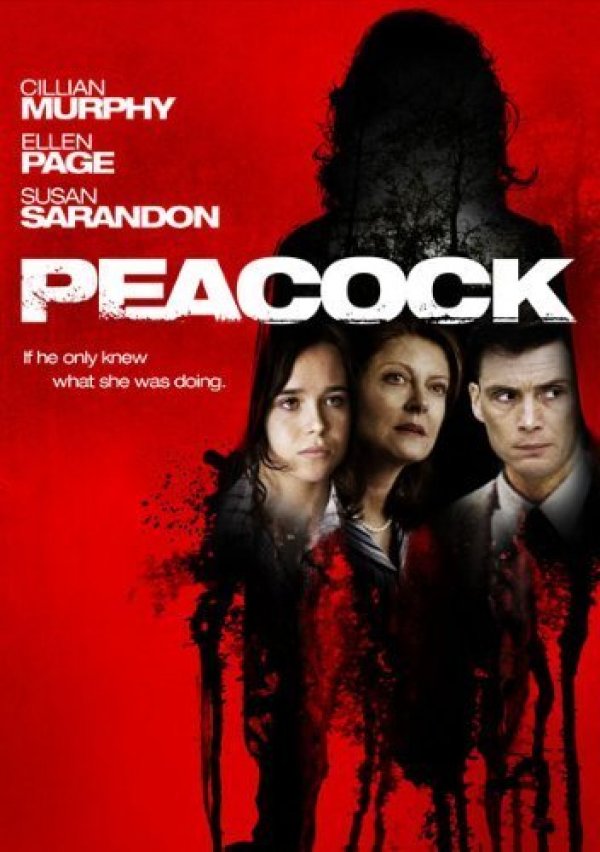
Peacock (2010)


John Skillpa (Cillian Murphy) is a timid, socially-awkward bank clerk living in tiny Peacock, Nebraska who prefers to keep to himself. This might have to do with John’s secret: he has another personality no one knows about, a woman named Emma, who each morning does his chores and cooks for him before he starts his day. However, everything changes when a train derails into Skillpa’s backyard, exposing Emma to the curious neighbors, who assume “her” to be John’s wife. As John struggles to maintain control over his other personality as well as keep up the façade that she is his wife, his already disturbed psyche becomes further unbalanced.

Peacock is an above-average thriller, but I’ll tell you right now it definitely won’t be for everyone. It’s a slow, subtle character-study about a man with a fractured psyche that plays more of like a drama than a thriller (though it’s pretty darn suspenseful!). If you aren’t put off by languidly paced films, however, Peacock is an intensely psychological experience that I definitely found to be worth my while, despite its flaws.

The best thing about the film is no doubt Cillian Murphy’s amazing performances as both John and Emma. These are two completely separate people, with distinctly different ways of talking, walking and different personalities and facial tics, but Murphy makes them both believable and I even starting thinking of them as two separate people instead of one man. How Murphy didn’t receive more accolades for his performance is beyond me, because he is purely brilliant in this film.

Rounding out the cast are several other famous faces – Ellen Page, Susan Sarandon, Bill Pullman, Josh Lucas, Keith Carradine. Not even against these accomplished actors is Murphy’s performance diminished, though the other actors do a fine job as well. Page played the role of a desperate young mother, Carradine and Sarandon played the wealthy mayor and his wife, Lucas the town cop and Pullman the annoying boss at the bank. While each character adds another layer of complexity to the story, some of these extraneous characters felt like they weren’t really vital to the story. Perhaps the connection between some of these characters and John/Emma never really meshed for me, but something was a bit lacking in their development.

Nevertheless, the best parts of the film were when John/Emma went behind the others’ back to interact with the townsfolk. When Emma would approve something (like a political rally in the backyard), John would find out later and just lose it! John was so out-of-control that you came to prefer Emma’s cool-headed way of approaching problems, even if she was manipulative and calculating. As she slowly took over more and more of John’s life and became the more dominant personality, John really begins to panic and this unbalance creates a lot of tension and suspense.

Now, a lot of people have commented that it’s not at all believable that the townspeople couldn’t tell that John/Emma were the same person, and while watching the movie I tended to agree. However, looking back I realized that if Murphy’s performance was so convincing to me, I suppose it would also work on the townspeople. Plus, the two separate personalities had completely different ways of moving and speaking. However, I still think it would have been more believable if writers Michael Lander (who also directed) and Ryan Roy had just made Emma John’s sister or cousin. At least that way it would explain the striking resemblance between the two!

Despite this, I found myself getting sucked into the twisted, dreary story. Besides the fantastic performances, director Michael Lander creates a somber, post-Dustbowl era (the movie could be set anywhere from the 1930’s to the 1950’s) atmosphere. The film itself is beautifully filmed and its dark tones create a melancholy, ominous tone. Even the obligatory backstory of John being an abused little boy or the previously mentioned flaws didn’t really sully the hauntingly filmed movie.

Peacock doesn’t work all the time, but if you are looking for a sophisticated, tense psychological film it is worth checking out!

Available from Amazon!

Wednesday, June 9, 2010

Book Review: Valley of the Dead by Kim Paffenroth


What if Dante’s Inferno was based on truth? What if in his life Dante faced such insurmountable horror that he wrote it all down but had to pass it off as fiction because it was just too unbelievable?

Well, that is the premise behind Kim Paffenroth’s new novel, Valley of the Dead.

From the back cover:

Working from Dante’s Inferno to draw out the reality behind the fantasy, author Kim Paffenroth unfolds the horrifying true events that led Dante to fictionalize the account of his lost years…

For seventeen years of his life, the exact whereabouts of the medieval Italian poet Dante Alighieri are unknown to modern scholars. It is known that during this time he traveled as an exile across Europe, working on his epic poem, The Divine Comedy. In his masterpiece he describes a journey through the three realms of the afterlife. The most famous of its three volumes, Inferno, describes Hell.

During his lost wanderings, Dante stumbled upon an infestation of the living dead. The unspeakable acts he witnessed – cannibalism, live burnings, evisceration, crucifixion and dozens more – became the basis of all the horrors described in Inferno. Afraid to be labeled a madman, Dante made the terrors he experienced into a more ‘believable’ account of an otherworldly adventure filled with demons and mythological monsters.
But at last, the real story can be told.

This may sound like another piece of classic literature being updated to include monsters like zombies (see Pride and Prejudice and Zombies, its sequel and a ton of other reconstituted classics), but Valley of the Dead is different. First off, it doesn’t take the original text and warp it to fit the author’s goal. Instead, VotD is an entirely original work, and the only text used from the original epic Inferno are a few lines before each chapter. Author Kim Paffenroth delivers another original, stunning and exciting novel that weaves an epic journey through a zombie-infested landscape with philosophical leanings. Through his story, Paffenroth perfectly captures the sheer ruthlessness of the human race as well as showing their compassion.

The cruelties that the living humans inflict not only on the zombies but on each other are truly shocking. It seems that with each new page Paffenroth has Dante encounter some truly horrific stuff – an army slaughtering innocent men, women and children, rape, cannibalism, witch burnings and many more evil acts besides all the zombie slaughtering going on. However, contrasted against the chaos and depravity are the virtuous lead characters of Dante, soldier Radovan, pregnant peasant Bogdana and monk Adam.

I am not intimately familiar with Dante’s Inferno, so I can’t really say what scenes in Paffenroth’s book take their cue from the classic poem, but the scenes in VotD are truly horrific and quite hellish! I really enjoyed how Paffenroth created such a vivid picture of the surrounding countryside Dante and his companions must traverse to escape the zombies. It starts off with green fields and lush forests, but as they are forced to escape higher and higher into the mountains the landscape becomes more desolate and otherworldly…and yet it seems the undead dwell there nonetheless. Despite the hopeless evil that seems to surround Dante and his friends, they grimly continue on in hopes of escaping the zombies and I was rooting for them the whole way.

As in his previous novels (Dying to Live and its sequel), Paffenroth’s character development is extremely strong. We care for each and every one of the main characters and through their journey really understand who they are and what they stand for. This makes the horrors they must face all the more cringe-worthy and terrifying for the reader. The characters seem to always be in constant danger, whether from the undead, the approaching army and from the strangers they encounter. This creates a tension that makes the book hard to put down! And when the characters do have to stand their ground and fight (which they do plenty of times in the book) we are treated to suspenseful battles.

However, to balance out all the action is the somber tone that permeates the story. Like in Inferno, Dante laments the horrors occurring around him and is disheartened by all the violence. While it isn’t quite Hell in VotD, it’s damn close! The tone reflects this and is more thoughtful, pensive and philosophical. I think this restrained, downbeat tone works beautifully within the confines of the story and perfectly matches the appalling actions that Dante and his friends are witness to.

Valley of the Dead is another stunning novel from Kim Paffenroth that mixes philosophical meanderings with gruesome zombie action and a creative re-telling of Italian poet Dante Alighieri’s inspiration for his most famous work, Inferno. Any fans of intelligent and sophisticated zombie stories will no doubt enjoy VotD!

Available from Amazon!

Friday, March 5, 2010

The Wolfman (2010)


With the poor performance at the box office, not to mention its delayed release, one might think The Wolfman isn’t worth checking out. On the contrary, however, it is a stunning film that even makes you forget it’s a remake. Its gorgeous gothic visuals (stark trees against a full moon, a decaying estate holding onto its stately yet tragic past, fog shrouded moors, dank dungeons) perfectly set the mood of the dark, tragic tale set in 1891 in England.

Lawrence Talbot (Benicio Del Toro), renowned actor, is called back to his childhood home by his brother’s wife Gwen (Emily Blunt), whom he has never met, after his brother goes mysteriously missing. When he arrives and is greeted indifferently by his father (Anthony Hopkins), he learns that his brother’s ravaged body has been found – and looks to have been attacked by wild mad man or ferocious beast. He vows to discover who or what killed his brother, even if it means dredging up painful childhood memories and putting himself in harm’s way.

In a tense and whirlwind attack of a gypsy encampment Talbot is bitten by the beast. He almost dies, but is nursed back to health by Gwen, whom he forms a special bond with. Yet, when he heals completely the townsfolk come around and tell him that on the next full moon he too will become a beast and murder people. He is also paid a visit by Det. Abberline (Hugo Weaving), who suspects that he is responsible for the killings.

To be truthful, I really wasn’t expecting much. I hadn’t heard that much of a buzz behind the film and I saw it in a near empty theater. This is really a pity, because the film is a wonderful homage to the original as well as making the storyline different enough so that it feels like its own movie.

Also, while I wasn’t too keen on Benicio Del Toro as the lead, I was surprised at how quickly I embraced him in his role. Same goes for Anthony Hopkins. Del Toro really made me sympathize with Talbot and his tortured, puppy dog eyes just sold the act even more. I also enjoyed seeing Hopkins in the role of the distant elder Talbot, and though he isn’t given that much to do, he still did a very believable job playing a father with a few skeletons in his closet.

Really, though, we don’t see a werewolf movie solely for the performances – we see it for the action and for the creature effects! And I’m happy and surprised to report that all of these things were fantastic. The film opened with a jarring scene and I felt that the rest of the action sequences (the werewolf’s grisly attack on a gypsy village, a rampage through London, the final hunt and so on) were appropriately paced throughout the film so there wasn’t a dull moment! The creature makeup and special FX looked great (another great job by Rick Baker) and shots of shoddy CGI were so few and far-between they aren’t even worth mentioning. There were also some choice cuts of bloody gore, far more than I was expecting, which should please all you gorehounds out there.

The Wolfman heralds the return of classic horror with its elegance, gothic atmosphere and exciting action. I really cannot comprehend the negative reviews it has been getting – it’s not a rip off of the original (have these people even seen the original?), it’s not boring and it certainly doesn’t “lack bite” (I wonder if they wrote that just cuz they wanted a cute headline), but it’s one of the few good (if not downright great) horror films I’ve seen in a theater for quite some time! I hope people will come to their senses and sniff out The Wolfman, because it is definitely a howling good time!

Available from Amazon!

Thursday, March 4, 2010

Book Review: Incarnadine - The True Memoirs of Count Dracula Vol. 1 by R.H. Greene


In the richly descriptive Incarnadine: The True Memoirs of Count Dracula: Volume One, we are given a detailed account of the man that will come to be known as Count Dracula in his early years. We see what life was like for “Konstantin Kuzmanov” when he was a man and experience his life as a soldier during the Ottoman Empire, then his conversion to pious priest and witness his falling in love, only to see him lose his one true love and his subsequent defiance of the heavens that transforms him into one of the undead. During this transformation he takes several companions with him, three which survive and become his infamous “brides”. Incarnadine tells of Dracula’s early origins in Medieval Eastern Europe and author R.H. Greene fills the imaginative tome with historical fact, including religion, rule and superstitions, all of which make for a wondrous backdrop to the philosophical, religious, emotional and physical challenges the future Count Dracula encounters.

The novel is beautifully written by Greene, and has a rather bittersweet, melancholy tone that runs throughout. You really get a sense of Kuzmanov/Dracula’s point of view in Incarnadine, a perspective that runs much deeper and more philosophical than most books based on Bram Stoker’s character of Dracula. Since the book covers a large span of time, there are lots of profound and major events that occur, all of which add to the grand legend of Count Dracula. For example, at one point the newly undead vampire, distraught over what he has become, turns into a grand oak tree for a period of years. Yes, yes, I know how that sounds but instead of being outlandish and silly, author Greene makes the event a very poignant one.

Greene also weaves Slavic myth and legends throughout the novel, making it seem that much more realistic. Some of it (like the tree passage, mentioned above) seems straight out of a Brothers Grimm tale, but it is also nice to see some of the familiar vampire lore and superstition (crosses, the ability to shapeshift, the ability to control animals, sun sensitivity, etc.) peppered throughout the book. So while this particular book shows a wholly new perspective on Dracula, it still keeps some of the familiar vampire tropes and goes a step further by explaining their origins.

Indeed, there is so much both old and new going on in Incarnadine that I’m glad that these memoirs have been broken in two volumes. I haven’t had the pleasure of reading the second volume (though I hear it has already been written), but I eagerly look forward to it, as it picks up with Jonathan Harker paying Dracula a visit at his castle home in the Carpathian Mountains.

Incarnadine is a thoughtful, exciting and wholly engrossing novel that sheds new light on vampire lore and lets us experience the grand legend of Count Dracula through his own eyes. It has its share of gross-out gore (in particular, the description of some of the “brides” is cringe-worthy), but overall the novel delves into more profound, philosophical territory. If you like your vampire stories with a little more bite, I highly encourage you to check out Incarnadine: The True Memoirs of Count Dracula: Volume One.

Buy it on Amazon!

Wednesday, March 3, 2010

Book Review: Pride and Prejudice and Zombies - Dawn of the Dreadfuls by Steve Hockensmith


Right on the heels of the delightful Pride and Prejudice and Zombies comes its prequel, Dawn of the Dreadfuls. Dawn of the Dreadfuls is a completely original work (it’s not based on an Austen classic like the original was) with a different author than P & P & Z. Yet, it still manages to retain the charm and bloody action of P & P & Z.

Dawn of the Dreadfuls takes us through the colorful account of the Bennet sisters as the “unmentionable” menace threatens their idyllic life in the English countryside. After a corpse reanimates during a funeral, Mr. Bennet insists that his daughters be trained in the deadly arts. After much wailing about impropriety, reputations and what the neighbors will think, Mrs. Bennet finally accepts his decision and the rakishly handsome martial arts instructor Master Hawksworth is brought into the household and takes a special liking to his star pupil, Elizabeth. Meanwhile, soldiers are also amassing around the countryside in preparation to fight the growing zombie horde and Elizabeth meets their peculiar but charming scientist Dr. Keckilpenny who likes to conduct experiments on the “unmentionables” to better understand them. Not only is Elizabeth’s heart pulled between Master Hawksworth and Dr. Keckilpenny, but she also has to mind the ever-increasing numbers of zombies roaming the countryside. Everything comes to a head at Elizabeth’s coming out ball, held at repugnant Lord Lumpley’s estate, when an army of undead decides to attack the party-goers.

As a prequel to Pride and Prejudice and Zombies, Dawn of the Dreadfuls is an extremely fun and fulfilling novel that manages to fill in a lot of the back history of how the Bennet sisters were trained in the deadly arts. It is just delightful to see the Bennet sisters grow from naïve young country maids to deadly warriors. I also enjoyed the interaction between Elizabeth and the colorful characters of Master Hawksworth and Dr. Keckilpenny, both who vie for her attention in very different ways. Author Steve Hockensmith has populated the novel with many other colorful characters as well, including Captain Cannon, who lost all his limbs to zombies and now has four soldiers acting as “limbs” for him, the previously mentioned Lord Lumpley, whose physical description matches his name but doesn’t prevent him from womanizing, the legendary Catherine De Bourgh, zombie slayer extraordinaire, and many more!

Though the novel doesn’t match the witty Austen-isms from P & P & Z and lacks its clever dialogue, it makes up for this with action and its interesting characters. The characters I discussed above, but the action is just as great. From the sisters training in their dojo to having their first experiences with killing zombies to the great zombie siege at the end, the book moves fast and the action comes quick. I also didn’t mind the few hints at romance but also appreciated that Hockensmith didn’t go overboard with it. What he did go overboard with was the gore, which I more than gleefully appreciated! From desiccated corpses to the freshly undead to decapitations, impaling, and all sorts of gore, the novel didn’t disappoint!

Dawn of the Dreadfuls is a fun zombie period piece that will work well for both fans of Pride and Prejudice and Zombies and fans of just zombies in general. Since it isn’t adopted straight from a Jane Austen novel like P & P & Z was, it is more accessible to the general horror populace with a craving for brains. With full-fledged zombie mayhem contrasting against a genteel English populace, Dawn of the Dreadfuls is the perfect cup of tea for horror fans thirsty for an entertaining zombie novel!

Order Dawn of the Dreadfuls on Amazon!

Tuesday, February 23, 2010

Book Review: Queen Victoria - Demon Hunter by A.E. Moorat


I started reading Queen Victoria: Demon Hunter right after seeing Young Victoria (what can I say, I’m a sucker for period dramas!) and was delighted to find that this book parallel the film in many ways. Well, at least in historical accuracy regarding the Queen’s ascension to the throne, members of Parliament as well as those of Royal Family and other historical figures, her falling in love with Prince Albert and their subsequent marriage! Of course, the book also featured many fictitious twists and turns involving the undead, demons, werewolves, succubi and the Queen’s own demon-slaying team, called the Protektorate, all of which were heartily welcomed by this horror fan!

From the book’s back cover:

London 1838 – Queen Victoria is crowned; she receives the orb, the sceptre, and an arsenal of blood-stained weaponry. Because if Britain is about to become the greatest power of the age, there’s the small matter of the demons to take care of first.

But rather than dreaming of demon hunting, it is Prince Albert that occupies her thoughts. Can she dedicate her life to saving her country when her heart belongs elsewhere?

With lashings of glistening entrails, decapitations, and foul demons, this masterly new portrait will give a fresh understanding of a remarkable woman, a legendary monarch, and quite possibly the best Demon Hunter the world has ever seen…

From the first moment I picked up Queen Victoria: Demon Hunter I did not want to put it down! It is packed with vivid imagery, fierce battles, villainess characters, clever quips and the gripping story of how Queen Victoria ascended to the throne and her struggles of not only ruling a kingdom, but also slaying demons. I love the re-imagining of her as a demon hunter, and though the revamping of period pieces or historical figures into more horror-themed books seems to be all the rage (see Pride and Prejudice and Zombies, Sense and Sensibility and Sea Monsters, Abraham Lincoln: Vampire Hunter and so on) Queen Victoria: Demon Hunter is still an extremely engaging novel.

Author A.E. Moorat has done a seamless job weaving blood and guts with a royal biography. He also offers up plenty of twists and turns that kept me entertained and on my toes. Highlights include a Lord that employs a zombie manservant (with a fake zombie leg, no less!), a thrilling battle on horseback between the Queen’s Protektor and demon horsemen, a trip to the dreary mental hospital, Bedlam, an intriguing backstory on demon lineage, a bloody zombie battle at the House of Commons, and many, many more exciting tidbits.

As you can see, this is not just a book for history buffs, but one that horror fans will definitely fall head over heels for. It’s got everything you could possibly ask for – drama, political intrigue, romance, action and loads of gooey gore! All is seamlessly woven together by author Moorat, coinciding with a nail-biting climax where the Queen must rescue her Prince from evil’s clutches, but not before she learns an awful family secret.

I cannot recommend this book enough! It kept me up into the wee hours of the morning, as I devoured chapter after chapter to find out what was to become of Queen Victoria and the many other characters that bring the story to life. I just could not get enough of the novel, and as the end drew near I was both excited and sad – excited to see the conclusion of the story but also sad that it was coming to an end! I do hope that perhaps we get a sequel out of Queen Victoria: Demon Hunter, because it deserves one (and I would love to see the Queen battling demons as she grows older!).

Get your copy on Amazon!

Thursday, January 7, 2010

Sauna (2008)


I’ve always loved period horror films, especially those that features rich history and superstitious folklore come to life. Period horror films are few and far between so, when I first heard about the Finnish film Sauna, set at the end of the 1500’s, I was excited to check it out. I will say the name threw me off a bit, which to me sounded more like a been-there, done-that J-horror than anything else. Yet, when I popped the DVD I was immediately taken in by the eerie atmosphere of Sauna as I let the film chill me to the bone.

Sauna is set in 1595 at the end of a war between Russian and Sweden. A new border between the nations is being mapped out in the far reaches of northern border by a group of Russian soldiers and two Swedish brothers, the hot-headed soldier Eerik (Ville Virtanen) and the more cerebral and sensitive Knut (Tommi Eronen).

One night, Eerik and Knut seek refuge in a local peasant’s home belonging to a father and daughter, but after discovering some religious iconography pointing to the father’s Russian loyalties, Eerik kills the father. Knut tries to protect the daughter from Eerik’s violence by locking her in a shed. As they rejoin the group of Russian soldiers and continue their trek across the dismally gray landscape, Knut begins to see the peasant girl following them. Eerik tells him to snap out of it and confesses he never let the girl out of the shed and left her to die.

As the eerie images of the peasant girl continue to haunt Knut, the group presses on until they come across a village in the middle of a misty swamp. The village is uncharted on the map, so the group decides to stay there to decide whether the village goes to the Russians or the Swedes. Yet, there is something very unsettling about the village and its inhabitants. The weirdness seems to stem from the half-submerged sauna that sits apart from the village. In folklore, saunas are supposed to cleanse you of your sins, but this particular sauna seems to force people to face their sins.

Sauna is a very deliberately paced and cerebral film that asks more questions than it answers. If you are looking for a ghost story filled with jump scares, look elsewhere, because Sauna is a much more of a thinking person’s horror film with many layers and subtexts. It raises many questions about guilt and redemption, salvation and repentance and at what cost can sins be cleansed. While these philosophical questions (and many more) are raised, the film never really seeks to answer them and instead leaves them up to the viewer to decide. The film is very ambiguous and it’s left open for interpretation by the viewer. Personally, I enjoyed the open-endedness of coming to your own conclusions that director Antti-Jussi Annila and writer Iiro Küttner offered the audience and how the consequences that the characters suffered really got you thinking.

I also loved the heavy, ominous atmosphere that Sauna offered. Throughout the entire film there is a palatable uneasiness that creeps up on you. Through the bleak cinematography (lots of gray skies, leafless trees, muddied water, dead grasses, etc.) and several eerie events like the appearance of the peasant girl to Knut as well as several dead villagers that scratched out their own eyes (reminding me of the Bible passage in Matthew 18:9 – “And if your eye causes you to sin, gouge it out and throw it away. It is better for you to enter life with one eye than to have two eyes and be thrown into the fire of hell.”) and the stark and sinister sauna itself, the film builds tension and unsettles the viewer.

It is this eerie atmosphere where Sauna succeeds the most. Some horror fans might not appreciate its deliberate pacing, but I thought the slowly building suspense was well worth it! And the film’s final frightening images sent shockwaves through my system! Director Antti-Jussi Annila and writer Iiro Küttner, along with the amazing cast, have truly delivered an artistic, emotional and grim horror film, and while it is not for everyone, those who appreciate more cerebral horror films will no doubt enjoy Sauna.

Buy it on Amazon!

Wednesday, December 9, 2009

Book Review: On Monsters - An Unnatural History of Our Worst Fears by Stephen T. Asma


What do you think of when you hear the word “monster”? Do you think of what could be lurking in the shadows or do you think of the latest murderer to pop up on the news? Are our fears governed by the unknown or the ever-present threat that a monster could be living next door? Where do our fears of monsters even come from?

Stephen T. Asma’s masterful and whimsical tome, On Monsters: An Unnatural History of Our Worst Fears, seeks to answer these questions by giving a comprehensive account of all kinds of monsters and their changing roles in society. Asma takes on through different eras to show us how monsters were perceived and how humans tried to explain and rationalize them. He covers five different parts with his book, starting with ancient monsters (griffins, Cyclops, gorgons, etc.) to Biblical monsters (Behemoth, Gog and Magog, demons, etc.) to scientific monsters (where seemingly supernatural or abnormal “monsters” were explained and rationalized by science) to the more modern “inner” monsters and examining their psychological aspects to the final part of the book which examines monsters today and tomorrow (terrorists, technology, etc.).

Asma’s expansive book seeks to examine monsters from the past and present and exactly pin point how and why each era’s monsters so terrified its denizens. The book explores how monsters were handled and how some became incorporated into scientific rationality while some defied (and continue to defy) logic.

On Monsters is an amazingly insightful, educational and even humorous book and begins with detailing some of the oldest recorded writings on monsters. Asma presents all the facts, then postulates on whether ancient monsters were actually real or just embellished accounts of extraordinary animals. He continues to do this across each era he examines, presenting more and more monsters that have been written about through the centuries. On Monsters would be a fascinating read if it were merely a catalog of monsters, but Asma goes much, much further than cryptozoology and examines the philosophies of many different cultures when dealing with “monsters”. For example, Asma delves into the philosophies of Aristotle, Plato, Socrates, Darwin, Freud and many, many more to try and discern their views on the monstrous and how monsters fit into their world views.

Asma accompanies his cultural and philosophical studies of monsters with his many detailed drawings along with reprinted photographs and pictures from other texts. These add to an overall comprehension of the monsters and each era’s apprehension about them. It’s so great to be able to see interpretations as to how certain by-gone monsters looked (griffins, Cyclops, manticores, Behemoth, the dog-headed version of St. Christopher, sea monsters, etc.) as well as more misunderstood “monsters”, including people with medical conditions that were put into side shows (Fedor Jeftichew – the “dog-faced boy” and William Henry Johnson – “Zip the Pinhead”) and medical anomalies like the so-called “headless children”. Asma’s own drawings are extremely detailed and really look like sketches one might find in old scientific texts on supposed “monsters”.

On Monsters is an insightful and wondrous book packed to the gills with the history of monsters and how views on monsters have changed across time. Yet, each era will have its own examples of monsters and the monstrous can never be fully eradicated. Asma shows us that if we learn to live with our “monsters” our lives might be all the better for it.

Order it on Amazon!

Monday, December 7, 2009

The Curse of Micah Rood (2009)


The Curse of Micah Rood is a short film based on an old and true Connecticut legend of cursed apples that have a pattern that looks like a blood stain in their center. The legend dates back to 17th century Connecticut, and the variety of apple was available up until the 1930’s.

Filmmaker Alec Asten has stayed true to the original legend of Micah Rood and constructed an eerie short film on the supposed true events.

The film begins in 17th century Connecticut and hard-working farmer Micah Rood. Rood is obsessed with his apple orchard, which yields some of the sweetest fruit in New England, and he is convinced the townspeople are stealing from him. Because of this, he distrusts pretty much anyone and has become a recluse. His suspicions are further aroused when a traveling peddler comes to his farm and seeks shelter. He seems overly interested in Rood’s apples, putting Rood on the defensive. The next morning Rood discovers that the peddler has stolen apples from him and exacts swift and brutal justice underneath his prize apple tree. Obsession and madness soon follow when the apples are discovered to be tainted in their middles with blood-like splotches.

Filmmaker Alec Asten has crafted a taut and intriguing short film that is also visually rich. The unique story, with the screenplay by Nick Checker, is one that hasn’t been explored before and it makes for an eerily haunting film. The fact that the film is based on a true story makes it that much more interesting. The Micah Rood apple, with its distinctive bloody spot in its middle, mysteriously appeared in conjunction with the legend, but the last known variety of the apple tree was destroyed by a hurricane in the 1930’s. Still, its strange markings have never been scientifically explained and there have never been any other apple varieties like it.

Besides the rich story, the film is wrapped in an ominous tension that keeps building until the startling finale. The cinematography by Marc Wishengrad is filled with stark tones, flickering shadows and splashes of vibrant color, all which help build suspense and create a spooky atmosphere. I especially loved the shots of blood dripping from the apple trees.

The acting was also surprisingly good, especially for a low-budget film. Ron Palillo, best known for playing “Horshack” in the ‘70s show Welcome Back Kotter, does well playing Micah Rood, though sometimes the character’s thick Scottish accent gives the short an unintentionally comic feel. Some of the dialogue feels a bit heavy-handed and melodramatic at times, but other than those two problems I enjoyed this short very much.

The Curse of Micah Rood is an excellent short film that relies on psychological thrills as opposed to copious blood and gore. If you dig historical horror stories that are based on true legends, The Curse of Micah Rood is a very engaging film to check out!

Visit the Official Site!

Thursday, November 19, 2009

Book Review: Creeping Shadows - Three Dark Tales


Creeping Shadows is a novella anthology that contains three different stories from authors Alan Draven, Brandon Ford and Jessica Lynne Gardner. The novellas differ from historical supernatural horror, to a story based on recent true events to a tale about an ancient Aztec curse. I loved the variety of the stories and how they each offered something completely different to readers!

The first story, Vengeance is Mine by Alan Draven, re-envisions the the tale of Jack the Ripper. The infamous Whitechapel butcher, whose actual name is Vincent Fowler in this story, starts off attending the prestigious Royal Academy of Surgeons of England but gets kicked out for a distasteful prank as well as his low social rank (his mother was a prostitute and he feels the Academy has always looked down upon him for that shameful fact). After traveling to America, Fowler returns many years later to seek his vengeance on London and begins killing prostitutes. Yet, as much as he relishes spilling their blood and bodily organs, he begins to be haunted by a specter of one of his victims…and this ghost just won’t quit until she gets revenge!

I really enjoyed how masterfully Draven wove true facts throughout his fictional story, even paying attention to the little details! The whole class war aspect of the Jack the Ripper case, in which he was supposedly trying to draw the attention of the aristocrats the the poorer areas of London, was even explored! And his hatred of prostitutes is very well established as his own mother was one. As someone who is very much interested in the macabre Jack the Ripper case, I definitely appreciated Draven’s careful following of the facts in the case and how his own interjections fit squarely into the facts as well.

Furthermore, the novella was very quickly paced and a very exciting read. It was interesting to get to take a peek inside Jack the Ripper’s head and see exactly what he might have been thinking. Plus, the gory killing scenes were quite shocking, even if you already knew all about the case and its victims. The inclusion of the supernatural was an added treat!

The next novella, Merciless by Brandon Ford, was probably my least favorite and didn’t seem to quite fit within the other two novella’s supernatural themes. It is based on a true story about two young high school girls abducted by a madman. They are brutally raped and beaten within an inch of their lives, but they work together to try and escape the madman’s clutches, even as he drives them further and further away from anything familiar.

There is no doubt that Merciless is a horrifying story, but its unfortunately something we read about in the news every day (the original story it is based on is here) and I don’t necessarily want to read about it in my leisure time. While the story is well-written, it just doesn’t offer anything new or original like the other two stories contained in this anthology. Still, this is more personal preference and there is no denying the talent of Ford’s writing…I just wish the subject matter had been a bit more engaging.

The last story, Sugar Skull by Jessica Lynne Gardner, is probably my favorite of the anthology. Someone or something is killing Latinos with a rare poison that the police can’t track down. The victims all had a sugar skull shoved down their throats coated with what appears to be a Central American poison. When Annabel’s father is also found dead, she, with the help of her mother and a forensic specialist, must track down the killer, who appears to be tied to an ancient Aztec curse.

Sugar Skull was a fantastic story that I just couldn’t put down! More so than the other novellas in the anthology, I found myself glued to the pages of Sugar Skull, rooting for the characters to solve the supernatural case! I really loved the uniqueness of the story and appreciated that the author used Dia De Los Muertos and Aztec legends as the backdrop for the tale. I also thought that the villain turned out to be very frightening! I still get the heebie jeebies when I think about it! I also enjoyed the tragic backstory of the villain and the sacrifice it took to finally stop the killings.

Creeping Shadows is an extremely engaging, creative and worthwhile anthology. It definitely lives up to its title and you will definitely be checking over your shoulder after reading the stories contained in Creeping Shadows! I highly recommend this book to pretty much all horror fans, because it definitely has something for everyone!

Order it on Amazon!

Wednesday, September 9, 2009

Book Review: Anoxic Zone by John G Rees


The term “anoxic zone” refers to “an oxygen-depleted region in a marine environment,” according to Answers.com. In this novel, the anoxic zone in question is in the Black Sea. According to author John R Rees, the anoxic zone “occurs naturally at depths greater than 200 meteres [and] has no oxygen to support life or accelerate decay. This creates a unique environment for the preservation of ancient shipwrecks, as well as modern day detritus.” 

When I first picked up Anoxic Zone I had no idea what the term meant or how it would be used within the context of the novel, but I have to admit I was definitely intrigued. I hadn’t heard about anything like it before so I was eager to dive right in (pardon the pun). Plus, the synopsis offered some supernatural hints as to who, or what, the main characters were. Take a looksie at the description from the back cover and see if you get an inkling as to what they are:

This is the tale of two men, who become service personnel for Megacorp, a multi-national corporation that operates under its own laws. The dark cadre is brought back to life to maintain the infrastructure of a narcissistic, self-involved culture at the end of the industrial age. Chosen for their skills, Jake, a commercial diver, and Johnny, a scientist, have been friends for over one hundred years. Human curiosity and human nature conspire to have our friends discover just what they are; the whys and hows of how they came to be.

In the course of this discovery they release evil that spawned their kind, which had been imprisoned and used by Megacorp in a most despicable manner.

Their adventure takes them from Hawaii to Romania and the Black Sea, as Jake and John struggle to accept what they have become while trying to keep the evil from the hands of Megacorp and return it to the darkness of its birth.

This novel definitely has a lot going on, from Jake and John’s initial discovery of what they are to their escape from Megacorp to encountering their “maker” to plotting how to destroy him. Don’t let the slim tome, coming in at just under 300 pages, fool you -  author Rees has packed a lot of action into this novel! That’s not to say it is convoluted, by any means. The pacing of the story is quick and just keeps drawing you in as you get further and further into the story. I ravenously drank it up!

I also love that author Rees has set the book in a not-too-distant future where people have become lazy and prefer that menial and/or dangerous labor be done by a part of the population called “reusables”…kinda sounds like the current state of things, no? Rees also borrows from several different genres to complete Anoxic Zone, too. There is futuristic sci-fi, a bit of noir, a lot of historical facts, a touch of romance, gore, action and horror…pretty much a little bit of everything!

The locations vary as much as the tone of novel. We start off in Hawaii, then move to the unearthly underwater world, then to the bustling ports of Romania and eventually to the Carpathian mountains…with many other stops in-between! Rees effortlessly captures the atmosphere of each location in the novel and brings them to life. I especially loved the descriptions of the crumbling, centuries-old castle in the most remote region of the Carpathian mountains.

I loved the characterizations of our two lead characters, Jake and John, and their transformations over the years as they embrace what they really are. If you haven’t guessed already by their old age, they are vampires, though I don’t think the word “vampire” is ever mentioned in the book! Megacorp has made them and many others like this, calling them “reusables” and using them for dangerous or life-threatening work. Jake can dive to depths far further than any human ever could and also go without air for longer. John can test out disease, viruses, etc. on himself to see their effects but won’t die from these experiments. Yet, when they both discover their true nature and the true extent of their abilities they attract the attention of a notorious (and historical) Count who spawned their race…and wants revenge on those that have used him. John and Jake go from lowly “reusables” to realizing their power and becoming the pupils of their “master,” until he takes things too far and John and Jake turn against him.

And the “master” himself is quite a force to be reckoned with. Rees draws from a well-known historical figure (the very ruler who inspired Bram Stoker’s Dracula) to create a menacing and scary villain that still elicits awe from the two main characters as well as the reader.

Anoxic Zone is a very unique, nontraditional vampire tale that I couldn’t put down! It is a thrilling, exciting read that tries something new with the tired vampire genre…and succeeds! If you get a chance, I highly recommend picking up John G Rees Anoxic Zone!

Order it from Amazon!

Monday, August 10, 2009

The Masque of the Red Death (1964)


The 1960’s brought us a plethora of Edgar Allen Poe stories that were adapted for the screen. Behind these was the “King of the B’s” Roger Corman, who brought audiences Poe titles like The Fall of the House of Usher (1960), The Pit and the Pendulum (1961), The Raven (1963) and, of course, The Masque of the Red Death. The Masque of the Red Death is arguable the best of Corman’s Poe adaptations. It is an ambitions film, featuring lavish sets, period costumes, Bacchanalian indulgences and a strong performance by the prince of horror himself, Vincent Price. Though the film takes a few liberties with Poe’s original story, namely adding some Satanism to the mix, it remains fairly faithful to the short story and certainly stands heads above other Corman films.

Prince Prospero (Vincent Price) is a wicked ruler, leaving the peasants to die from a strange plague called the Red Death that is sweeping the land while he and his noble friends wall themselves up in his castle. They ignore the outside world and indulge in every kind of debauchery available while breaking all the seven deadly sins of greed, gluttony, lust, sloth, envy, pride and even wrath. Prince Prospero is a Satan worshipper, though, and enjoys watching the corruption of his guests. He is baffled by peasant Francesca’s (Jane Asher) steadfast faith, and is determined to corrupt her pure spirit. Meanwhile, the Red Death creeps closer and closer to the castle, and no amount of brick and mortar or weapons can keep Death away.

The Masque of the Red Death is one of my favorite Poe stories, and Corman’s film is like watching it come alive. The stunning visuals and vibrant colors are all captured in the film. I especially liked the set design and how the different colored rooms in Prospero’s castle were presented. The contrast of light and dark is well represented within the visuals of the film; even the order of the rooms goes from bright to dark to bright to dark again. The good vs. evil theme was supported by the color schemes, including the fact that Francesca wore white in her first appearance of the castle and Prospero’s garb was always dark.

Besides the obvious color symbolism, the medieval and gothic visuals are striking. This is one of Corman’s most colorful films, and the large palette used seems decadent and sinful in itself! The bright, bold interiors of the castle are quite a contrast to the bleak peasant village and fog-shrouded countryside. The theme of class struggle within the film can be seen not only in the actions of the nobles, but also in the gaudy colors they parade around in. Of course, all, both peasant and noble, are made equal by the Red Death! This is another theme the film explores. It doesn’t matter what you believe or how much money you have because no one escapes death.

Moving on from the abundant themes found within the film, I must say that Vincent Price’s performance as the cruel Prince Prospero is a joy to watch! He is absolutely perfect as the villain, even forcing his guests to behave like animals at one point!! He does everything for his own amusement and entertainment and his lavish, non-stop ball is just a means for him to further corrupt his guests. His cold, detached demeanor makes you shiver in anticipation, but his maliciousness makes you want to keep watching what he’ll do next! On the contrary (because the film is all about contrasts), the peasant Francesca, played marvelously by Jane Asher, does things for others instead of herself. She basically sacrifices herself to save her father and the man she loves from Prince Prospero, all the while infuriating and fascinating Prospero with her acts of love and kindness.

In a film all about juxtaposing good vs. evil, it’s odd to note that though Prospero is obviously evil, Price gives him a charming subtext that is almost irresistible. No matter how evil we see him as, we can’t help but want to know more about him. It’s hard to say if this is because of how the character is written or because of how Price played him, but this temptation to follow Prospero remains.

Overall, The Masque of the Red Death is probably the best adaptation to date of the Edgar Allen Poe story. It stays faithful enough to the story but holds the audience’s interest by adding a satanic subplot to the proceedings. It also explores the sharp contrasts between good and evil through use of symbolic use of colors, costumes, sets and other visuals. The Masque of the Red Death is Corman at the top of his game during his “Poe” period, and I encourage anyone who is a fan of the “King of the B’s” or Vincent Price to check out this lavish production!

Buy on Amazon!

Tuesday, July 21, 2009

I Sell the Dead (2009)


I have always loved the evocative atmosphere of old horror films. You know the ones – they always seem to feature fog-shrouded cemeteries, an ominous score, stark trees silhouetted against an October moon and just a deliciously macabre feel to them. So when I heard about I Sell the Dead, a film that promised the same kind of spooky atmosphere combined with a morbid buddy comedy, I was definitely eager to see it.

The tongue-in-cheek horror comedy definitely lived up to my expectations, even surpassing them at times. Not only is the romantically macabre atmosphere of old horror films perfectly captured, but the story is gleefully unique with a good heaping of gallows humor thrown in for good measure!

The film is told in flashback form, but opens in the present 1800’s Ireland with convicted grave robber Willy Grimes (Larry Fessenden) meeting an unkindly end at the guillotine. His partner, Arthur Blake (Dominic Monaghan), is awaiting a similar fate when he is visited by Father Duffy (Ron Perlman), a rather odd priest who seems to take unusual delight in hearing all about Blake and Grime’s misdeeds. For five hours before his scheduled execution, Blake recounts how he fell into the corpse snatching business with Grimes, their ghoulish client Dr. Vernon Quint (Angus Scrimm) who always needed fresh corpses for his mysterious experiments, the many unusual “undead” things he and Grimes were paid to dig up and their unfortunate run-ins with the House of Murphy, a rival grave robbing gang.

I Sell the Dead is no doubt one of the best horror films I’ve seen all year! I really think 19th century Ireland, with its bawdy bars, decrepit old cemeteries, moon-lit back alleys, desolated moors and strange isles populated by the undead, was the perfect setting for the film. It definitely captured that old Hammer horror atmosphere, giving the film a nostalgic feel. What’s even more amazing is because of a small budget the movie was filmed in New York! When there wasn’t enough money to construct elaborate sets, existing locations were used (such as for the pub used in the film) and backgrounds and such were added in by computer effects and mixed art media like photography, painting and illustration. Yet, when you watch the film, it is absolutely seamless!

Besides the nostalgic look of the film, the story, written by Glenn McQuaid (who also directed) is also absolutely delightful. As I watched the story unfold, I was just as gleeful as a kid on Christmas morning! When was the last time you saw a film that made you want to crow its praises from rooftops? Besides the fact that the story keeps popping up with surprises as to what Grimes and Blake would dig up next, the whole repartee between Grimes and Blake reminded me of Abbott and Costello-style shenanigans. There is some slapstick, but most of it is witty banter. Even the dialogue between other characters, especially Blake and Father Duffy, is very playful. The whole story has this irreverent, imaginative feel to it, but it is not without its moments of horror. Though the undead they encounter are more cartoonish than serious, there are several nice jolts throughout the film. I especially enjoyed a discovery of a vampire, though the two main characters had no idea what they had dug up and proceeded to remove the garlic around the undead’s neck as well as removing a stake through her heart. As a result, hilarity and horror ensues. Even the addition of the not-undead-but-still-damn-scary House of Murphy gang was pleasurable and added another dimension to an already colorful film!

The characters are fancifully drawn, with even the lesser characters being fully fleshed out. Besides the main characters of Arthur Blake (Dominic Monaghan), Willy Grimes (Larry Fessenden) and Father Duffy (Ron Perlman), I loved the menacing members of the House of Murphy, including Cornelius Murphy (John Speredakos) with his grim childhood at the hands of the cruel Murphy senior, Valentine Kelly (Heather Bullock) whose face was so disfigured by a fire that she now wears a blank, white mask that she only removes when she is about to kill someone and Bulger (Alisdair Stewart) whose toothy maw is full of razor-sharp dog teeth. Then, of course, is the sinister Dr. Quint (Angus Scrimm), who keeps demanding more and more bodies from Grimes and Blake and corpulent barkeep Ronnie (Joel Garland), among the many memorable faces! Plus, all of the actors delivered stellar performances. I have to make special mention of Daniel Manche, who played the young Arthur Blake! Hats off to the rest of the excellent cast, including a rather gleeful performance from the “Tall Man” himself, Angus Scrimm!

I really cannot speak highly enough of I Sell the Dead. It is a whimsically macabre film that will delight and entertain all horror fans. So far, I Sell the Dead is one of my favorite films from 2009!

Available from Amazon!

Tuesday, June 30, 2009

Book Review: Shadows in the Mist by Brian Moreland


There is something so inherently evil about Nazis that even when you hear the word it makes your skin crawl. All the atrocities they committed, all the innocent people they killed and all the secret experiments they conducted make the Devil himself look tame! Well, it looks like the terror of Nazis is back – on film and in books, you see. Most recently the Nazi zombie film Dead Snow was released and now Brian Moreland’s new supernatural Nazi novel Shadows in the Mist is available. Look out, the Nazis are coming!

Set in World War II, Shadows in the Mist tells of a platoon of soldiers led by Lieutenant Jack Chambers who have accepted a special mission to accompany a special ops unit called X-2 behind enemy lines to intercept and capture a deadly Nazi weapon that the enemy is set to unleash. As the Allies delve deep into enemy territory in the dark, mist-shrouded Hürtgen Forest, they will have to worry about more than just Nazi soldiers because something else lurks within the dense fog. Something that is rooted in the occult and involves an ancient power that is near unstoppable.

Shadows in the Mist is a fast-paced thrill ride that blends bloody scenes of combat, a history of secret societies, espionage, the Nazis’ love of the occult, nearly unstoppable monsters and the supernatural. Its vivid descriptions make you feel like you are standing shoulder to shoulder with the platoon.

Author Brian Moreland must first be commended for his remarkable attention to detail found within the pages. Moreland spent years researching WWII, Nazis and even traveled to the real-life location of the Hürtgen Forest where real battles were fought. He interviewed veterans, read countless books on the Nazis’ obsession with the occult and watched countless films on WWII. Every detail within the book, from what soldiers wore and ate to military language to the location of the book is rooted in reality. All this detail just makes the book feel more real and more immediate.

Besides the sheer detail of the book, the use of description and action also places the read front and center to the battles fought by Jack Chambers’ platoon. You can almost hear the bullets whizzing by, the rumble of the tanks, the drip-drip of the rain in the forest and the fast-beating hearts of the soldiers as they face a near-impossible mission against unimaginable monsters.

The story is tense and keeps you on the edge of your seat as you become emotionally invested in each of the characters. You really learn a lot about each of the platoon soldiers in a short amount of time and care about what happens to them. Whenever there is a soldier that is wounded or killed you feel the deep loss that their Lieutenant feels. I also liked how the story had many different surprises. Just when you think you know what the soldiers are fighting or who the “good guys” are, a twist comes out of nowhere to shock you and takes the story in an entirely different direction.

As for the mysterious Nazi soldiers the Allies end up fighting, boy, are they scary! Suited up in full SS regalia and wearing gas masks to boot, plus having some other nasty surprises up their sleeves (like glowing eyes and being seemingly unstoppable), made them very menacing villains.

From WWII history buffs to those looking for some new supernatural spooks, Shadows in the Mist should be at the top of everyone’s summer reading list. It is so fast-paced and involves you right away that you’ll never want to put it down once you start reading!

Available from Amazon!

Wednesday, May 27, 2009

Brotherhood of the Wolf (2001)


A little while ago I lamented the lack of modern-day horror movies filmed as period pieces. It seems that the rich superstitions of the past, coupled with the lack of technology back then, would make period horror flicks a no-brainer. Yet, because I think horror fans are continuously underestimated, the studios keep pumping out horror films that feature a bunch of modern-day teens fighting for their lives against a masked killer. Those kinds of films are all good and fun, but sometimes I want a film that delves deeper and has some history behind it.

Enter Christophe Gans’ 2001 film, The Brotherhood of the Wolf. Based on the true story of the “Beast of Gevaudan” that terrorized the French countryside during the reign of King Louis XV, Brotherhood is an extraordinary film that not only shows us the terror of people that feel completely unprotected and vulnerable to a monster, but also shows us how superstitions, religion, beliefs and lack of technology of that time influence people’s assumptions of just what the beast was. It also manages to mix a straight-up monster tale with a period drama and adds some amazing Kung-Fu action as well!

In the film, the French region of Gevaudan has been terrorized by a wolf-like creature that likes attacking women and children. The beast has eluded any attempts at capture, so King Louis XV sends his naturalist Gregoire de Fronsac (Samuel Le Bihan) to investigate reports of the beast and hopefully aid in killing it. Fronsac is accompanied by his “blood brother” Mani (Mark Dacascos), a Mohawk Indian who rescued Fronsac during the Seven Years War in America.

Through many hunts organized by the nobles of the region, Fronsac tries to discover exactly what the beast is and how it can best be killed. He is startled to discover evidence that proves the beast is not merely a large wolf, but something much more sinister…and that a man might be somehow controlling the creature.
As Fronsac is coming to his conclusions, he also begins to fall in love with Mariane De Morgangias (Emilie Dequenne), daughter in the affluent and influential family. Yet, he continues to visit prostitute Sylvia (Monica Belluci) until Mariane’s brother Jean-Francois (Vincent Cassel) alerts his sister to Fronsac’s infidelity.

With Fronsac being distracted from the hunt for the beast by thoughts of Mariane as well as his unusual findings suggesting that the beast is not a wolf, the King sends in his own lieutenant to dispatch the creature. The lieutenant kills a fairly large wolf and claims it to be the beast to appease the King and then coerces Fronsac to go along with the lie. Defeated in both hunting for the beast as well as in love, Fronsac returns to Paris and the King forbids him from ever returning or speaking of Gevaudan.

When the real beast strikes yet again, Fronsac defies the King’s orders and returns to the region to prepare for one final hunt…but nothing can prepare him for the true horror of what he finds.

Brotherhood of the Wolf is an absolutely stunning film in all respects. From its beautifully-filmed action sequences to the acting to the plot, it is as close to perfect as can be! The first thing I noticed about the film was the jaw-dropping cinematography, by Dan Laustsen. Each and every scene is just beautiful, whether it’s Fronsac inspecting a woman’s body laid out on fallen autumn leaves in the shallow end of a pond or it’s a shot of the tree-covered countryside swathed in snow. The film is just gorgeous! Director Gans certainly has an eye for the dramatic, especially in his exciting action sequences! Whether it was horses racing through the forest or Mani taking on a group of ruffians, the direction by Gans was near flawless and lets us see everything that was happening. I also appreciated how in a few scenes the action was slowed down so we could see it in all its glory! Simply breathtaking!

The story, written by Gans and Stéphane Cabel, was fantastic as well! I really loved how almost all of the characters (with the exception of Mani) actually did exist in real life and how the first third of the film is faithful to true events. The story also isn’t a traditional “werewolf” tale, though it makes short mention of the possibility, instead taking a more intriguing path as to the genesis of the creature. I also enjoyed how it encompassed aspects of different genres like drama, romance, horror, action, martial arts and period piece. This worked marvelously well and made it feel like a more complete story.

The characters were also all fantastic, and we can never be sure who to trust or who to suspect. The intrigue between characters really helped to heighten the tension of the film. The actors all did a phenomenal job of bringing their characters to life, especially considering the large cast! Samuel Le Bihan was stunning as the swashbuckling Fronsac and Vincent Cassel put forth a very memorable performance as the suave yet creepy Jean-Francois De Morgangias. Monica Belluci added a mystical, noble air to her character of the prostitute Sylvia while Emilie Dequenne added some spunk to her innocent character of Mariane De Morgangias. I also enjoyed Mark Dacascos in his physically-demanding role of Mani, especially in his amazing fight sequences!

The action sequences, as I’ve already mentioned time and time again in this review, just left me speechless. Whether it was someone fighting off the beast or Mani fighting a gang of ruffians or Fronsac’s final battle, I just couldn’t rip my eyes away from the screen! And these action-sequences aren’t that far and in-between either…they happen pretty often throughout the film and it’s just a thrill watching every single one of them! The martial arts Kung-Fu action used works surprisingly well in Brotherhood and I think the way these scenes are shot make them an appropriate fit into the context of the film. The glimpses of the beast also work very well, letting us see a bit more as the film progresses, but never quite revealing just what it is until the end of the movie.

I could wax poetic about all the merits of Brotherhood of the Wolf, but for time’s sake I will cut it short! Brotherhood of the Wolf is an exciting, luminous film that left me in awe. I am a sucker for period horror films, and this is certainly one of the best (if it isn’t THE best) I’ve ever seen. It utilizes its setting for optimum effect, using the superstitions of the 18th century as well as a true story to build its premise, then adding dashes of martial arts action and its own conclusions as to the identity of the beast to round out its awe-inspiring tale. If this review hasn’t convinced you to run out and watch it, let me reiterate by saying – GO! Watch it NOW!

Available from Amazon!
Related Posts Plugin for WordPress, Blogger...