The archives of the articles, reviews, interviews and other ramblings written by Sarah E. Jahier (aka Fatally Yours).
Showing posts with label author. Show all posts
Thursday, July 29, 2010
Interview with Author Scott Thomas
Scott Thomas is the author of the short story collections Midnight in New England, The Ghosts in the Garden and his newly released Quill and Candle anthology. His supernatural tales are sophisticated spookfests that are usually based in rustic locales that add to their creepy charm.
I was delighted to interview Mr. Thomas to find out the secrets behind his unnerving stories, how his older brother got him hooked on horror and how writing runs in the family. Enjoy the interview below!
Fatally Yours: When did you fall in love with the horror genre?
Scott Thomas: I can hardly think of a time when I wasn’t interested in horror, though in my younger days horror was not the primary focus so much as one of several major interests, the others being science fiction and fantasy. Not to diminish any fascination with the genre. It’s actually hard not to say we when referring to those more youthful times, because my interests were so interwoven with and influenced by those of my older brother Jeffrey — yes, Jeffrey Thomas the author of Punktown. My interests were our interests. We loved monster movies and Halloween, spooky old time radio classics like Lights Out, and publications such as Eerie, Creepy, and Famous Monsters of Filmland. Oh, yes, and TV shows such as The Twilight Zone and The Outer Limits.
FY: When did you realize you wanted to pursue writing? Have you always known you wanted to be an author?
ST: I came from a home where creativity was highly regarded. My father was a poet and an artist and my mother used to have her own musing newspaper column, so, creating, whether it be art, or homemade comic books (and eventually penning stories) became a way of expressing and inventing, a way of processing and indulging interests. Story telling, in that environment, seemed to come naturally. As far back as 5th grade I was writing what I considered novels, though I don’t think the actual word counts would have justified the label. Even so, my desire to be an author goes back at least to that time.
FY: How did you start your writing career and what was the very first thing that you had published?
ST: I wrote a certain vignette, an October mood piece called Only the Night Knows, that saw print in a pagan periodical called New Earth Journal some years before being published in anything like a horror publication.
Back in the early nineties there were a lot of small press genre magazines being put out with subject matter ranging from traditional horror and sci-fi to gothic stuff and hardcore fantasy (some will remember Deathrealm, Elegia, 2AM and Eldritch Tales, to name a few). Well, I started submitting short stories to some of those markets and scored a hit with a sale to a handsome magazine called Haunts. That was in February of 1991. The story, Memento Mori, came out in May of 1993 and later was scooped up for a reprint in DAW’s The Year’s Best Horror #22. Other short works appeared in this and that little magazine before the May issue of Haunts came out, but Memento Mori remains my first fiction acceptance.
FY: Do you follow a certain routine when writing a novel? Do you put in a certain number of hours per day?
ST: Well, whether I’m working on a novel, which is infrequent, or a short story, I guess I do it when I have time and energy and I’m in writing mode or mood. I can’t say there’s an actual pattern. I’d certainly like to write more often than I do.
FY: Your collection, The Garden of Ghosts, is set in Victorian times. What interests you about the Victorian period and why did you decide to set your book in this time period?
ST: My interest in that period stems, I would say, from my interest in the classic Victorian ghost story. The classic British Victorian ghost story especially. Some decades back, I was also rather taken with the architecture of the era, though I’ve since become more fond of earlier period houses. The Victorians were fascinated with death, of course, so setting stories in that environment seems appropriate. And, in my humble opinion, stories of a ghostly nature seem more at home in a time when people rode in carriages and relied on fireplaces and candles, and women wore long picturesque skirts. With The Garden of Ghosts I simply determined to do a collection of nothing but Victorian ghost stories, though in my own idiosyncratic interpretations of the tradition.
FY: Did you have to do a lot of research on the Victorian period before writing The Garden of Ghosts?
ST: I tend do quite a bit of research when I’m doing period stories. I get obsessive, learning more than I need. Even so, the research is a way of tuning into a certain place and period, so it proves a valuable expenditure of time. Yes, I would definitely say I did quite a bit for that particular collection. I recall looking into things such things as village life in 1830s New England, and the building styles and street lay-outs of old British villages, even the kinds of plants one would have encountered in Victorian times. A great deal of research went into the Jack-the-Ripper story Mr. Pickergill’s Unusual Oak-wood Box. I aimed to capture details of the actual crimes as well as the dreary slum environs where that gory bit of history took place. I wanted that crime-infested, down-trodden part of London to almost function as a character in the story.
FY: What are your favorite stories that you’ve written?
ST: Favorites change over time, but one that I would absolutely list is The Swan of Prudence Street, which appeared in Ministry of Whimsy’s Leviathan 3. I’m rather proud of that one. Two others that I consider favorites are The Second Parsonage, from my collection Midnight in New England and the title story from The Garden of Ghosts. The collective stories of my book Westermead are very dear to me as well.
FY: How do you feel about ultra-gory horror novels as opposed to more psychologically chilling tales?
ST: I can’t say I’m much of a novel reader, but as regards horror fiction in general, I favor quiet ghost stories to gore. I’m a big fan of Thomas Harris, though, and his violent, bloody work borders on horror (but also works on a psychological level as well). It’s sort of ironic, I suppose, because back when I was in my early twenties I wanted my writing to be the most violent stuff around. Not that I’m a prude now by any means. I enjoy a good exploding heads zombie flick as much as the next guy.
FY: What do you think of the recent popularity of period-based horror novels that take established classic texts and infuse monsters in them, like Pride and Prejudice and Zombies and Sense and Sensibility and Sea Monsters?
ST: I looked one of those books over in a store once. While some tolerant part of me almost wants to find the concept amusing and witty, I’m really pretty disgusted by the idea. It’s so smirky and arrogant to deface antique works of literature. Would it be cute and funny to spray paint giant boobs on the wall of some historical figure’s birth place, or to superimpose party hats on the portraits of historical figures? Splice silly blips of annoying music into a Bach cello piece? No, I can’t say I care for the trend and I hope I’m not alone in that sentiment. Is it, perhaps, just another emanation of a soulless, jaded, and barbaric pop culture?
FY: Where do you get inspiration for your stories?
ST: It really varies. Sometimes elements of a story will just sort of pop into mind. Sometimes it’s an image, or a line of descriptive, or I may get inspired by reading something about life in the past and roll from there. Reading or hearing something by a skilled author can stir the creative juices, certainly.
FY: Who are your main influences?
ST: My brother Jeffrey has always been an influence. Who knows, if it were not for his early interest in writing, I might not have gravitated to that pursuit myself. I’ve been influenced by M.R. James and Dylan Thomas, the singer/ musician/storyteller Robin Williamson and I’ve always loved Dickens’s A Christmas Carol with its ghostly elements.
FY: What are some of your favorite horror books and films?
ST: My favorite horror books are collections by M.R. James, H.P. Lovecraft and H. Russell Wakefield. And my brother’s work, of course! For novels I’d have to mention William Peter Blatty’s Legion. Films…The Innocents, which is a haunting 1961 black and white version of Henry James’s The Turn of the Screw. The masterful The Others! Carpenter’s Halloween! Others favorites include Eyes of Fire, Ghost Story, Kubrick’s The Shining, An American Werewolf in London, Carpenter’s The Thing, Reanimator.
FY: Who are your favorite authors?
ST: Jeffrey Thomas, Dylan Thomas, M.R. James, Charles Dickens, Thomas Harris, H. Russell Wakefield, H.P. Lovecraft, Thomas Hardy, Truman Capote.
FY: What was the last book you read?
ST: Devil’s Gate by David Roberts. It’s a haunting tale of true life horror and suffering, a documentation of the plight of Mormon pilgrims who died from starvation, exhaustion and freezing weather while pushing handcarts for over a thousand miles in the western wilderness of 1856. The book explicitly illustrates how dangerous religions can sometimes be. Over two hundred people lost their lives. It was the greatest tragedy in the history of western migration. Devil’s Gate, which is wonderfully written and constructed, was an odd choice of a book for me to read, as I’m not terribly interested in western history. The human drama of the event was what drew my interest.
FY: Do you have any upcoming projects you are working on?
ST: Well, my latest collection of supernatural short stories, Quill and Candle, is now available from Dark Regions Press as part of their Ghost House imprint. It features superb cover and interior artwork by Erin Wells and, like my book Midnight in New England, contains stories set in New England’s past.
I’ll soon be starting another collection for Dark Regions, more ghostly tales.
Thanks for having me by for a chat!
FY: And many thanks to you, Scott!
Buy Scott Thomas’ novels on Amazon:
Midnight in New England: Strange and Mysterious Tales
The Garden of Ghosts
Monday, April 5, 2010
Interview with Author Jeremy C. Shipp
Jeremy C. Shipp is a weird author of Bizarro, horror, dark fantasy, and magic realism. His work has appeared or is forthcoming in over 50 publications, the likes of Cemetery Dance, ChiZine, Harlan County Horrors, Apex Magazine, Pseudopod, and The Bizarro Starter Kit (blue). While preparing for the forthcoming collapse of civilization, Jeremy enjoys living in Southern California in a moderately haunted Victorian farmhouse with his wife, Lisa, and their legion of yard gnomes. He’s currently working on many stories and novels and is losing his hair, though not because of the ghosts. His books include Vacation, Sheep and Wolves, and Cursed. And thankfully, only one mime was killed during the making of his first short film, Egg.
Fatally Yours: When and how did you fall in love with the darker genres of horror, fantasy and sci-fi?
Jeremy Shipp: In truth, I can’t recall a time when I didn’t love dark tales. My favorite movies as a kid included Dark Crystal, The Adventures of Baron Munchausen, Return to Oz. And when I played pretend with my brothers, our recurring characters consisted of a mummy, the grim reaper, and a floating mouth that could eat people and transport them to another dimension.
Fatally Yours: When did you realize you wanted to pursue writing? Have you always known you wanted to be an author?
Jeremy Shipp: In 4th grade, I wrote a rather long short story about a semi-friendly opera-loving alien named Chomper. That’s when I first realized how much I loved the writing process. Then, when I was 13, I wrote my first novel, and I’ve been writing about one book a year ever since. I think I’ve always wanted to be a writer. As a baby, one of my favorite toys was a pen.
Fatally Yours: How did you start your writing career and what was the very first thing that you had published?
Jeremy Shipp: When I was 18, my high school creative writing teacher took me under his wing and encouraged me to send out my work. So that’s what I did. The first story I sent out was a horror comedy called “Love Thy Demon,” which was soon published in an online magazine.
Fatally Yours: Do you follow a certain routine when writing a novel? Do you put in a certain number of hours per day?
Jeremy Shipp: After an idea wriggles its way into my skull, I brainstorm my brains out. Then, I start writing the novel from the beginning. And I carry around an Idea Notebook everywhere I go. My novel-writing process also involves eating copious amounts of peanut butter. I try to write at least a few hours every day.
Fatally Yours: The worlds you create are usually surreal distortions of reality. How do you come up with such imaginative worlds and make their issues so relevant to our own reality?
Jeremy Shipp: When writing a tale, I let my imagination run wild and I let my muse dance a strange jig, but my mind is always rooted deeply in reality. And so, my stories are funhouse mirror reflections of my life and of our world.
Fatally Yours: Do you hope to convey a certain message to your readers through your writing? When a reader is finished with one of your books, what do you hope they take away from it?
Jeremy Shipp: I want my readers to explore the evils of our world. Evils like racism, sexism, class stratification, factory farming, hierarchical thinking. And, above all else, I want my readers to recognize the light in the darkness. There is evil everywhere, yes. But there is good everywhere too. And that’s a wonderful thing.
Fatally Yours: Does your writing ever involve any kind of research or do you make it up as you go?
Jeremy Shipp: I’m always researching various topics and interviewing people. Even when writing a story set in unfamiliar reality, I want the details of that reality to ring true. For instance, I recently spoke to a guy who eats raw animal organs, so that I could realistically describe the taste of brains.
Fatally Yours: Where do you get inspiration for your stories?
Jeremy Shipp: I’m inspired by the wide, wide world of twisted social systems, and I’m inspired by my small world of family and friends and strangers (the stranger the better).
Fatally Yours: Tell us about Cursed, your novel that is on the Stoker Awards final ballot.
Jeremy Shipp: Cursed is the story of Nicholas and Cicely. They’re cursed, so they decide to create a support group of sorts for cursed individuals. Together, this group of oddballs and outcasts attempt to figure out who cursed them, why, and what the heck they can do about it.
Fatally Yours: What are your favorite stories that you’ve written?
Jeremy Shipp: Right now, I feel especially fond of Camp, Those Below, Dog, The Sun Never Rises in the Big City, Fungus of the Heart, Monkey Boy and the Monsters, Ula Morales, and Agape Walrus.
Fatally Yours: How do you feel about the trend of ultra-gory horror novels as opposed to the classically more psychological tales?
Jeremy Shipp: I’m actually rather wimpy when it comes to reading and writing and watching ultra-gory tales. For instance, I could barely read American Psycho, and my soul ached for weeks after watching Martyrs. I don’t have a problem with ultra-gory horror novels, but as far as my own preferences go, I don’t like reading or writing stories where violence exists for its own sake.
Fatally Yours: Who are your main influences?
Jeremy Shipp: I started writing novels when I was 13, and back then, my main influences were Ray Bradbury, HG Wells, Alexandre Dumas, Jules Verne. These days, I’m inspired by many of my favorite writers, including Arundhati Roy, Lois Lowry, Franny Billingsley, George Orwell, Jeff Kinney, Francesca Lia Block, John Ajvide Lindqvist, Kurt Vonnegut, Amy Hempel, Aimee Bender, Haruki Murakami.
Fatally Yours: What are some of your favorite books and films?
Jeremy Shipp: Some of my favorite books: The God of Small Things, 1984, The Giver, The Mighty Book of Boosh, Wicked, Diary of a Wimpy Kid, American Born Chinese, The Folk Keeper, Let the Right One In, Slaughterhouse-Five, Like Water for Chocolate, Kafka on the Shore, Original Wisdom, Ishmael, I Was a Teenage Fairy, A Clockwork Orange. Some of my favorite films: The Lost Skeleton of Cadavra, Princess Mononoke, Oldboy, Memento, Happiness of the Katakuris, Fight Club, the original Star Wars trilogy, Spirited Away, Kung Fu Hustle, Lagaan, Lord of the Rings, Ponyo, Totoro, Dead Alive, The Adventures of Baron Munchausen, City of Lost Children, The Nightmare Before Christmas, Up, Robin Hood, Enchanted.
Fatally Yours: What is one horror novel you think more people should read?
Jeremy Shipp: Let the Right One In by John Ajvide Lindqvist.
Fatally Yours: What was the last book you read?
Jeremy Shipp: Kira-Kira by Cynthia Kadohata, which is a superb novel about family and illness. One of my goals right now is to read all the Newbery Medal winning books.
Fatally Yours: Can you tell us about any upcoming projects and/or new novels you are working on?
Jeremy Shipp: My newest story collection, Fungus of the Heart, is coming out later this year. I also have short stories forthcoming in Cemetery Dance, Rosebud, Apex Magazine, Agape Walrus, Wicked, and other publications. In addition to this, I’m working on a new novel, a comic book series, and a short film. You can learn more about all my projects at www.jeremycshipp.com
Friday, February 26, 2010
Interview with Filmmaker and Actress Kimberly Amato
Kimberly Amato has appeared in a variety of independent films, including Fistful of Sand, Deception, Perfect Criminals, Weekend Rental, Amity and Billy’s Choice. Most notably, she portrayed the title character in Susan Adriensen’s Under the Raven’s Wing. The role garnered Amato with critical acclaim with coverage from wide variety of places including Pretty-Scary.net, AfterEllen.com and Curve Magazine. The film was awarded the best film of 2007 by BumsCorner.com.
Amato has a knack for getting into a characters mind having in her arsenal a BA in Psychology from Hofstra University and a MA in Forensic Psychology from John Jay College of Criminal Justice. She’s been called a “Jack of All Trades” working behind the camera as well as in front as often as possible.
Along with the award winning television pilot Party Girl Amato has co-produced Under the Raven’s Wing and two other short films. Most recently she and Michelle Tomlinson created The Mis-Adventures of McT & A as sketch comedy series which will be screened at the Pretty Scary Blood Bath Film Festival in 2010.
As if that wasn’t enough, Kimberly Amato is also working with Bridge and Tunnel Media on a Spanish Novella trilogy and is in the final stages of editing her first novel.
Fatally Yours: How and when did you fall in love with horror?
Kimberly Amato: I don’t know exactly when, but I remember Nightmare on Elm Street being the first horror film I saw. There was something fascinating about it. I’ve always been interested in the macabre and this is just an extension of it.
Fatally Yours: What does horror mean to you?
Kimberly Amato: It’s the ability to take the simplest and most inane thing and make it terrifying.
Fatally Yours: What are others’ reactions when you tell them you are involved in the horror genre?
Kimberly Amato: Some people scoff at it asking how often have I taken my clothes off. Others ask to become part of my next project if I’m producing it. I’ve met very good mix of people and I truthfully enjoy hearing everyone’s opinions. It gives me more to work with on the next project.
Fatally Yours: Why do you think the horror genre has primarily been a man’s domain?
Kimberly Amato: I think it’s because there has always been the idea of women not being strong enough to combat evil. Fortunately, with the advent of the women’s movement, strong female characters have gained momentum.
Fatally Yours: As a woman, do you think you are viewed differently than your male counterparts in the horror genre? If so, how and why?
Kimberly Amato: I do think I’m viewed differently, partially because of my gender but also because of my background. The viewers are used to seeing women in certain roles, so it’s hard to bring a strong female character to life and still give the fans what they want. You have to bring sex appeal across even if you are fully clothed, buried in mud or just sitting at the kitchen table.
Fatally Yours: Even though women seem to be getting more and more involved behind the scenes in horror, why do you think there are less female horror directors, writers, producers, etc. in the genre than males?
Kimberly Amato: I think it’s because it’s difficult to be taken seriously in other genres after you have directed horror. For men it can be a stepping stone, but it feels like for women it makes you a one trick pony. I co-produced a feature horror film and didn’t get credit for the hard work I did from people outside of the horror industry. However, once I co-produced, starred, co-wrote and directed a comedy television pilot – I earned more respect. The work load was the same, but the recognition and respect was not, unfortunately.
Fatally Yours: What elements can female filmmakers/authors/journalists/etc. bring to the horror genre that are lacking in males’ perspectives?
Kimberly Amato: I don’t think it’s that we bring something specifically different to the table. I think it’s the opposite. Women in general can make a movie just as well, complete with gore, nudity, and all the elements that make a great horror flick – but are not being given as many opportunities to do so.
Fatally Yours: Do you think it’s harder for women to be taken seriously in a genre that seems to be dominated by males?
Kimberly Amato: In some ways, yes. If you notoriously have women being used as nothing more than skin, why would you take them seriously? Film has some basis in the real word – does a woman who sells her body for show get respect? Not really. Why would filmmaking be any different? Unfortunately, women in general are utilized for our bodies more than our talent or our minds. Slowly, we are dispelling these generalizations but in order to succeed we have to play the same game as men. We have to sell DVD’s or tickets and skin sells.
Fatally Yours: Since you’ve been involved with the horror genre, have you noticed a change in women’s roles in the industry?
Kimberly Amato: I have seen more women taking strides behind the camera to make quality productions as directors, producers and writers. Having been in a horror film directed by a woman it’s wonderful to see the trend continue with more fervor than ever.
Fatally Yours: Do you ever get annoyed at how women in horror movies always end naked or with their clothes ripped off?
Kimberly Amato: Very much so. I understand the main audience demographic is male, so that’s the driving force behind it. I wish it was different, but at this point in time it isn’t. Personally, if the female character is going through something where nudity will enhance the story line – I’m all for it. However, seeing a woman nude for the sake of nudity just seems wrong and such a step in the wrong direction for women in the entertainment industry.
Fatally Yours: What horror movie would you say is equally fair in terms of men being objectified or at least, losing the same amount of clothes?
Kimberly Amato: I wish I could name a few, but honestly none come to mind.
Fatally Yours: Do you feel you’ve become desensitized to stereotypical scenes in horror like the half-naked girl screaming and running for her life in slow motion? Or are these types of familiar horror tropes still effective and necessary?
Kimberly Amato: I have become extremely desensitized at this point. I love horror and enjoy watching it regardless, but sometimes I wish the tired old adages would change. Heck, at least shoot them in a different way. To be blunt, my friends are not huge horror fans, but for them to tell me a film is very predictable with specific cliché scenes – things need a new point of view or a different presentation.
Fatally Yours: Do you feel that other people view women as being “soft” and not able to endure horror as well as men? How do you fight this stereotypical view?
Kimberly Amato: I don’t know if people view women as “soft” since we are expected to be easy going. So, I wonder if “soft” is the right term. However, some people would view women as incapable of making a good, solid horror film. The only way to combat this view is to keep our integrity, never quit and put the most amazing project we can out there. Once more people see what women are capable of, the more doors open.
Fatally Yours: What women in horror do you admire and why?
Kimberly Amato: I admire Jamie Lee Curtis as a mainstream Scream Queen. She took her following and made it into a massively successful career. Then there is the obvious choice of Brooke Lewis, she can create a feature, a web series and anything else she puts her mind to – all the while bringing the best possible performance to the screen to accompany the project.
As far as up and coming actresses, I admire Michelle Tomlinson. I saw her film, The Cellar Door, and found she did more stuck in a box (literally, she was trapped in a wooden cage) than someone with a script full of dialogue and a huge set. Since I started working with her, I find her ability stretches much further than the average Scream Queen.
Fatally Yours: What advice would you give women who want to become involved in the horror genre?
Kimberly Amato: You better have a thick skin. This industry is hard and there are women and men willing to knock you down a few pegs to get what they want. Be true to who you are, fight for what you believe in and don’t be afraid to say no. Sometimes passing on a project you feel ill at ease being a part of is a good decision. Don’t be afraid to say no.
Fatally Yours: What’s the last disturbing horror movie you saw?
Kimberly Amato: The Descent – I hate small spaces and seeing the women trying to climb through these little caverns, with no air, the roof collapsing. Yeah, it freaked me out a bit.
Fatally Yours: What’s one horror movie you think is HIGHLY overrated?
Kimberly Amato: Paranormal Activity – the new Blair Witch… all hype and very little return on my money. What makes it worse, they ordered a sequel.
Fatally Yours: What are your favorite horror films, books, etc.?
Kimberly Amato: I read mostly non-fiction books about various criminals so that in itself is frightening. I have always been very partial to the Nightmare on Elm Street series, The Descent, the first Saw film (the subsequent sequels lost the essence of the original) and Silence of the Lambs.
Fatally Yours: What is your ultimate goal while working in the horror genre?
Kimberly Amato: To create films that showcase the worst of humanity in the most realistic manner possible. They don’t have to make a fortune, but they have to be good quality films.
Fatally Yours: What upcoming projects are you working on?
Kimberly Amato: I’m working on a bunch of projects this year. First, there is the web series, The Mis-Adventures of McT & A, Michelle Tomlinson and I have begun working on. The first episode is located on my YouTube page and we have a Facebook group where fans can send us suggestions, emails and images. Michelle and I are also working on two feature films this year. One called Touch – the teaser trailer is also available on my YouTube page. Then there is Dreaming Reality – both are in the pre-production phase. We’re also doing a benefit for abused women in Los Angeles.
I’ve also been brought on board to work with Bridge & Tunnel Media on a Spanish novella trilogy. We’ll be shooting the first episode of the first novella in the next few months. And last but not least, I’ve just completed my first novel. It’s a murder mystery and the lead is a female psychotherapist.
Fatally Yours: Where can people find more info on you?
Kimberly Amato:
http://www.imdb.com/name/nm1742671/
http://www.KimberlyAmato.com
http://www.myspace.com/KimberlyAmato
http://www.twitter.com/KimberlyAmato
http://www.LittleCrownProductions.com
http://www.youtube.com/user/kkat76
“The Mis-Adventures of McT & A” Facebook Group
Labels:
actor,
author,
director,
female filmmaker,
interview,
producer,
WIH 2010,
woman directed,
women in horror,
writer
Thursday, February 25, 2010
Interview with Author Skyler White
Skyler White crafts challenging fiction for a changing world. Populated with angels and rock stars, scientists, demons and revolutionaries, her dark stories explore the secret places where myth and modernity collide.
The child of two college professors, she grew up in an environment of scholarship and academic rigor, so naturally left high school to pursue a career in ballet. She’s been dancing around research and thinking through muscle cramps ever since. She has a master’s degree in theater and work experience in advertising, has won awards as a stage director and appeared on reality TV. She is mother to a tall red-headed athlete and a short blond Lego master, married to a Mohawk-wearing inventor, and lives in Texas.
Fatally Yours: What does horror mean to you?
Skyler White: For me, horror is a way of doing with fear what tragedy does with sorrow: It gives us a protected space to not just confront, but to actively play with, an emotion we typically avoid. It’s a little perverse, really, because there’s nothing saying we couldn’t just keep avoiding it; but I think that’s what’s interesting about fear and about the people who are attracted to it. We have a special relationship with fear.
Fatally Yours: How did you fall in love with the darker side of life?
Skyler White: I fell in love with it because I couldn’t escape it. A sort of interior Stockholm Syndrome, maybe. I saw the dark side of myself, and my interest in the darker side of life as a pathology, as a deformity, and I chose to create myself around it. I don’t have a natural talent for happiness the way some people do. It took years of travel through some pretty dark places on my way to the life I have now. I’ve earned my visitor’s badge to Hell. And I go back the way you visit an aging but demanding parent, so they don’t arrive unannounced one day, plunk their shit in your kitchen and stay for six weeks.
Fatally Yours: How and when did you start writing about the darker aesthetic?
Skyler White: Writing has always been my battlefield. Long before I thought of myself as a writer, when I had something I needed to hash out, anything I needed to wrestle with, I did it through writing.
Fatally Yours: Why do you choose to write about horror as opposed to other genres? Would you ever write in another literary genre?
Skyler White: My past is too checkered to claim to be a purist in anything! I write a messy tangle of genres. and Falling, Fly (Berkley, March 2010) is part dark fable, part love story. In Dreams Begin (Berkley, December 2010) is part horror, part time-travel. Genres, to me, are like moods. You may have one that predominates, but it’s never all you are, or even all you feel in any given moment. Each of those books is also about many other things, too.
Fatally Yours: What sub-genres in horror (vampires, zombies, werewolves, etc.) are you sick of? What sub-genres do you want to see more of?
Skyler White: I’m not really sick of any sub-genre. Vampires, zombies, and werewolves are centuries old, but they’re still exciting and enduring, and we always have something to learn from them. A werewolf can be Hesse’s Steppenwolf or Rowling’s Professor Lupin; what the beast-in-man means for each writer is so different! Sure, they can become a kind of shorthand, and writers can get lazy and let monsters-as-symbols carry too much of the narrative burden, but you can’t blame that on the werewolf!
So OK, I’m sick of certain portraits of vampires, but not of vampires altogether. I’m writing vampires. I’m writing vampires because I believe they will always have something new to say, and we have new questions. In and Falling, Fly, I’m using them to ask questions about desire, particularly about women’s relationship to desire. So take, for example, the old trope that vampires don’t have a reflection. Olivia (my vampire) can’t see herself in a mirror unless someone is looking at her. Her body alters to conform to the tastes of those who want her. She feeds on the desire of others, and would break her teeth on someone who wasn’t either attracted to or afraid of her. So I’m playing with the story to ask questions about what it means to have your survival depend on your beauty. To be so desirable to others that you can’t see who you are.
Fatally Yours: Why do you think the horror genre has been primarily male-dominated?
Skyler White: You know, my first reaction to that was, “It is?” Most of the horror I read is written by women, so my perception is skewed I guess. I’ll give you a cynical answer and a speculative answer:
- Men have traditionally dominated most fields, why should this one be different?
- Men, perhaps, have a more convoluted relationship with fear. There’s less social permission for men to admit to being frightened and more direct interaction with things that are scary. Because the taboo is stronger for men, more of them have been attracted to exploring it in their work.
Skyler White: I think there are anxieties and fears that are, if not unique to women, at least more prevalent among us, and female authors are more likely to explore those.
Fatally Yours: Do you feel women authors in horror get the proper recognition when compared to their male counterparts?
Skyler White: Honestly, I’m new enough to this to just not know; but there is a tendency, I think, in the world in general to take the work of women less seriously that than that of men – as though male attention, by definition, makes something attention-worthy – so it certainly wouldn’t surprise me to find that the case.
Fatally Yours: As a woman who writes about horror, have you found it harder to be taken seriously in a genre that seems to be dominated by males?
Skyler White: I never really had any expectation of being taken seriously. Not because I’m female, but because I’m kinda weird. The things that interest me, the intersection of fear and desire, the line between sex and god, or sex and satan, I’ve always thought of belonging to conversations most people don’t want to have. It’s been incredibly gratifying to find other like minds “out there” who do take it seriously. It may be because I’m so new to it, but I’m just loving the conversation, and whether others outside that dialog take it seriously doesn’t concern me at all.
Fatally Yours: Do you feel that other people view women as being “soft” and not able to endure horror as well as men? How do you fight this stereotypical view?
Skyler White: I think people often think of women as more vulnerable than men, so you have to careful not to invite the thought “a man could have defended himself in that situation.” It’s a sticky issue though, because a reader, even a female reader, is likely to judge a woman’s behavior differently than a man’s. You don’t think the man is stupid for going into the woods alone, but you’d have a hard time taking a mortal heroine seriously if she did. And you have to be aware of that in the minds of readers, even if just to point out it’s there.
Fatally Yours: How do you go about creating strong female characters?
Skyler White: I try to write all my characters as a mix of strengths and weaknesses. I’m not a quick writer. It takes me quite a long time to write a book, so when I begin sketching the characters, they have to be interesting enough to hold my attention for the hours and months I’m going to be dealing with them. Pure weakness isn’t interesting to me. Damage, on the other hand, is interesting, as are compensated-for weakness and hidden or unknown weakness.
Fatally Yours: What women in horror do you admire?
Skyler White: Anne Rice, Caitlin Kiernan, Poppy Z Brite, Elizabeth Hand, and Mary Shelley, of course…
Fatally Yours: What inspires, influences and motivates you to keep writing about the darker side of life?
Skyler White: It’s where all the interesting people and ideas are! And honestly, I can’t do ‘light’. I’ve tried. I just don’t have the voice for it. I tried to write a straight, single-title romance. The female lead was a chef, ‘cause I love food, and food’s a happy thing, but even with antics in the kitchen and silliness on the stairs, I keep seeing the shadows under them finding myself drawn there instead.
Fatally Yours: What advice would you give women who want to become involved in the horror genre?
Skyler White: Write the stories you want to tell. Write them and work on them. It’s the work that matters.
Fatally Yours: Who are your favorite horror authors and what are your favorite horror novels?
Skyler White: I know Charles deLindt isn’t standard horror, but I just recently ready his Wild Wood and thought it was deliciously eerie. Add Poe and Lovecraft to the list of women (Rice, Kiernan, Brite, Hand, Shelley) from above, and that’s a pretty decent representation.
Fatally Yours: What was the last good book from the horror genre that you read?
Skyler White: The Red Tree. If you want to talk about women in horror, there’s a voice, a delicately creepy voice, that I think could only be female. It’s a beautiful mind-worm of a story and done with such a light touch that you can never feel confident about where the real danger is located: In the story itself, in its narration, or in your own mind.
Fatally Yours: What are your goals for yourself within the literary world?
Skyler White: To keep writing things that challenge and excite me. Period. Now, that isn’t to say critical praise and popular recognition aren’t things I’d love to land, but I feel like they’re mostly out of my control, so I can’t really assign them ‘goal’ status. A goal is something you deliberately and methodically work to achieve, and I have enough trouble managing the stuff I’m directly responsible for.
Fatally Yours: Where can people find more info on you?
Skyler White: My website, www.SkylerWhite.com, has all the standard info, an appropriately dark tattoo contest, an excerpt from and Falling, Fly and a ‘contact me’ link.
Labels:
author,
interview,
WIH 2010,
women in horror,
writer
Interview with Author and Actress Barbie Wilde
Barbie Wilde was born in Canada and educated in the USA and England. As an actress, she has appeared as the Female Cenobite in Clive Barker’s classic horror movie Hellbound: Hellraiser II, as a vicious mugger in Death Wish III, as a robotic dancer in the Bollywood blockbuster, Janbazz and as a drummer for an electronica band in the so-called “Holy Grail of unfinished and unreleased 80′s horror” Grizzly II: The Predator, AKA Grizzly II: The Concert.
In the early 1980′s, Barbie performed in New York, London and Amsterdam with the mime-dance-music group, SHOCK: supporting such artists as Gary Numan, Ultravox, Depeche Mode and Adam & the Ants.
As a television presenter and writer, Barbie helmed The American Hot 100 for Skytrax TV, The Morning Show and Supersonic for Music Box TV, The Small Screen for ITV, Hold Tight for Granada, and The Gig for LWT. She also presented the film history show Sprockets, which is still shown on Sky TV.
After completing her first novel, The Venus Complex, a fictionalized journal of a serial killer, Barbie is currently working on an erotic vampire novel called Valeska. She has also contributed a well-received short story entitled Sister Cilice to Hellbound Hearts, a horror anthology based on Clive Barker’s novella, The Hellbound Heart, which was the basis for eight subsequent Hellraiser films.
Fatally Yours: What does horror mean to you?
Barbie Wilde: Horror is a very intimate thing for me – rooted in my childhood. I watched a lot of horror movies when I was a kid and I took them very seriously. I believed them and I was quite a fearful child because of it. My nightly routine was to check in the closet for monsters, underneath the bed for alien pods (from Invasion of the Body Snatchers) and underneath the covers for flesh-eating spiders.
Fatally Yours: How did you fall in love with the horror genre?
Barbie Wilde: I can’t really say that I’m unconditionally in love with the horror genre, but it certainly had a major impact on me.
As a kid, I was fascinated by vampires, but to be frank, it was more a pre-teen/teen sexual thing. After all, who wouldn’t want to get bitten on the neck by Dracula (played by Christopher Lee) or Barnabas Collins from Dark Shadows? I wrote a term paper in junior high entitled “The Vampire in Gothic Literature” and my teacher, Mr. Eugene Roche (I can’t believe that I remember his name), told me I had a truly Gothic mind, which was a thrilling complement at the time.
The things that really got me going are the 1950s and early 1960s Sci-Fi Creature Classics on “Saturday Afternoon at the Movies” that my older brother made me watch on TV. I recently viewed the 1956 version of Invasion of the Body Snatchers again and I still found it hard to look at – it had such a devastating effect on me when I was young. (I was always devising tests for friends and family to see if they had been taken over by aliens. It made for a very paranoid childhood.)
Other favs were The Thing (1952), The Haunting (1963) and The Innocents (1961). Of course, television horror was influential, such as repeats of the original series of The Twilight Zone, Night Gallery and The Outer Limits.
I’ve also enjoyed (if that’s the right word) the Alien franchise, Event Horizon, The Ring, John Carpenter’s The Thing, Audition and Constantine. I’m not really into the new visceral horror movie trend, such as Saw and Wolf Creek. I recently watched Drag Me To Hell and while effective, I couldn’t really take it seriously, although it had its truly gross moments.
Of course, to me, horror is much more intertwined with humans rather than monsters, hence my fascination with serial killers: horror with a human face, in other words. Horror for me is more concerned with human yearning and anxiety. It’s not gore that turns me on, but the plausibility of the ordinary turning into the extraordinary.
Hitchcock’s Psycho still sets the standard for me and I remember very clearly watching it on television with my parents in the late 1960s. It was ground-breaking for its time and still is, in my opinion. My favorite modern equivalent would be Se7en.
Fatally Yours: You are most well known for your portrayal of the Female Cenobite in Hellbound: Hellraiser II. What drew you to this role and how did you land it?
Barbie Wilde: I suppose I was asked to attend the audition because of my training as a mime artist. They used mime artists for 2001: A Space Odyssey in 1968 and a lot of film-makers since then have gone for mimes or dancers for mask or creature work because of their physical discipline. I can’t think of any other reason why they would’ve call me in, other than the fact that I was the right size for the costume made for Grace Kirby, the “Female Cenobite” from the first Hellraiser film.
I nearly didn’t go to the audition, because I found the first Hellraiser movie so disturbing. I also thought that I was going up for “The Chatterer” and the concept of being in a complete face mask was too much for this claustrophobic. I was relieved to find out that I was auditioning for the role of the “Female Cenobite”.
Perhaps I got the part because I knew what a Cenobite was, since I looked it up in the dictionary before my meeting with the director, Tony Randel. He was under the impression that Clive had invented the word and I had to correct him on that point.
Fatally Yours: You’ve done a lot in your career, from acting to mime performances to interviewing rock stars to hosting a film review program to writing, among other things. If you can pick, what has been your favorite?
Barbie Wilde: To be honest, I never felt that acting was my forte, but I really enjoyed being a TV presenter and being myself on camera. However, my new love is writing - creating characters and stories, and being the ruler in my own little universe – but it is the hardest thing to do.
Fatally Yours: As an author, are there any sub-genres of horror (vampires, zombies, etc.) that you are sick of? What type of horror would you like to see more of?
Barbie Wilde: There has been a real glut of vampires on the market recently, but I can’t say I’m sick of them, because I’m writing a vampire novel. Trying to create something unique out of that genre is a challenge.
As mentioned above, the type of horror that I prefer is less blood and guts, and more suspense.
I know that this might be an unpopular thing to say, but I really don’t have much time for zombies. They’re weird, dead and boring. Werewolves seem to be mindlessly violent, but to be fair, I haven’t seen any recent zombie or werewolf films lately.
Vampires have a bit more class, depth, sexuality and character, which is why they’ve had such enduring popularity over the years.
Fatally Yours: Why do you think the horror genre has been primarily male-dominated?
Barbie Wilde: Well, let’s face it, the world is male-dominated, so it’s always going to be a battle to get your work noticed. I take heart that one of the first great modern horror stories, Frankenstein, was written by a woman. Think of the problems that Mary Shelley must have had, trying to get published back in the early 19th century, but she managed it. (Of course, the first edition in 1818 was published anonymously, so that may have helped.)
Fatally Yours: What elements can female authors bring to the horror genre that are lacking in males’ perspectives?
Barbie Wilde: Horror from the clichéd male perspective is normally a nasty monster chasing a screaming girl whose clothes are slowly falling off. The discomfort for men might be seeing this in reverse!
I don’t like to be judgmental of writers, male or female, so I can only speak for myself. In my own work, I seek to use my imagination to expose the sensuality and sexuality that is inherent both in horror and crime. In my novel, The Venus Complex, which is still looking for a publisher to understand it, I wanted to show the sexual mindscape of an ordinary man who becomes a serial killer. I don’t think sexual motivations have been fully addressed yet in most of the fictional serial killer literature that I’ve read.
In Sister Cilice, the story that I wrote for the Hellbound Hearts anthology, I explored the sexual frustrations of a woman who was never allowed to be herself and who was so demoralized by her world that summoning the Cenobites was a relief and an escape for her.
By the way, one horror author that I know of that does address sexuality and sensuality beautifully is Clive Barker.
Fatally Yours: Do you feel women authors in horror get the proper recognition when compared to their male counterparts?
Barbie Wilde: Well, like I said above, it’s a struggle to get your work recognized, whether you’re male or female. I think that there may be a perception amongst reviewers and publishers that women may not be quite up to the task, or perhaps they find the idea of women writing horror unpalatable.
Fatally Yours: Since you’ve been involved with the horror genre, have you noticed an increase in women becoming involved with the genre, whether they be fans or writers?
Barbie Wilde: I’m seeing a lot more women being involved in all levels: writing, directing, running websites, you name it.
Fatally Yours: Do you feel that other people view women as not being able to endure horror as well as men? How do you fight this stereotypical view?
Barbie Wilde: I think men and women may view horror from different perspectives, as there are plenty of women of my generation that I know who wouldn’t dream of watching films like Hellraiser or Saw. However, there is a tough new breed of females out there that I’ve met at conventions who absolutely adore horror.
And as to how to fight the stereotype: well, three quarters of the men on this planet still regard women as their possessions who are just there for sex, babies and cooking. As long as women are out there creating and making powerful statements about their art and the alterative ways to be perceived by men, there’s hope that this might change eventually.
Fatally Yours: How do you go about creating strong female characters in your stories?
Barbie Wilde: I just like to create interesting characters; their sex is immaterial. I loved inventing my serial killer, Michael. I think that I have a lot of hidden rage that I was able to tap into to make him a believable character.
To create Sister Cilice, I went back to the source material: The Hellbound Heart by Clive Barker. I loved the sensuality and tone of that story. After thinking about it for a few days, I came up with the opening paragraph of the story and then it just spewed out of me. I don’t know where my ideas come from, it’s almost like channeling, if you like. Once I create the characters, I let them go and see where they take me.
Fatally Yours: Which women in horror do you admire?
Barbie Wilde: Mary Shelley, Shirley Jackson, Anne Rice (for Interview with a Vampire only). I liked Sarah Pinborough’s story, The Confessor’s Tale, in Hellbound Hearts. I really enjoyed the True Blood TV series – from the books written by Charlaine Harris. True Blood was violent, audacious, sexy and hilarious – and quite original.
Fatally Yours: What inspires, influences and motivates you to keep writing about the darker side of life?
Barbie Wilde: I’ve always been obsessed by the darker, criminal side, perhaps because it’s so alien to what I am as a person. Is it admiration with the power the dark side exudes? Probably.
As far as influences are concerned, you just have to turn on 24-hour TV news to be confronted with the dark side of human beings – as well as the more unpleasant aspects of Nature.
Fatally Yours: What advice would you give women who want to become involved in the horror genre?
Barbie Wilde: Don’t give up. Follow your passions and obsessions, wherever they may lead. (Although keep it legal, if you can.)
Fatally Yours: Who are your favorite horror authors and what are your favorite horror novels?
Barbie Wilde: Writers: Clive Barker, Paul Kane, Bram Stoker, Mary Shelley, Shirley Jackson. Novels: Dracula, Frankenstein, The Stand, The Shining (at the heart of the story is a perversion of family relationships, which is very interesting), The Hellbound Heart, American Psycho, Paul Kane’s Red.
Actually, my favorite books are usually nonfiction, because I’m constantly, continually researching. My top non-fiction author who specializes in crime would be Colin Wilson – for Order of Assassins: The Psychology of Murder, Written in Blood and The Criminal History of Mankind.
Fatally Yours: What was the last good book in the horror genre that you read?
Barbie Wilde: I thought that Darkness and Light by Paul Kane was excellent. I also liked Closer by Sarah Gran.
Fatally Yours: What are your goals for yourself within the literary world?
Barbie Wilde: I’d like to get my first novel The Venus Complex published and finish my vampire book as soon as possible. I’ve also co-written a musical and I’d love to see that produced. It’s quite violent and contains elements of film noir. The website is at: http://www.sailormusical.com
Fatally Yours: Where can people find more info on you?
Barbie Wilde: at http://www.barbiewilde.com
Labels:
actor,
author,
interview,
WIH 2010,
women in horror
Monday, February 22, 2010
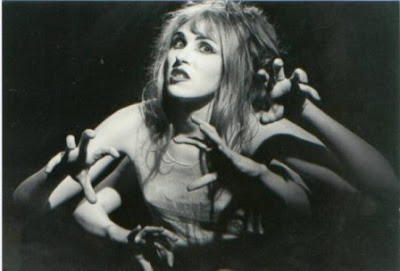
Interview with Artist and Comic Book Author Dame Darcy
![]() |
| Dame Darcy - "Many Hands" by Marcelle DuJour |
Dame Darcy is known worldwide as an illustrator, writer, fine artist, musician, filmmaker and animator. She had the pleasure to do illustrations for writers Alan Moore (DC comics), Poppy Z. Brite, Trina Robbins (Women In Comics), and fashion designers Anna Sui (NYC), Jared Gold (LA), CWC, and Coi Girl Magic (Tokyo) among others.
Her TV series, Turn Of the Century, won many awards for the movies and animations made in collaboration with Lisa Hammer and additional filmmakers and is currently being distributed.
Dame Darcy is presently on her 17th issue (and counting) of Meat Cake, her long standing comic book title published by Fantagraphics. She has also released several graphic novels, including Frightful Fairytales (published by Ten Speed Press 2002), Dame Darcy’s Meat Cake Compilation (Fantagraphics Books 2003), The Illustrated Jane Eyre (Putnam Penguin USA 2006), Dollerium Book and DVD (Presspop, Tokyo 2007) and Comic Book Tattoo, a comic compilation illustrating the songs of Tori Amos (Image Comics 2008) among other compilations.
Gasoline the graphic novel has an accompanying music release by her current band Death By Doll on Emperor Penguin Records entitled Gasoline. Dame Darcy is also adapting Gasoline into a screenplay. Her next graphic novel projects are Hand Book for Hot Witches and The Excorsisters. She’s also developing an online game based on her illustrations. Her fine art is currently represented by Sloan Fine Art in New York City.
Fatally Yours: When did you become interested in art?
Dame Darcy: I originally started drawing/writing books (sequential art) at the age of 2. My Dad is an artist, so is my uncle, brother, and a lot of my family. We are related to John Wilkes Booth and many of the guys in my family look like him (like a handsome villain) I contribute a lot of my family’s talent and good looks to Booth but also the craziness. I loved the books my family had on Klimt and Rossetti and the other pre-Raphaelites, Dada, (my first word was dada) Victoriana, and Faeiry tales Greek myths and legends.
They also had a lot of feminist literature and contemporary poetry books and faeiry rock music. My favorite bands that I consider my children’s albums that influenced my psychedelic subconscious are that song by the Stones about the girl with rainbow hair, Donovan’s A Gift From a Flower to a Garden, The Kinks song “Victoria,” The Zombies, Tiny Tim’s album God Bless Tiny Tim, The Beatles’ White Album and bluegrass classics like Doc Watson, Dolly Parton, Johnny Cash, etc.
My dad plays banjo and taught me when I was 10 how to play and at 5 how to play autoharp. We used to play shows together and he was in a band then too.
We lived in Idaho. Not a very artistic place.
Fatally Yours: What kind of films, books and comics did you read growing up that influenced and continue to influence your work?
Dame Darcy: I loved Alice in Wonderland and the Oz books series. Pippi Longstocking (all the books and the movies), I loved Tales From the Crypt and Edward Gorey. I liked the show Night Flight. Creature Feature would show lots of fun stuff on Friday nights. I kind of thought my family was like the Addams Family and that I would grow up to have an Addams Family of my own which I currently always have incarnations of.
The movies that made me think I would grow up and have a place in the world are Time Bandits, Neverending Story, Beetlejuice, Splash, Twilight Zone The Movie, Carrie (which was like my high school experience), Flash Gordon, Eraserhead, Cabinet of Dr. Caligari, the movie Popeye, Watership Down, The Last Unicorn was so much like my life and it is STILL like my life. The Last Unicorn is wandering around with that depressing Cat Stevens song or whatever it is searching for her unicorn sisters while the other characters in the movie fuck with her. Finally a curse is put on her, she becomes human (i.e. The fantasies of childhood are broken and you realize you will have to take on all the human crap of being a woman) and when the unicorn turns into a girl, I looked JUST LIKE the girl, it was sick. Then finally she gets to the ocean and joins her other unicorn sisters who come out of the ocean in a wave and gallop together free. I moved to the coast, near the ocean, like San Francisco and NYC and met the other freaks.
Movies that have influenced me as an adult are Barry Lyndon by Kubrick, Terry Gilliam, anything by Todd Haynes. Michel Gondry does good contemporary work, Spike Jonze does good movies as well. I love those really Dada Betty Boop cartoons from the 20′s that Cab Calloway sings on, Night Of The Hunter where Lillian Gish plays an old Christian lady battling a demented preacher with a shotgun while she sings a hymn in harmony with him. This movie stars a doll. Beauty and The Beast by Cocteau, The Blue Angel with Marlene Deitchrich is also a great cabaret film and is sort of like the movie Freaks I just realized. The Devils by Ken Russell 1971, an account of the apparent demoniacal possession of the 17th-century nuns of Louden, climaxing in the burning of their priest as a sorcerer. There is the cutest cabaret scene in it where a gorgeous gay boy plays the Venus Di Milo. This is also like the 1971 release of Wicker Man. A lot of the best movies came out in 1971. Dark and psychedelic.
I think Interview with a Vampire is the most hilarious movie in the planet! Just a laugh riot all the way through. Speaking of vampire movies, Valerie and her Week of Wonders is THE BEST! Salem’s Lot is the scariest. Herzog does a great Dracula too with Klaus Nomi (he is also the star of a documentary called My Best Fiend) and the one where William Defoe plays Dracula is awesome, Shadow of the Vampire. These two were obviously based on the original movie Nosferatu. And lest we not forget The Hunger. That movie I clung to like a life raft when I was a teen in Idaho. I want to see Let The Right One In but have not yet.
I always draw the endless pages and commission designs while watching movies, and crafting. I watched Gone with the Wind (which is a costume drama AND an apocalyptic movie all in one) over and over for a month one time. I just didn’t care to see anything else. The song that the slave men sing in that movie as so poignant and creepy it sends chills up my spine.
Fatally Yours: What sparked your interest in creating your comic book, Meat Cake?
Dame Darcy: I began self publishing Meat Cake when I was 17. It was picked up by Fantagraphics in 1991 when I was 19 and Fantagraphics is releasing a graphic novel compilation of Meat Cake with stories up to issue 10 I think. I am currently on issue 18 and am reissuing out of print Meat Cake issues as part of my new self publishing company Dame Darcy Publishing Ink, found at Dame Darcy.com. Anyone can get them directly from me on Etsy: http://www.etsy.com/shop/damedarcy.
I had this dream place, a little sea coastal town called Sobriety Straight where freaks lived together. A mermaid that thought death was funny and liked to flirt with and torture men. Hindrance (a hindrance to Perfidia) and Perfidia (meaning two-faced), a Siamese twin that was always fighting with itself (I am a Gemini on the cusp of cancer, need I say more). Richard Dirt, named for the pen name I once considered when I thought I would create an alter ego like George Sand the lady Victorian writer did, but instead I created a comic book alter ego which I am really glad I did not make my pen name Richard Dirt, that is sooooo confusing! Strega Pez is a hard working gal who is also an orphan, when she was born she came from her mother’s throat, thus killing her, and was cursed by only being able to talk through her throat on Pez. I invented this character because I felt like I always had to work mundane jobs like that before I became a freelance artist. Later Strega Pez becomes a world renowned scientist and invents invisible strong string made from goat’s milk and spider webs and gets out of poverty. Friend the Girl is inspired by Louise Brooks and is a good friend, she has a boyfriend named Friend the Boy. Wax Wolf is a cad zombie werewolf made from real wolf hair and wax who is the undead so is killed thousands of times in different ways and always comes back.Granny was once a flapper mobster moll who puts poison in her cookies out of habit. Scampi the Selfish Shellfish is Richard’s pet. And then there’s the sundry pirates and hot sailor lads from the port town.
Fatally Yours: Besides being well-known for Meat Cake, you also make dolls, create music, design clothes, create fine art, make graphic novels, are a filmmaker and are a cartoonist. How and why do you find yourself pursuing so many different avenues of creativity?
Dame Darcy: I always wanted to make feature films, which combine music, animation, film and are themselves fine art. So until I get my big break I make everything separately and keep pitching my feature film concepts which are based on graphic novels.
Fatally Yours: How would you describe your art and artistic style?
Dame Darcy: Like a demented tortured Gypsy that wants to escape this place and time into a faeiry fantasy world near Atlantis. Place beyond place time out of time.
Fatally Yours: Your art contains many Victorian motifs. What attracts you to the Victorian period? Do you ever find yourself gravitating to other eras?
Dame Darcy: Did you know that glass (like glass windows) is always in a permanent liquid form? This is why the stained glass of the Byzantine churches have some images where the colors have melted from one frame into the next. And also why the cut glass windows in the craftsman house I grew up in were warped from the windows slowly melting over 100 years. It’s always this way in old houses.
The Victorian era is a romantic and tragic place at the dawn of industrialization. Mother earth had not been completely slaughtered yet then. Women were oppressed but there was a chivalry to it all too. As a kid I had nostalgic longings and still do for the smell of Victorian cotton curtains blowing in the half open window of an attic room while it’s raining outside on the roses and ivy that have grown to cover the dirty, spider webbed glass that is slightly warbled from the glass slowing melting over time.
In my graphic novel Gasoline the Witch family lives in a post apocalyptic utopia which is in a simultaneously existing time /space mirroring this one. I am writing a new one called Gold Leaf about how I channeled my past life as a Druid in 500 AD. It is called Gold Leaf because that what the illuminated letterers of the time used, and will be drawn as if stained glass windows were panels of a comic book (which is essentially what they are). Other than that I am currently in the process of publishing my latest graphic novel, The Hand Book For Hot Witches. It is modern, but touches a lot on ancient magic lore and is basically a practical guide to magic of all lineages.
Fatally Yours: When you first started out, did you encounter any gender bias as a woman in a mostly male-dominated world of comic books and graphic novels? Or were people pretty open to your ideas, regardless of your gender? Do you find your gender makes a difference in how people view you nowadays?
Dame Darcy: Again, I feel like The Last Unicorn because I am well aware that the comic book world and feature film and animation world is a boys’ club. In a way it’s good to be different and naturally stand out from the crowd, but at the same time my people are the gothic Lolita fashion and weirdo darkwave music scene which doesn’t necessarily know or care about comix. To fix this problem and combine all of it I am creating a special Doll Game which will be seen soon on Dame Darcy.com and whose details I can not disclose yet.
Fatally Yours: Do you feel that your art has a feminist subtext? Please explain.
Dame Darcy: I am a hardcore feminist so I wrote The Hand Book For Hot Witches, here’s what it’s about…. I also created the EZ Bake Coven which I encourage everyone to join and post and enact on the forum and in real life…again here’s the Manifesto for that too…I made these things because WE NEED THEM!
Hand Book For Hot Witches: Combine graphic novel with a “how to” guide, add a dash of cook book and a fairy sprinkle of witch spell, wrap it all up with women’s history and you have the Hand Book For Hot Witches. This is a girl’s guide to the apocalypse. This book addresses the unique needs women have, and covers heavy issues like sustainable living once water, heat, and food have become scarce. It harkens back to an ancient time when women lead as the herbalist healers, nurturers and disciplinarians of the community. But also looks to the future and gives advice on how to handle crisis in a time of global extremes and addresses mood fluctuations and how to handle inner turmoil.
Hand Book For Hot Witches addresses our need for self defense. It celebrates and acknowledges our inherent power of creativity, intuitiveness, and every female’s role as a conduit to the spirit realm.
This guide book is for girl scouts grown up and facing the realities of surviving in the jungle of today’s political society with complex ecological implications. And gives them simple answers through philosophy, skill, crafts and song to deal with these issues one step at a time through comics, fully illustrated step by step how to’s, in depth text with spot illustrations and resource guide.
Most of women’s history is blotted out from the pages of society. Hand Book For Hot Witches recognizes and profiles “witches” who stood out of the crowd changed the world and fought for not just the rights of women but for humanity and for justice. This book will help their legacy live on.
There are many “how to” books, and post petroleum guides of how to live sustainably. The Hand Book For Hot Witches stands out from the rest because it has a unique view that addresses the needs of women. Although it brings up topics that at some times are hard to face, the visual style and literary sense of humor make these overwhelming concepts and problems easier to handle and thus easier to solve.
This book is here to inspire individuals to make a change and inform them how to do it. It’s also here to empathize with the current situation the world is in and does not ignore the symbiotic relationship that women have to Mother Nature. Respecting the earth is respecting womankind, and respecting yourself.
The information and insight within is something daughters, mothers, and grandmothers can all relate to, connect with, and remember. To proactively create a future so all girls can inherit a legacy.
The E Z Bake Coven has been going for 10 years now, and now has an exciting new look. We are creating a forum to profile artists and a place for ladies (and the men who worship the Goddess) to live chat, video blog, and even create their own local covens virtually and in reality. It is located in the EZ Bake Coven section of Dame Darcy.com
Fatally Yours: What elements do female artists offer that differ from males’ perspectives?
Dame Darcy: The sense of entitlement that all women, the earth, animals and all plant life is here to serve “man” was invented by Christian white guys a while ago and just because it’s been the mainstream way of thinking for a long time, does not now nor never was right.
Jocks think this way and to this I say “FROCKS NOT JOCKS” they do not think or consider the perspective of women or other races and to this I say “I AM THE CRACKER ATTACKER” and women are bitches who are not feminist and do not see other ladies as their sisters. So they I say “WITCHES NOT BITCHES”.
Fatally Yours: What women in your industry do you admire and why?
Dame Darcy: Natasha Rambova, [who] was born Winifred “Winnie” Kimball Shaughnessy on January 19, 1897. [She] grew up to not only to be the creatrix of Hollywood [to] its biggest and most influential star Rudy Valentino, but also is the inventor of the Art Deco style. She was a costume and set designer, artistic director, screenwriter, producer, actress, fashion designer, and was also influenced by German Expressionism. She earned more than her husband Valentino, who had notoriously bad contract deals and had a career due to her styling and marketing of him. Their break up and his death ensued when the big money guys at the studios wanted to take her influence away. She designed for a film Nazimova wrote titled, A Doll’s House. Rambova’s designs for the movie Salome were seen as extremely daring and risqué. She based them off drawings by Aubrey Beardsley for Oscar Wilde’s version. Plus look up her photo she is the hottest and most beautiful witch ever. Truly amazing! Also the German animatoress Lotte Reiniger and her film Die Abenteuer des Prinzen Achmed (1926), the first feature-length silhouette animation. Really ladies, I’m not kidding look this up and watch it somehow, it will change your life.
Fatally Yours: What advice would you give women who want to pursue a career in art?
Dame Darcy: LIFE ALIGNED WITH PASSION
When you have a big or unusual goal you may be daunted by trying and failing a million times, but just keep throwing your work out into the public and researching who to talk and pitch your ideas to /show your art. And keep going. The way big ideas get made into reality is by trying time and time again, each try is one try closer to manifesting your goal. No one manifests anything who didn’t try and your convictions will make all obstacles fall away of their own accord.
So many people when they ask, “What do you do?” they mean, “What do you do to make money?” They are trying to judge who you are by what you do to make an income. To which some people take offense if their passion does not make them money and does not align with their work.
If you choose to favor your passions above and beyond all else and stay committed, the life of your choosing will manifest. Daily responsibilities and expectations arise all around you.
Fatally Yours: What are your favorite dark works of art, horror books, comics, etc.?
Dame Darcy: I love Suhiro Maruo , a Japanese graphic novelist who does stories about a dark circus and vampires. The Strange Tale of Panorama Island is his latest book. Sandman series by Neil Gaiman was always a beautiful but sad story and From Hell about Jack the Ripper written by Alan Moore has an extremely enlightening section in the back pages about the dark occult underbelly that London’s streets and politics are based on. His latest book Promethia has very enlightening occult information. I have always admired Ralph Steadman’s drawing style and was inspired by Sue Coe in my early days. I also as previously mentioned Charles Addams’ Addams Family comics and Edward Gorey’s comics as a kid. Egon Sheile illustrations/paintings look so contemporary and Francis Bacon is a beautiful sicko and just had an amazing exhibit at the Met in NYC last summer. Hans Bellmer (the one who did those weird sculptures of dolls) also did illustrations which were amazing as well. Aubrey Beardsley of course. All Art Nouveau.
Fatally Yours: Who are your current favorite artists?
Dame Darcy: Camille Rose Garcia, Joe Coleman, Joanne [Burke] of Chromium Dumb Belle is a genius! Kime Buzelli. Marcelle DuZama , Matthew Barney , Cindy Sherman, I love Grandma Moses (but she’s not current) Christy Kane, Jared Gold, Adam Dugas, Machiene Dazzle, Madeline Von Forrester and so much more but I’m going crazy.
Fatally Yours: If you could collaborate with anyone, living or dead, on a comic book or graphic novel, who would it be and why?
Dame Darcy: O M G ! It would be to illustrate Alice in Wonderland. Also, I LOVE Hunter S. Thompson, Urusala K. Leguinn and Philip K. Dick. I would love to turn any of their books into graphic novels.
Fatally Yours: Do you have any upcoming projects you’d like to talk about?
Dame Darcy: I already mentioned myself publishing company Dame Darcy Publishing Ink, The E Z Bake Coven, my darkwave band Death By Doll’s upcoming album Goth As Fuck, Meat Cake comic book series, Gasoline graphic novel, Hand Book For Hot Witches, Turn Of The Century DVD of my TV show was just re-released. All my current and past multimedia projects and current shows and events can be seen at Dame Darcy.com and can be acquired at my Etsy store which is the arts/crafts section on dd.com
Fatally Yours: What goals do you hope to accomplish in 2010?
Dame Darcy: To live in a state of enlightened tranquility. To learn Spanish, to learn how to sail, to find my home, or at least get an idea of where it is, to have my feature film go into preproduction, to get the biggest publishing deal possible for Hand Book For Hot Witches, to master and release Death By Doll’s new album, to start my doll game , to make the EZ Bake Coven Forum the best it can be, to get a licensing deal for my designs, and to make my 84 year old doll Isabelle finally happy so she can stop bitching at me.
Fatally Yours: Where can people find more info on you?
Dame Darcy: For everything me go to: www.damedarcy.com
And I also want to thank my business
partner and Gemini twin Vincent D. Dominion. He is an artist as well and
you can check him out at myspace.com/vincentdominion
Thursday, February 18, 2010
Interview with Author Sarah Langan
Sarah Langan’s first novel The Keeper (2006) was a New York Times Editor’s Pick. Her second novel The Missing (2007), won the Bram Stoker Award for outstanding novel, was a Publisher’s Weekly favorite book of the year, and an IHG outstanding novel nominee. Her third and novel, Audrey’s Door, was just released. She’s published about a dozen short stories, one of which won the 2008 Bram Stoker Award.
She’s currently at work on her fourth novel, Empty Houses, a young adult series called Kids, and her Master’s in Environmental Toxicology from New York University. Langan lives in a quasi-haunted house in Brooklyn, New York with her husband, screenwriter/director/children’s book author JT Petty, their daughter Clementine, and a rabbit named Lorraine.
Fatally Yours: What does horror mean to you?
Sarah Langan: For me, it’s a feeling of unease about things society ordinarily considers innocuous. Good horror informs its readers, and lets them know what they ought to fear, as well as what’s not so scary, after all. To me, Brazil is horror. Catch 22 is horror. Fahrenheit 451 is horror. They reflect back to us the world in which we inhabit, only from a different and more terrifying perspective.
Fatally Yours: How did you fall in love with the horror genre?
Sarah Langan: I’ve always liked hyperbole and I’m a drama queen. Why moan about something, when you could scream? Also, as a kid, I always loved the possibility of magic that you get from kids’ books, and the only place that magic persists is in horror.
Fatally Yours: How and when did you start writing about horror?
Sarah Langan: I’ve always written what I wanted, and let other people put labels like horror or supernatural thriller or chick lit or literary on it. To believe your own label is to trap yourself into a box, and stop learning.
Fatally Yours: Why do you choose to write about horror as opposed to other genres? Would you ever write in another literary genre?
Sarah Langan: I didn’t choose horror so much as I’m drawn to dark subjects and I deal with them in a realistic way. For some, that means I write horror. I’m currently working on a dark fantasy series, and I’ve written what’s considered straight literary stuff, too. What they’ve all got in common is a fascination with the macabre.
Fatally Yours: What sub-genres in horror (vampires, zombies, werewolves, etc.) are you sick of? What sub-genres do you want to see more of?
Sarah Langan: I think if the story is good and well-told, the vehicle (vampire, zombies, werewolves) doesn’t matter. Audiences like it, and it’s fun to play with the old myths, so I’ve got no problem with any of them. I do wish people would stop mistaking me for an author of stories about sexy vampires and the sexy lady detectives/waitresses/school girls who love them, though. They’re fun stories, but not at all what I do. All that said, werewolves could use some reinvention.
Fatally Yours: Why do you think the horror genre has been primarily male-dominated?
Sarah Langan: Lots of women have made names for themselves in horror. It became male-dominated in the 70s and 80s, probably because horror got defined as King, Straub, and Barker (all deserving of every good thing said about them), and the offshoot authors from that wave often depicted ultra violence, particularly against women. So, women kept writing fiction, but their books got packaged differently so that their potential audiences didn’t mistake what they wrote for ultra violence or rape porn. Now that’s changing, and paranormal romance is a big part of the horror genre. There’s a middle ground between romance and ultra-violence that a lot of readers don’t know about, and I think that’s where the most interesting work is and has always been happening: I’d read Ellen Datlow’s Year’s Best anthologies to get a taste of that, and from the favorite stories a reader finds there, go out and buy the novels and collections written by those same authors.
Fatally Yours: What elements can female authors bring to the horror genre that are lacking in males’ perspectives?
Sarah Langan: Good writing is gender and genre blind.
Fatally Yours: Do you feel women authors in horror get the proper recognition when compared to their male counterparts?
Sarah Langan: Well, I know that booksellers can’t ever figure out where to stock my fiction because I’m a woman, and it’s not romance, but the cover isn’t bloody either, so my work often gets stocked nowhere, which kind of sucks. But that happens to a lot of writers for lots of reasons, and isn’t gender-specific. I’ve also benefited from my gender because less women write straight horror, so I got more attention (both positive and negative) when my first novel The Keeper was released.
The genre pool is very small, and many of us know each other. I mostly wish women would support each other more, the way men do. There’s something called the narcissism of nearness, in which you hold the familiar in contempt, and I think it applies to horror writers. From the outside, we all seem the same, and should for logical reasons, get along and help each other out. But from the inside, we create tiny distinctions that to us, seem huge.
Fatally Yours: As a woman who writes about horror, have you found it harder to be taken seriously in a genre that seems to be dominated by males?
Sarah Langan: No. I don’t take bullshit.
Also, the fact that most other horror writers are men doesn’t mean much. The editors (and marketing people) at publishing houses have the power, and they’re mostly women. Also, more women buy books than men.
The perception within horror that men have the power is wrong, and perpetuated by people who are misinformed. When a male editor from a small press tells me I’m cute, or acts inappropriately toward me at a convention, I don’t get upset, and think that everybody in the industry is sexist. I remember his name, and make a mental note never to work with him.
Fatally Yours: Since you’ve been involved with the horror genre, have you noticed an increase in women becoming involved with the genre, whether they be fans or writers?
Sarah Langan: Yeah, horror in general has gotten bigger, and I think that’s great. My only worry is that editors and marketing people will publish anything about a vampire or zombie because they’re unfamiliar with the genre, and assume blood is the formula for success. That won’t win long-term fans who will endure past the fad. I don’t want quality dark fiction to get overlooked by the boom.
Fatally Yours: Do you feel that other people view women as being “soft” and not able to endure horror as well as men? How do you fight this stereotypical view?
Sarah Langan: We push ten-pound babies out of our bodies; we can handle a little blood and guts.
Fatally Yours: What women in horror do you admire?
Sarah Langan: Ellen Datlow, Elizabeth Massie, Liz Hand, Tannith Lee, Lisa Tuttle, Sarah Pinborough, Alexandra Sokoloff, Rhodi Hawk, Deborah LeBlanc, Cherie Priest, Kelly Link, Gemma Files—and lots, lots more!
Fatally Yours: What inspires, influences and motivates you to keep writing about the macabre?
Sarah Langan: I honestly just sit down, think about character, and go from there. The newspaper inspires me—the world is pretty screwed up. Also fun for ideas are science magazines. Neurology is pretty awesome.
Fatally Yours: What advice would you give women who want to become involved in the horror genre?
Sarah Langan: The same I’d give men: a writer writes. Don’t get drunk at conventions, no matter who tells you it’s cool. It’s dumb. If some schmuck treats you like a cocktail waitress, walk away. Believe in yourself enough to know you don’t need him.
Fatally Yours: What has been your best experience while working in the horror community? What’s the worst?
Sarah Langan: I’ve met a lot of wonderful people through the horror community and am grateful to it. They’re my people, and where I feel most at home. We like the same movies, we have the same sense of humor. I feel at home, and understood, when I’m around fellow horror writers.
The worst I can say is that I wish the community as a whole aimed a little higher. When somebody wants to publish your story but not pay you for it, that’s bad news. When they want to publish your novel, and you’re supposed to pay them, that’s really bad news. Why not hold out for something better? It’s hard work and takes a dog’s age, but every door that closes has to open eventually, if you try hard and long enough. Maybe you’ll even become a better writer along the way.
Also, there’s nothing wrong with trying to scare the crap out of somebody, and trying to write something that will be remembered for decades or more, too. I’m not saying I do both, but I try. And that’s important.
Fatally Yours: Who are your favorite horror authors and what are your favorite horror novels?
Sarah Langan: I’ve been bad this year, and haven’t read a lot of genre. But last year:
The Resurrectionist by Jack O’Connell, Tender Morsels by Margo Lanagan.
This isn’t horror, but it’s fantastic, and I’m a little jealous: The View from the Seventh Layer by Kevin Brockmeier
Fatally Yours: What was the last good book in the horror genre that you read?
Sarah Langan: Well, this is more dystopian, but I loved Walter Tevis’ Mockingbird. Best book I’ve read in years.
Fatally Yours: What are your goals for yourself within the horror genre?
Sarah Langan: I’d like to keep writing, and getting better, and getting published. I don’t care what the label of what I produce is, so long as it finds its audience, and is honest.
Find more info on Sarah Langan at:
www.sarahlangan.com
www.openaudreysdoor.com
Labels:
author,
interview,
WIH 2010,
women in horror,
writer
Friday, February 12, 2010
Interview with Author and Actress Axelle Carolyn
Axelle Carolyn has been a horror fan for as long as she can remember. Brought up on a steady diet of scary movies and Stephen King and Clive Barker novels, she started out as a film journalist and contributed, amongst others, to Fangoria and IGN.
Her published first book, It Lives Again! Horror Movies in the New Millennium, came out in May 2009 from Telos Publishing, and received rave reviews. Her first short stories were published the same year in various horror anthologies, including Dark Delicacies III: Haunted, alongside Clive Barker and Chuck Palahniuk.
As an actress, Axelle has worked on a series of genre features, including upcoming thriller Psychosis with Charisma Carpenter, and Neil Marshall’s Roman epic Centurion, in which she played a Pict warrior called Aeron alongside Michael Fassbender and Olga Kurylenko.
Fatally Yours: What made you fall in love with the horror genre?
Axelle Carolyn: Ever since I was little I’ve always been attracted by the darker side of things, ghosts and skeletons and haunted mansions and spooky stories. But I think what really made me fall in love with the genre was discovering my dad’s collection of horror books when I was about 7 or 8. He had several books of ghost stories by Belgian writer Jean Ray, and also Dracula, Frankenstein… the classics. A few years later I read my first Stephen King novel, and I was hooked for life.
Fatally Yours: What does horror mean to you?
Axelle Carolyn: Anything supernatural or scary, anything that takes you away from reality. What the French call “fantastique”… Perhaps the reason there aren’t quite as many female horror fans is that the genre is too often confined to gore and cheap scares.
Fatally Yours: How and when did you become involved in the horror genre?
Axelle Carolyn: Professionally? I guess my first taste was when I was still studying, and I got the chance to conduct some interviews for a website. My first interviewee was Stuart Gordon! Soon after that I started visiting sets for Fangoria, and got my first horror script optioned.
Fatally Yours: You’ve been involved with all different aspects of the horror genre – being a journalist, an actress, a model and an author. Would you like to pursue one of these exclusively or do you like to be involved with many different aspects of the horror genre?
Axelle Carolyn: Apart from the odd column piece on IGN, I haven’t written articles in a good couple of years. I’ve never really pursued modeling as a career… So that leaves acting and writing, and that’s the two aspects of horror I like the most. They complete each other perfectly. I have a feature in development right now, based on a script I wrote, and in which I’ll be starring. I can’t wait to see it happen!
Fatally Yours: While working in the horror genre, what do you feel has been your crowning achievement so far?
Axelle Carolyn: As a writer, I’d say my book, It Lives Again! Horror Movies In The New Millennium (Telos Publishing). It was also hugely exciting to see my first short story published in the new Dark Delicacies anthology this year. As an actor, the most fun I had was on Centurion, with all the fights, horse riding and archery it involved. But as far as achievements go, if the film I just mentioned gets made in 2010, that’ll definitely take the crown.
Fatally Yours: If you could work with any female horror figure, alive or dead, who would it be and why?
Axelle Carolyn: Sigourney Weaver. She’s just so great, beautiful, strong… I would have loved to work with Bette Davis, too.
Fatally Yours: Even though women seem to be getting more and more involved behind the scenes in horror, why do you think there have traditionally been less female horror directors, writers, producers, etc. in the genre than males?
Axelle Carolyn: It’s not exclusive to horror. Even outside the genre, there are so few female screenwriters or directors. It might have to do with the fact that historically, women have rarely been pushed to grab the top positions in society. I often notice amongst my non-industry friends that even women who are brilliant at their jobs often aren’t really interested in becoming CEOs or being in positions of power. They want a family, they have other priorities. But then again, it could be that women are just not that interested in screenwriting or directing. Who knows?
Fatally Yours: Do you feel women in horror get the proper recognition when compared to their male counterparts?
Axelle Carolyn: Sure. Personally I’ve never really felt discriminated against, or witnessed other women’s work being dismissed on that basis. Although you know what? There’s one stupid thing that bugs me every time I go to festivals or convention booths. I can never find good horror shirts in my size! Guys get those brilliant gory shirts, with Re-Animator or Iron Maiden on them, and all we girls get are cutsy Emily Strange logos – when we’re lucky. That’s a pain.
Fatally Yours: As a woman in the horror genre, have you found it harder to be taken seriously in a genre that seems to be dominated by males?
Axelle Carolyn: No. If anything, it helped me stand out. People are more likely to remember the one knowledgeable horror chick amongst the fifty guys. The only misconception I have to fight against is that some people think I’m into horror because of my husband [director Neil Marshall]. That’s silly: I’d been working in the industry and in the genre years before we even met.
Fatally Yours: Since you’ve been involved with the horror genre, have you noticed a change in women’s roles within horror whether it be roles in horror films, women behind the camera or women writers?
Axelle Carolyn: Not really. I’d like to say there’s been more interesting roles for women in genre films, but I think these kinds of things come and go. Though I would kill for a part like Angela Bettis’ in May or Beatrice Dalle’s in Inside! This being said… one interesting thing is that in the past decade, producers have come to acknowledge women as potential target audience for horror movies. J-horror for instance had a largely female audience.
Fatally Yours: What women in horror do you admire?
Axelle Carolyn: Amongst directors, Kathryn Bigelow. I’m also very curious to see what Jovanka Vuckovic is going to do now; she did such a great job with Rue Morgue! As a writer, how could I not mention Mary Shelley? And as an actor, I admire what Barbara Steele managed to do, playing all those strong villains. She was the closest thing to a female Vincent Price, I guess. Or Bette Davis towards the end of her career: she perfectly captured both the strength and the vulnerability that some women tend to have as they grow old. Most horror actresses play a fair share of victims (hence the name scream queens), but I personally find that no fun whatsoever. I’d rather be the villain! Even if that means that most of the time, the make-up artist is told to make me look old, sick or insane, rather than pretty and fresh…
Fatally Yours: What inspires, influences and motivates you to keep you working in the horror genre?
Axelle Carolyn: Good books inspire me. Film festivals, too – it’s hugely inspiring and energizing to spend five to ten days watching tons of horror movies and chatting with fans and filmmakers. I also have a great group of friends in LA who are a constant source of inspiration: Mike Mendez, Ryan Schifrin, Mick Garris, Adam Green – people who have a true passion for and understanding of the genre. Every time I fly back to London, I can’t wait to get to work! On my last trip I had the chance to visit Clive Barker at his home in the hills, and it was the most amazing place. It seems he lives and breathes horror 24/7. Looking at his work on display everywhere, it just makes you want to work and write and create…
Fatally Yours: What are your favorite horror films and books?
Axelle Carolyn: My favorite horror film is David Cronenberg’s The Fly. I’m a big Cronenberg fan. I also love Re-Animator, The Fog, Whatever Happened to Baby Jane, The Devil’s Backbone, Return of the Living Dead…
Book-wise, I picked up my first Stephen King book when I was 10 and I’ve loved him ever since. And I read all kinds of ghost stories. Right now I’m reading The Woman In Black. I’m also reading a lot of Dan Simmons novels these days.
Fatally Yours: Outside of horror what do you enjoy doing?
Axelle Carolyn: Reading, watching non-horror movies, horse riding, traveling, eating in great restaurants…
Fatally Yours: What are your goals for yourself within the horror genre?
Axelle Carolyn: As an actress, as I mentioned… become a female Vincent Price. As a writer: write one really scary or touching film or novel, something that readers or audiences would remember for a long time. Short-term goals include getting that feature made… If it happens, I’ll definitely keep you posted!
Fatally Yours: Where can people find more info on you and your work?
Axelle Carolyn: On IMDB and my book It Lives Again can be found on Amazon, at Dark Delicacies, or on the publisher’s website: http://www.telos.co.uk
Labels:
actor,
author,
interview,
journalist,
WIH 2010,
women in horror,
writer
Subscribe to:
Posts (Atom)


