The archives of the articles, reviews, interviews and other ramblings written by Sarah E. Jahier (aka Fatally Yours).
Showing posts with label dark. Show all posts
Wednesday, December 15, 2010
The Bunny Game (2010)
The terror you witness on-screen of The Bunny Game is real. Let me clarify…it’s not just realistic…it actually happened. It’s like watching a snuff film, only no one really died during filming (as far as we know). The actors weren’t merely acting, but they were subjected to most everything you see on film. Ballsy actress Rodleen Getsic gives a graphic blowjob, pees in public, is shaved bald and is actually branded in the film, not to mention the preparation that went into her role as an emaciated, drug-addled prostitute. Getsic fasted for over a month to prepare for her role! As you probably have guessed by now, The Bunny Game isn’t your ordinary horror movie. In fact, it feels more like a brutal snuff film coupled with avant-garde performance art.
The film is about a hard-knock prostitute named Bunny (Getsic) who trolls the streets of LA turning tricks and snorting coke whenever she gets the chance. This prostitute certainly doesn’t have a heart of gold, but nonetheless you feel pretty bad for her as you watch her engage in graphic sexual acts, get high, get raped and get robbed. Things go from bad to worse when she is picked up by a trucker (Jeff F. Renfro) who takes her out to the desert and brutalizes her for days on end.
While the plot might make it seem like just another torture flick, let me assure you that The Bunny Game is anything but. Is there torture? Well, yes, but it’s more the nasty psychological kind that sticks with you for days, rather than straight-up blood and guts. And the intense psychological wringer that the film puts both the victim (Getsic) and viewer through makes the film seem that much more realistic, which, believe me, will further raise the audience’s anxiety! And after all the things the cast (namely Getsic) went through, it is no wonder the film feels so authentic!
Director Adam Rehmeier, who co-wrote the film with actress Getsic, says the film wasn’t written with a strict script (there is very little dialogue) and most of the performances came organically from the actors. They were just sorta let loose on one another and given license to go as dark as they could…and, boy, did they ever go dark! Not only were the performances spontaneous, but so was the camerawork. Most scenes were filmed in only one take (usually unheard of in a film), which only adds to the immediacy and realism of the film.
The film also has a very voyeuristic feel, which adds to the snuff-like, performance art quality of it. The shaky camera angles, the constant zooming in and out and so on really make you feel like you are right there with the characters. And no matter how hard you try and get away (or look away), you just can’t.
Despite its shocking brutality, there isn’t that much blood and gore, if that’s what you’re hoping for. Most of its terror comes from psychological torture. Bunny is just as mentally broken down by the trucker as she is physically abused. He locks her up for days and submits her to all kinds of torment – stripping her down, humiliating her body, flashing a spotlight in her eyes, chaining her up, taking her for walks on a leash, shaving her head, etc. And that doesn’t even begin to detail the physical and sexual abuse he perpetuates against her. It is this kind of damaging psychological horror that is most effective, at least in my opinion. Anyone can do gross-out blood and guts, but it takes real talent to get into the audience’s brains and truly disturb them.
Congratulations are in order for director/co-writer Rehmeier and co-writer Getsic, because they have crafted a hauntingly unsettling film! It may be intensely difficult to sit through, but at least it looks stunning and isn’t just a point-and-shoot affair. There are even some beautifully dynamic shots in the film that momentarily relieve you of the brutality on-screen. It is filmed completely in black and white, which gives it a monochromatic and artistic look.
However, even the way the film is shot echoes the manic madness of the film, for juxtaposed against the gorgeously framed shots are choppy, disorienting edits, frantic shaky cam shots, voyeuristic zooms and more to make the viewer experience even further discomfort. Even the music, which features chaotic metal in the first few scenes but devolves into a creepy score as the film progresses, adds heightened emotion to scenes that are already difficult to watch…And just when you think you can’t possibly take anymore the next scene comes up to further test your limits.
I can only use “disturbing”, “unsettling” and their derivatives so much to describe The Bunny Game, but hopefully by now you get the point. This film definitely isn’t for most people, but if you like challenging films that push limits, you should give The Bunny Game a view. It’s probably the closest you’ll ever get to a snuff film!
The Bunny Game on Facebook!
Labels:
artistic,
black and white,
brutal,
controversial,
dark,
disturbing,
explicit,
indie,
kidnapped,
low-budget,
psychological,
rape,
realistic,
recommended,
shocking,
snuff,
torture,
violent,
voyeur
Monday, October 11, 2010
Book Review: Morbid Curiosity Cures the Blues edited by Loren Rhoads
You might recognize the name Morbid Curiosity, as it was a nonfiction magazine from 1997 to 2006 that has quite a cult following. Though the magazine has been defunct for some years now, its popularity has never really waned…and because of that editor Loren Rhoads compiled some of the best true stories featured in the magazine’s pages and put them in this delightfully dark book!
True Stories of the Unsavory, Unwise, Unorthodox, and Unusual…with that description on the front cover titillating me, I couldn’t wait to explore Morbid Curiosity Cures the Blues as soon as I received it. In fact, it wasn’t relegated to my tottering stack of books needing review, but immediately was set by my favorite reading spot. My fingers were itching all day to pick up the book, and when I was finally able I flipped through the pages with gusto!
Here’s the synopsis from the back of the book:
For ten years, Morbid Curiosity was a one-of-a-kind underground magazine that gained a devoted following for its celebration of absurd, grotesque, and unusual tales – all true – submitted from contributors around the country and across the world. Loren Rhoads, creator and editor of the magazine, has compiled some of her favorite stories from all ten issues in this sometimes shocking, occasionally gruesome, always fascinating anthology.
This quirky book is filled with tales from ordinary people – who just happen to have eccentric, peculiar interests. Ranging from the outrageous (attending a Black Mass, fishing bodies out of San Francisco Bay, making fake snuff films) to the more “mundane” (visiting a torture museum, tracking real vampires through San Francisco), this curiously enjoyable collection of stories, complete with illustrations and informative asides, will entertain and haunt readers long after the final page is turned.
I don’t know what draws me to the morbid, the unusual, the weird or the downright offensive. I like to think it is mere curiosity, but I’m sure there’s also a darker nature at work here. The same dark nature that we all share, in varying degrees, that causes us to slow down when passing a horrible car accident.
The experience of reading Morbid Curiosity Cures the Blues is also like rubbernecking; you know you shouldn’t be so interested, but you can’t help staring (or in this case, reading). You get sucked into the whole peculiar experience, whether it’s reading about loss of innocence, weird customs, grave-robbing, surviving a bomb explosion, hanging out with sanguinarians, necrophilia, assisted suicide, etc. It’s a very voyeuristic experience as you are given a glimpse into ordinary people’s lives that take an extraordinary turn.
The novel is nicely balanced in tone – the stories range from scary (“Lock it Behind You,” “This Is a Very Old Scar”), heartbreaking (“Killing Max”, “A Night in the House of Dr. Moreau), depressing (“Souvenir of Hell”), gross (“DIY Urology”) and shocking (“Holiday in Genoa”), but all are fascinating. My personal favorite stories included “The Keeper of the Shop” by Jill Tracy, a bittersweet tale about the mysteries of life; “Going into Tombs” by Hugues Leblanc about exploring and photographing the interiors of old mausoleums; “Feed” by Katrina James, about vampires in San Francisco; “Halloween Hell” by Mary Ann Stein, about managing a Halloween super-store; and “Blood Gags” by Frank Burch, about making fake snuff films.
Morbid Curiosity Cures the Blues is a collection of the strange, the shocking and the sinister, but at the same time the stories are all so personal that they are also heartfelt and heartwrenching. These stories go beyond mere voyeurism, as through them you take a journey with the authors themselves to some very dark places. Like the authors, you won’t emerge unscathed, but perhaps you’ll have a deeper understanding of the dark side of the human psyche, including your own.
Buy it on Amazon!
Labels:
anthology,
books,
collection,
dark,
magazine,
morbid,
non-fiction,
quirky,
short story
Monday, August 30, 2010
Book Review: Oddities of West Blankshire by Dan Holst Soelberg
When I received Dan Holst Soelberg’s illustrated book, Odditites of West Blankshire: A Book of Odens Grebal, it immediately put a huge smile on my face. You see, the book contains short, witty and often morbidly funny two-line poems accompanied by beautiful black and white illustrations. For an Edward Gorey/Charles Addams fan such as myself, Oddities and its Victorian characters coupled with its dark humor was exactly my cup of tea!
However, I’ve had this book sitting on my desk for quite some time, so I must apologize to author Soelberg as well as to you, dear readers. It’s a shame I waited so long to review this absolutely enjoyable collection that depicts the eerily odd children of West Blankshire (hence the title). Now that I’ve taken the time to review the book, it shall still remain on my desk because I just love looking at it every once in a while, especially when I need a good giggle!
If I had a home big enough, I would frame every single page in the book and display them! The artwork is that spectacular and unique! I love the Victorian characters and how they are often paired with such unexpected and morbid fates.
Here is a little taste of one of the poems (for full effect it’s best viewed with Soelberg’s illustration):
Consumed by his unceasing feline perversion
Van surgically fused himself with his Persian
If you are a fan of dark humor and memorably strange characters, do yourself a favor and check out Dan Holst Soelberg’s astounding and amazing Oddities of West Blankshire!
The book is a limited edition, so hurry to get your copy today!!
Buy it on Amazon!
Labels:
books,
comedy,
creepy kids,
dark,
morbid,
quirky,
recommended,
Victorian,
visually striking
Wednesday, July 21, 2010
Book Review: A Boy Born from Mold and Other Delectable Morsels by Lorin Morgan-Richards
Following his unique first book, Simon Snootle and Other Small Stories (which I absolutely adored), author Lorin Morgan-Richards has released another delightfully delectable collection of illustrated short stories in A Boy Born From Mold. In this, the author’s second pocket-sized, handmade and handbound book, he returns with quirky stories of fantastical characters, from the titular boy born from mold named Ruin (or Rune proper) to a young vampire named Zoog whose parents are distressed at his distaste for blood. The small tome boasts seven new tales, each a delight to read!
Just like the first book from Morgan-Richards, A Boy Born From Mold boasts a very high quality with the handmade craftsmanship. This book’s longevity is ensured with the high quality of its faux leather, black ribbon and acid-free blue linen paper used. Only 400 copies of the book were handmade by the author, so these are definitely a collector’s item!
A Boy Born From Mold and Other Delectable Morsels from Lorin Morgan-Richards is a fun collection of stories for those with darker sensibilities. Fans of Edward Gorey and Tim Burton are sure to fall hopelessly in love with Morgan-Richards’ unusual characters and their disturbing situations. Plus, it’s the perfect size to fit in your pocket so you can take it with you during your daily stroll through the cemetery!
Available from Amazon!
Visit Lorin Morgan-Richards’ Official Site!
Monday, June 28, 2010
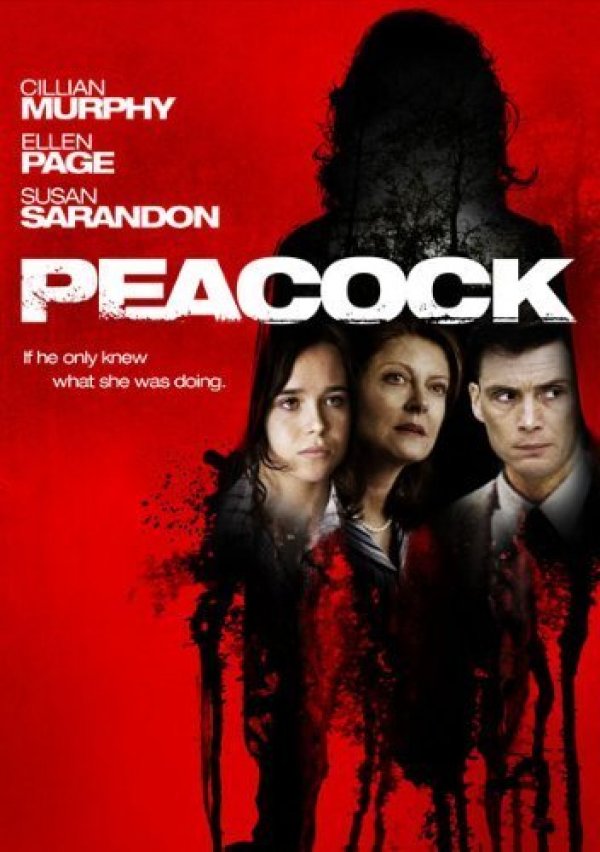
Peacock (2010)
John Skillpa (Cillian Murphy) is a timid, socially-awkward bank clerk living in tiny Peacock, Nebraska who prefers to keep to himself. This might have to do with John’s secret: he has another personality no one knows about, a woman named Emma, who each morning does his chores and cooks for him before he starts his day. However, everything changes when a train derails into Skillpa’s backyard, exposing Emma to the curious neighbors, who assume “her” to be John’s wife. As John struggles to maintain control over his other personality as well as keep up the façade that she is his wife, his already disturbed psyche becomes further unbalanced.
Peacock is an above-average thriller, but I’ll tell you right now it definitely won’t be for everyone. It’s a slow, subtle character-study about a man with a fractured psyche that plays more of like a drama than a thriller (though it’s pretty darn suspenseful!). If you aren’t put off by languidly paced films, however, Peacock is an intensely psychological experience that I definitely found to be worth my while, despite its flaws.
The best thing about the film is no doubt Cillian Murphy’s amazing performances as both John and Emma. These are two completely separate people, with distinctly different ways of talking, walking and different personalities and facial tics, but Murphy makes them both believable and I even starting thinking of them as two separate people instead of one man. How Murphy didn’t receive more accolades for his performance is beyond me, because he is purely brilliant in this film.
Rounding out the cast are several other famous faces – Ellen Page, Susan Sarandon, Bill Pullman, Josh Lucas, Keith Carradine. Not even against these accomplished actors is Murphy’s performance diminished, though the other actors do a fine job as well. Page played the role of a desperate young mother, Carradine and Sarandon played the wealthy mayor and his wife, Lucas the town cop and Pullman the annoying boss at the bank. While each character adds another layer of complexity to the story, some of these extraneous characters felt like they weren’t really vital to the story. Perhaps the connection between some of these characters and John/Emma never really meshed for me, but something was a bit lacking in their development.
Nevertheless, the best parts of the film were when John/Emma went behind the others’ back to interact with the townsfolk. When Emma would approve something (like a political rally in the backyard), John would find out later and just lose it! John was so out-of-control that you came to prefer Emma’s cool-headed way of approaching problems, even if she was manipulative and calculating. As she slowly took over more and more of John’s life and became the more dominant personality, John really begins to panic and this unbalance creates a lot of tension and suspense.
Now, a lot of people have commented that it’s not at all believable that the townspeople couldn’t tell that John/Emma were the same person, and while watching the movie I tended to agree. However, looking back I realized that if Murphy’s performance was so convincing to me, I suppose it would also work on the townspeople. Plus, the two separate personalities had completely different ways of moving and speaking. However, I still think it would have been more believable if writers Michael Lander (who also directed) and Ryan Roy had just made Emma John’s sister or cousin. At least that way it would explain the striking resemblance between the two!
Despite this, I found myself getting sucked into the twisted, dreary story. Besides the fantastic performances, director Michael Lander creates a somber, post-Dustbowl era (the movie could be set anywhere from the 1930’s to the 1950’s) atmosphere. The film itself is beautifully filmed and its dark tones create a melancholy, ominous tone. Even the obligatory backstory of John being an abused little boy or the previously mentioned flaws didn’t really sully the hauntingly filmed movie.
Peacock doesn’t work all the time, but if you are looking for a sophisticated, tense psychological film it is worth checking out!
Available from Amazon!
Labels:
child abuse,
dark,
historical,
psychological,
somber,
thriller,
twisted
Wednesday, April 28, 2010
After Dark Horrorfest 4 - All 8 Films to Die For Reviewed (2010)
I finally got around to checking out all of After Dark Horrorfest’s “8 Films to Die For” since they were only in theaters for two seconds!
I don’t feel like writing a lengthy review for each film, so I’m going to do a quickie review of each and list them from best to worst.
Note: All synopsis are courtesy of Netflix. Yeah, I’m lazy like that sometimes.
1.) Hidden (aka Skjult)- Kai Koss (Kristoffer Joner) returns to his family’s eerie woodland estate and makes plans to sell the house, hoping to put the memories of his tragic childhood behind him. But a presence even more wicked than his abusive mother has taken up residence in the place. Pål Øie (Dark Woods) writes and directs this atmospheric horror flick from Norway. Karin Park, Arthur Berning and Bjarte Hjelmeland co-star.
Definitely the best of the bunch, Hidden’s atmospheric story was intriguing, mysterious, and, best of all, scary! The psychological thriller is methodically paced and offers plenty of twists and turns. It is also gorgeous to look at (the creepy house, the weird, woodland-themed hotel, the eerie woods)! I also enjoyed how it is a mixture of haunted house/ghost/serial killer/slasher themes and makes you think. If you like subtle horror that slowly gets under your skin, Hidden is for you!
2.) Lake Mungo – When a series of inexplicable supernatural events strikes their home, Russell (David Pledger) and June (Rosie Traynor) Palmer try to figure out exactly what is behind the tragic drowning death of Alice (Talia Zucker), their 16-year-old daughter. A psychic (Steve Jodrell) might be able to help them. Joel Anderson writes and directs this psychological thriller; Martin Sharpe, Scott Terrill and Tamara Donnellan co-star.
Another methodically paced spookfest, Lake Mungo plays like a faux docu-drama where family members, police, doctors, neighbors, etc. are interviewed about the drowning death of Alice and subsequent home video is shown that appears to capture Alice’s ghost. The spook-factor comes from the fact that this film feels so real and offers some definitively creepy grainy video evidence of a haunting. The film loses some steam after a twist towards the middle, but the creepy images will haunt you for days!
3.) The Graves – When sisters Megan (Clare Grant) and Abby (Jillian Murray) Graves go on a road trip before recent college graduate Megan starts a job in New York, their fun search for a silly roadside attraction turns into a nightmare after they stumble into evil Skull City. The supernatural residents of this abandoned mine town like to rip out visitors’ souls, and after Megan is badly wounded, Abby must fight to save them both in this bloody spine-chiller.
While the two previous films are subtle and psychological horror, The Graves is straight up survival horror as Megan and Abby try to survive the nasty residents of a former mining town. This is a fast-paced and entertaining film, especially since the two lead female characters are so strong and a joy to root for. However, it does become a bit repetitive after a while (they keep running and hiding) and it would have been nice if the townsfolk were a bit more developed. However, it’s a fun flick that doesn’t disappoint!
4.) Kill Theory – A celebratory vacation turns into a nightmare for a group of recent college graduates when a sadistic sociopath forces them into a horrific game: They must kill each other off until only one survivor remains. As tensions grow and the murders begin, relationships falter and new alliances are formed. Chris Moore directs this gory slasher flick that stars Agnes Bruckner, Taryn Manning and Patrick Flueger.
Though this sounds like a stereotypical slasher, it actually has some tricks up its sleeves and turned out to be pretty entertaining. It has an interesting premise that it follows through with until the end and even throws us for a loop with a nice twist! It does have its “meh” moments, but overall Kill Theory turned out a lot better than I expected it to.
5.) Dread – Assisted by two naïve classmates, duplicitous Quaid (Shaun Evans) conducts a devious research project examining students’ innermost fears. Once armed with data, Quaid methodically torments his hapless subjects, taking full advantage of their weaknesses. Adapted from a short story by Clive Barker, writer-director Anthony DiBlasi’s horror movie offers a potent mixture of heart-pounding thrills and extreme violence. Jackson Rathbone co-stars.
I was really looking forward to this film, especially since it was adapted from a Clive Barker story. However, I found it kind of boring and meandering. I lost interest in the film pretty quickly and was disappointed in its predictable story and ending. However, I will say that it has one of the best (worst?) scenes of torturing a vegetarian ever! The vegetarian is locked in a room and will starve unless she eats a hunk of groddy meat left in her cell. As a vegan, this scene definitely skeeved me out! However, that was the only scene that really “got” me…the rest of the film was pretty blah.
6.) The Final – Dane (Marc Donato), an unpopular high school student, leads a group of outcasts seeking revenge on the popular kids who harassed and humiliated them for years — and their plan includes gruesome forms of torture learned in history class and horror films. Confining the bullies at the remote house Dane inherited, the outcasts turn the tables and subject their victims to a night of grisly treatment in this gory horror flick.
Ya know, this film didn’t start out so bad, but after a while it just felt like a high school version of Saw. It definitely needed more character development of both the popular (victims) and unpopular (killers) kids. It really went downhill when the characters we are supposed to identify with, the unpopular kids, turn into the bad guys and start killing indiscriminately. When that happened I didn’t have anyone to root for or identify with so I was pretty ambivalent for the rest of the film. The set-up of the costume party to get revenge on the popular kids was pretty clever, though, and made for some great scenes! Too bad it went downhill after about 30 – 45 minutes. FAIL!
7.) Zombies of Mass Destruction (ZMD) – When flesh-eating zombies assault their idyllic town, a ragtag group of locals — including gay couple Tom (Doug Fahl) and Lance (Cooper Hopkins), Iranian American college student Frida (Janette Armand) and conservative Rev. Haggis (Bill Johns) — join forces to repel the brutal onslaught. Set in a paranoid post-9/11 America, this nerve-racking horror movie offers witty social satire as well as an abundance of blood and guts.
I just could not get into this movie and was bored all the way through. I don’t know what it was but it didn’t engage me at all. It just felt like any other zombie movie except with two gay dudes in it. I guess I was expecting it to be funnier or something, but I can hardly remember this film at all. Pass.
8.) The Reeds – When a group of London friends boating through Norfolk Broads takes a wrong turn in the dense, reedy waters, they find themselves haunted by a terrifying and ancient evil in this eerie spine chiller directed by Nick Cohen. It soon becomes apparent that they’re no match for the malevolent forces that lurk in the vast waterway. Eli Marienthal, Scarlett Alice Johnson, Geoff Bell and Emma Catherwood star.
The bottom of the barrel is The Reeds, which just feels unoriginal and that you’ve seen the same movie 100 times before. It boasts a few gross-out/spooky scenes (the scenes of the burned dog were sick), but overall the story is just weak and didn’t keep my interest. Even the “twist” at the end was predictable. I think I even started doing chores while this was on because I was so bored. Definitely pass!
Order the box set on Amazon!
Labels:
atmospheric,
collection,
creepy,
dark,
foreign horror,
haunted,
Norway,
psychological,
scary,
serial killer,
slasher,
spirits,
supernatural,
teen screams,
violent,
zombies
Wednesday, January 13, 2010
Book Review: The Death Panel - Murder, Mayhem and Madness edited by Cheryl Mullenax
Comet Press follows up its fantastic short story collection Vile Things: Extreme Deviations of Horror with The Death Panel: Murder, Mayhem and Madness. Like Vile Things, The Death Panel is edited by Cheryl Mullenax and she definitely knows how to pick ‘em! The Death Panel is chock full of vicious, ultra-violent and hardboiled short stories from authors Randy Chandler, Tim Curran, John Everson, Brandon Ford, Kelly M. Hudson, David James Keaton, Scott Nicholson, Tom Piccirilli, Zach Sherwood, David Tallerman, Fred Venturini, Erik Williams and Simon Wood.
The collection starts with a bang with Randy Chandler’s Lipstick Swastika, a story with a ‘40s noir feel about a hotel security guard that suspects a buxom German blonde to be an escaped Nazi war criminal. The story is full of smoky rooms, irresistible broads, hard men and steamy sex contrasted against explosive violence.
The violence continues with Blood Sacrifices & The Catatonic Kid by Tom Piccirilli. This is about an older gentleman in a mental institution and the “The Catatonic Kid,” who one day snaps and escapes the institution, leaving a bloody wake behind him. Things aren’t always what they appear though, and the story features a you-will-never-see-it-coming twist!
One of the most imaginative of the stories is Kelly M. Hudson’s What Makes An Angel Cry, which creates a world where angels run Queens and Satan runs Brooklyn and the two sides are always fighting like rival gangs while humans try to steer clear. I really enjoyed this one, just for the sheer whimsy and creativity of the author, but there is also plenty of bloody fighting in it for the gorehounds out there. Hudson really develops the main character, a human named Billy who runs a bar, and the story has a gruff, New Yorker feel to it that just rang true.
In Brandon Ford’s disturbing tale The Neighbor, he keeps us on our toes as a trailer park wife suspects her neighbor may be a serial killer. This is a nitty-gritty tale that ratcheted up the suspense and kept surprising me with its many twists and turns.
The hits keep on coming with The Name Game by Scott Nicholson, about a snitch that loses his new identity only and the only way out from the mobsters he’s running from.
Next is one of my favorites, Fly by Night by Tim Curran, about some criminals who picked the wrong truck to hijack…and now must pay a very pissed creature of the night with their lives.
My absolute favorite of the collection, though, is Fred Venturini’s Detail. Precise and perfect, this short story had me by the short hairs. It’s about a car detailer that cleans up after people’s “accidents” and is known for being discreet, yet he keeps evidence against his clients in case he ever needs it. A fiber here, a blood sample there, all stored in a safe and carefully filed for potential future use. When he falls in love with a client who had been cheating on her husband, though, things take a tragic turn. Just like the stories title, it’s all about the details in this one and Venturini fits them together beautifully.
Parental Guidance by Simon Wood is about the perfect all-American family, the Barnes, and father Preston Barnes’ secret and extreme method of keeping his kids in check. Rindelstein’s Monsters by David Tallerman is a murder mystery filled with supernatural beasts confined to a mental institution. The Hooker in the Backseat by Erik Williams is about a grim father/son reunion after the son gets out of prison for covering for his pop.
The most shocking story of the collection is John Everson’s The Mouth, about a prostitute whose mouth is a vagina and whose vagina is a mouth. Apparently it gets pretty confusing for a john and he sticks it in the wrong place and impregnates her neck. Things don’t end well…
Nine Cops Killed for a Goldfish Cracker by David James Keaton is a surreal urban tale about a junkie trying to pay rent on time but having to face innumerous obstacles. I loved the inventive writing style of this one, but it’s definitely not for everyone.
Zach Sherwood’s Board the House Up end the collection with an uneasy story about a cop on suspension that decides to check out a burglary in progress but finds something much more horrifying than robbers.
There is not one bad story contained between the pages of The Death Panel: Murder, Mayhem, and Madness. I eagerly read the noir-tinged and hard-boiled stories of crime, violence and horror and eagerly await Comet Press’ next release, because they and editor Cheryl Mullenax are really making a name for themselves in the horror community!
Buy it on Amazon!
Wednesday, December 16, 2009
Book Review: The Black Act by Louise Bohmer
The Black Act by Louise Bohmer is a novel that opens a brand new whimsical world for fantasy and dark literature lovers. This novel establishes a whole new exciting mythology full of new creatures in a unique world.
The book explores the themes of forgiveness vs. condemnation, the strength of family vs. the strength of fate and doing what is right vs. the pull of the forbidden. The black acts discussed in the book span many generations of a particular witch family and show how one particular “black act” has cursed them.
The present day story opens with young witch, or Wise Women-in-training, twins Anna and Claire. They are being raised in the sacred valley of the mythical Wood People to learn how to use their inherited magical gifts for good. Yet a shocking ancestral secret threatens to unravel their peaceful existence. Anna starts having violent visions of her past kin while Claire starts acting out more and more and even starts secretly seeing a satyr in the woods.
As Claire threatens to bring the era of the Wise Women to a violent end through her actions, we get the backstory of the twins’ ancestors and see what black act marred their lineage and what exactly must be done to stop the curse.
Bohmer has created an enchanting and intriguing new world with the novel The Black Act. I love how she revisited many mythological creatures, like satyrs, and magically inclined humans, like witches, but added her own unique spin on them. The satyrs became these mysterious creatures literally made out of the elements of the earth, like bark, vines, dirt, moss and mushrooms. The witches had their own complex history of how and why they came to be and their own set of sacred oaths. I particularly loved the history of the whole land and how the Wood People (the mythological creatures) and the Dalthwein Clans (the humans, including the Wise Women) had fought many battles because of the hatred from a long ago human king before forming the fragile peace they have now. The rich history really wraps the story together and pulls you further into the complex mythology.
The novel is written deftly by Bohmer and she enthralls you with not only her unique mythology but also her engaging writing style. Her highly detailed descriptions of the Wood People make them both fascinating and frightening and her human characters are so developed that you feel like you know them. The book pulled me in from the opening pages and I finished it in merely two sittings!
The only thing I wasn’t too fond of was the last part of the book, where the two main characters of Anna and Claire, whom I cared about and emotionally invested in, are suddenly dropped and the rest of the tale is told by their descendant. Plus, the villains of the book, the ghosts of the two evil men who committed the first black act and started the curse, just don’t suffer enough for all the turmoil and death they’ve caused. I wanted their ends to be sweetly satisfying, but they get off far too easily and didn’t satiate my hunger for their blood!
Despite this issues, I still thoroughly enjoyed The Black Act and think that fantasy and dark literature fans will be enthralled with Louise Bohmer’s debut novel. I cannot wait to see what Bohmer does next with the memorable mythology she has created!
Order it on Amazon!
Thursday, November 12, 2009
Book Review: Simon Snootle and Other Small Stories by Lorin Morgan-Richards
In this tiny tome, author Lorin Morgan-Richards has woven the most whimsically woeful stories this side of Edward Gorey! While the seven stories and their accompanying illustrations are sure to delight, the binding and the outside cover of the book are sure to thrill as well. For, you see, the book is all hand-bound by the author and has the look and feel of a book that will be treasured for many years to come. In fact, it feels more like an heirloom art piece from the Victorian era than a book, but then that would discount its many imaginative stories contained inside!
Book Description:
Simon Snootle and Other Small Stories describe seven misguided tales of humorous woe by several downtrodden characters that are simply looking to be themselves. The book begins with Simon Snootle, a meager young man who lived most of his life at the bottom of a cistern with neighborhood cats. He is not aware of any tragedy of the situation, but rather makes the best of it, knowing that eventually more things will fall in as he did.
Simon Snootle is a unique and peculiar book and those with an appreciation for darker literature and odd tales in the tradition of such Gorey classics as The Gashlycrumb Tinies will no doubt cherish this pocket-sized collection of “small stories”. Its hopeless gothic romantic stance coupled with dark satirical humor and whimsical illustrations will definitely appeal to kindred spooky souls of mine who don’t take themselves or life too seriously.
Buy it on Amazon!
Visit Lorin Morgan-Richards’ Official Site!
Labels:
art,
artistic,
books,
creepy cute,
dark,
gothic,
handmade,
quirky,
recommended,
Victorian,
visually striking,
whimsical
Monday, October 19, 2009
Offspring (2009)
I had highly anticipated seeing Offspring, another film adapted from a Jack Ketchum novel with the script actually being written by Ketchum (he also makes a small cameo appearance in the film). The other two recent films that were adapted from Ketchum’s work, The Lost and The Girl Next Door, were both disturbing and extreme, so I was really looking forward to what they did with Offspring. Unfortunately, I was left luke-warm with this film and feel it is the weakest Ketchum adaptation to screen to date.
Offspring has a relatively straight-forward plot…a small New England town and its rural-dwelling residents are terrorized by a group of feral cannibals that are descendants from a lighthouse keeper that went missing with his family in the 1800’s. They’ve been living in the wild on the coast of northern New England and Canada and eating human flesh ever since.
This being a Ketchum-based story you can expect all the usual nasty and uncomfortable violence aimed at women and children, and this film has it in spades. Babies and children get slaughtered, women get brutalized and most of the men end up as gory slabs of meat. There’s lots of gore and blood on display, but it’s never so over-the-top that it becomes memorable. In fact, the only real gory bits that were memorable included the opening scene where a drunken mother stumbles back to her home after a night out to find her babysitter and baby butchered by the group of the feral kids and another scene where a captive woman is “eaten out” in a horrifying way. Maybe I’m just jaded, but while the violence was non-stop it didn’t really resonate with me.
Obviously, this film has its moments of shocking violence (we are dealing with feral cannibals here), made even more disturbing when it’s aimed at or perpetrated by children, but this dark tone is (unintentionally) lightened by the ridiculous look of the cannibal family. From their bushy hair to their ridiculous rags that made them look more like they were emulating the Lost Boys from Disney’s Peter Pan rather than frightening flesh-eating kids. Big points off for making the villains more silly than scary.
Despite the silliness of the costumes, there was one actress whose commanding presence was very frightening, and that was Pollyanna McIntosh. She played the matriarch of the cannibals and her snarling commands and brutal force were probably the scariest of the entire film. It was definitely nice to see such a vicious female villain for once! While the other actors all did a decent job, McIntosh was the real standout. I also appreciated that the female victims were actually resourceful and fought back against their cannibalistic captors instead of just weeping in a corner.
Director Andrew van den Houten did a great job evoking that atmosphere of the isolated and deserted New England coastline. There were a lot of aerial shots of the rocky coastline and desolate forests to show just how a freaky-looking cannibal family and its decedents could survive without detection. I also thought the evocative and sparse score, by Ryan Shore, was absolutely stunning and really made the hair on the back of my neck stand on end. If anything in the film created a foreboding atmosphere, it was Shore’s score.
Sadly, there aren’t many scares in the film, just a lot of gory cannibal scenes that quickly get repetitive. Sure, Ketchum throws in an estranged asshole husband into the mix and the ineffectual police, but the real focus is always on the cannibals vs. the innocent family. It just wasn’t enough for a full-length movie and the premise starts to feel stretched thin towards the end. The “psychos-in-the-woods” bit has been done to death, and this is just a slight variation on the Texas Chain Saw Massacre, Wrong Turn, etc. formula. There just isn’t enough originality and uniqueness to the story considering all the past and present inbred/hillbilly/backwoods cannibal movies.
Offspring has its flaws and definitely isn’t for those seeking something completely unique. Rather, it is recommended for Ketchum fans who want to see his work adapted to the screen and to those that would like to see taboos of children killing/children getting killed broken. Regular horror fans may be bored at the repetitive nature of the film and gorehounds will be disappointed by lack of memorable kills (though there are plenty of blood and body parts flung around).
Order it on Amazon!
Labels:
based on a book,
brutal,
cannibals,
child murder,
dark,
disappointing,
family,
gore,
Jack Ketchum,
shocking,
violent
Tuesday, October 13, 2009
Book Review: Murderland Part 1 - H8 by Garrett Cook
Imagine a future where killing is legal and fashion is dictated by famous serial killers like Jack the Ripper, Gacy, Bundy, etc. and serial killers are celebrities, obsessed over by fans. “Reap Chic” dominates, and Reap kids dress to emulate their favorite serial killers, from Victorian garb for Jack the Ripper to clown suits for Gacy. Serial killers are called “psychopomps” and their kills are celebrated. Cafes and bars serve food like “The Sharon Tate” and the “Mary Kelly” and are decorated with serial killer letters, artwork and blood, much to the delight of most of the population.
This is the sickening future envisioned by Garrett Cook in his slim-yet-no-less-satisfying novella, Murderland Part 1 – H8. In Murderland, serial killers are rock stars, complete with groupies and their own merchandise. Yet, one moves amongst them undetected…and his name is Jeremy Jenkins. Jeremy is sickened by the behavior of most “psychopomps”, especially since he too is a killer…but one that kills with purpose. He is convinced that beings from another dimension are turning women into breeding machines…so he has to kill as many women as he can before they are impregnated by the “Dark Ones”. Jeremy just might be the most successful “psychopomp” out there, but he doesn’t seek celebrity…he just wants to save the world from the “Dark Ones”. Yet, as Jeremy finds himself running into more and more psychopomps, he is driven to kill these worthless “entertainers” as well.
Murderland is a very inventive and dark novella from Garrett Cook. From chapter to chapter it moves from first person to third person…and we also learn there is something else inside Jeremy controlling or guiding his actions. Cook has truly created a memorable world in Murderland. The Reap subculture is intriguing and seems entirely plausible, especially today when people already revere some serial killers (like the huge following behind Charles Manson). I loved Cook’s descriptions of all the crazy Reap kids and their different costumes, from the “Whitechapel whores” (Victorian) to the “Bundy girls” (prim college co-eds) and everyone in-between.
I also loved the progression of the character of Jeremy. Whether viewing him from his own perspective or an outside perspective I could never truly tell if he was just batshit insane or if there really was “Dark Ones” invading the world as he believed. This ambiguity just made the novel even more exciting and kept me on my toes. Also, while he acted like a monster when he killed the “impregnated” women, I actually enjoyed it when he went after the (in)famous serial killers who pissed him off. I also thought he was a very clever killer – killing his victims in different ways, leaving different signatures, etc. I had mixed feelings for Jeremy at the beginning of the novel, but he quickly grew on me and by the book’s end I couldn’t wait to read more about him!
Cook has written a very fast-paced, engaging novella with Murderland Part 1- H8. It ends with a real cliffhanger, and I can’t wait to read the next installment to see what happens next!
Order it on Amazon!
Labels:
aliens,
books,
dark,
futuristic,
insanity,
obsession,
quirky,
serial killer,
short story
Monday, September 14, 2009
Book Review: The Dark Verse, Vol. 1 by M. Amanuensis Sharkchild
The Dark Verse, Volume 1: From the Passages of Revenants is a collection of 26 fantastical short stories from the darkly imaginative mind of author M. Amanuensis Sharkchild. Sharkchild’s stories were first featured on his self-produced podcast “The Dark Verse” where he would release a fantastically horrific story every two weeks.
The podcast developed quite a following and led to the stories being collected into The Dark Verse Volume 1. This is a beautifully black-bound book with a silver foil cover and black dusting that contains some of the most bizarre and engaging stories I’ve ever come across. The tales tell of distant dimensions and unbelievable beings all the while oozing with an otherworldly atmosphere.
Each and every one of the stories drew me in with the eloquent and sophisticated writing of Sharkchild. Delving deeper and deeper into the great unknown, Sharkchild conjures visions of horrifying monsters and mysterious worlds beyond our own. He creates a window that peers into the black abyss, and the result is that things from the unknown start to look back.
Some would be quick to point out the similarities between Sharkchild’s esoteric style and H.P. Lovecraft’s writings, but though they appear similar I would argue that Sharkchild has a very distinct and unique way of unveiling his mysterious stories. I will say that like any good horror author, Sharkchild’s stories will leave you unhinged as you get a glimpse of the strange species that permeate his imagination and have scrawled themselves into this book.
For example, in the short story What the Flesh Cannot Keep the “Haunter Behind Space” is described by the poor mortal who sees it as “eyes that covered every surface, the souls within them, and the vulgar, detestable complacency of existence that saturated every ounce of its being”. Of course, seeing such a creature would prove fatal to any mortal…
One of my favorite stories is The Changing of the Feyth, told in two parts, about feyths, which are regarded as demigods in their realm. The feyth protagonist describes his race as such: “Our flesh is ash gray and its texture is that of leather. Our eyes are as black as coal and our teeth are as sharp as swords. Our ears are large and so are our noses. We grow to be tall as giants, but our bodies always keep the same slenderness, no matter what our strength or what we consume. Our only master is the Almighty of Shadows…” The story is about how one feyth turns against his brethren and is filled with bloody battle, ghosts and even fairies.
In the story titled Between the Corridors, a small child is haunted by the “Midnight Apothecary”, a nightmarish vision that invades his very mind. It perverts childhood innocence and memories of balloons and ice cream with a menacing and sinister parasitic creature that invades the child’s mind and won’t let go until he relinquishes it.
The book is filled with excellent stories such as those mentioned above, so it is hard not to talk about each and every single one as there is not a bad one in the entire collection. For space sake, I’ll have to keep it down to those mentioned above with hopes they give you a general gist of the fascinating tales told by Sharkchild.
All of Sharkchild’s stories are inhabited by grotesque yet sometimes wondrous beings who have managed to break forth into our own world. These unimaginably horrific monsters populate these short stories, and Sharkchild’s writing brings them to startling and shocking clarity. His stories exist on a different plane, a dimension where unspeakable horrors lie in wait, ready to assault and invade our own existence. These are tales that could reduce you to madness as you marvel at their complex simplicity. Horror lies in fearing the unknown, and boy, does Sharkchild ever have a grasp of how to scare us!
Besides the articulate and intelligent way Sharkchild tells his stories, I must also comment on the overall aesthetic of the book, which is absolutely gorgeous. The outside of the hardback book is wrapped in a faux leather with silver foil stamping adorning it, as well as black dusting on the edges of the pages. Its presentation is impeccable, but only gets better when you open the tome, for inside is stunning artwork by John F. Stifter. Truly, this is one of the most beautifully books I’ve ever reviewed and Armored Books did a fabulous job with its design. This book, though no doubt well-read, will adorn my bookcase for a long, long time.
The Dark Verse, Volume 1: From the Passages of Revenants is an elite collection of fascinating and frightening stories that is sure to impress any horror aficionado who is looking for more peculiar tales rather than the standard slasher/zombie/vampire/serial killer novels that tend to permeate horror fiction. Its high quality is a rarity and I, for one, will treasure this book for a long while.
Order it on Amazon!
Labels:
alternate dimension,
bizarro,
books,
creatures,
dark,
fairy tale,
H.P. Lovecraft,
monsters,
nightmarish,
recommended,
scary,
short story,
whimsical
Thursday, August 27, 2009
Pop Skull (2009)
Everyone remembers their first heartbreak. To some, the memory might be hazy and distant, but to others the pain is all too fresh and real. I’ve had my own experiences with having my heart broken and dealing with rocky break-ups, some even leaving me feeling like I lost everything, even myself.
Director/co-writer Adam Wingard and co-writer/actor Lane Hughes are no strangers to heartbreak either, and were so upset by past breakups that they decided to make a film gleaned from their experiences. With writer E.L. Katz, they crafted an idea for a film and this idea eventually became Pop Skull, a trippy, hallucinatory movie about the unhinging of the lead character’s mind after his first break-up.
Daniel (Lane Hughes) is depressed and addicted to over-the-counter pills after his girlfriend breaks up with him for another guy. In his mind altered state he begins to see all sorts of things – until he can’t distinguish between reality and fantasy. Is something really haunting to him or is it just his mind on the verge of collapse?
The synopsis might not make Pop Skull seem like much, but as soon as you begin watching it envelopes you in its madness. The film shows Daniel’s unraveling in an artistic and inventive way…and you feel like you are right beside him. It makes you darkly dream, drifting further and further into yourself until you feel as hopeless and shut out of the world as Daniel does. A story that sweeps you up like that is a rarity, especially in a low-budget film, but that is precisely what Pop Skull does.
Pop Skull’s story wouldn’t be nearly as successful if the filmmakers hadn’t tapped into their own personal tales of woe and heartbreak, but thanks to those experiences we get a fantastic story as well as a truly mesmerizing performance by Lane Hughes as the quickly deteriorating Daniel. From Daniel’s heartfelt voiceovers with a tone that just oozes vulnerability and brokenness to his hypnotizing performance, Hughes completely owns the role. Don’t get me wrong, the other actors do a fine job as well, but Hughes completely steals the show and kept my eyes glued to the screen. He was just so darn believable and I could wholeheartedly relate to his feelings of desperation and hopelessness!
In regards to visuals, Pop Skull is beautifully filmed, though there are some scenes featuring flickering, pulsating or flashing images that just might induce seizures (a disclaimer in the beginning of the film urges epileptics to skip the film). The entire film was made for $3,000, and many shots were captured by director Adam Wingard and actor Lane Hughes just wandering around in the dead of night or at the crack of dawn. Sun-drenched exterior shots of Daniel and his ex-girlfriend kissing in an open field are juxtaposed with dark and gritty interior scenes in Daniel’s threadbare bedroom or his friend’s small house. I loved this contrast and thought it added a lot of depth to the film. The editing is also very creative, giving the film an artsy feel that elevates it above most low-budget horror films. Sure, some of the sequences of rapidly-flashing scenes were a bit hard to look at, but they effectively showed how disoriented Daniel’s mind was becoming.
Though Pop Skull is definitely not your typical horror film, there are quite a few effective scares peppered throughout the film. The jarring shots of the “things” Daniel sees in his home, imagined or not, are pretty freaky and caused me to jump more than once. The sound design also helped set the foreboding feeling. Though the music featured throughout was ambient most of the time, at key moments it distorted into awful noises to disturb the viewer with a double-whammy of jarring noise and frightening visuals.
Pop Skull is a disorienting, hallucinogenic and dream-like horror film unlike anything I’ve seen lately. It’s mesmerizing to watch the damaged lead character being pushed to the breaking point and experiencing just what he experiences, not knowing if its reality or fantasy. Plus, the ending is just riveting and probably the creepiest scene in the movie!
This low-budget film is not for everyone, but if you have an appreciation for slow-burning, artsy, independent films I highly urge you to take a dark journey with Pop Skull.
Order it on Amazon!
Thursday, August 20, 2009
Book of Blood (2009)
You’ve either read Clive Barker’s collection of short stories Book of Blood or you haven’t. The film Clive Barker’s Book of Blood, written and directed by John Harrison, is faithfully based on two of Barker’s tales from the book, Book of Blood and On Jerusalem Street, the wrap-around stories of the collection. The good news is that you don’t have necessarily have read the stories to enjoy the grim and ultimately grisly atmosphere of Book of Blood…but you may need some patience to watch the slowly unfolding, yet unique, film. That patience will definitely pay off in the end, though.
The film opens with a bang as a girl is gruesomely murdered by unseen spirits in a large, forebodingly dark house. We then meet paranormal expert Mary Florescu (Sophie Ward) as she is teaching a class on the paranormal, where she meets college student and medium Simon McNeal (Jonas Armstrong). Mary is investigating the very house where the girl was brutally murdered and, since she feels a special connection to her student, invites Simon to assist her.
Mary and her assistant, Reg (Paul Blair), set up cameras and other equipment to record any strange occurrences in the house, and sure enough Simon begins to have violent contact with the spirits. As the sexual tension between Mary and Simon grows and as Simon experiences more and more paranormal activity, they discover that the house is a crossroads for the dead and that the dead want their stories told…
Book of Blood was a tense, enjoyable story, but one that may require some patience to watch. The pacing is pretty slow and scenes can feel repetitive at times. The pacing didn’t bother me too much, because I was too caught up in its unique story and dark atmosphere. I liked that Book of Blood isn’t your typical horror film and tries something different. It’s not every day that the spirits carve their stories into the flesh of a human!
Being a Clive Barker adaptation, I was surprised that this film doesn’t have much gore but plays more like a haunted house/ghost movie. The introduction scene is sufficiently shocking (a very surprising and gruesome “face peel”) and the subsequent scenes featuring spirits writing on their living “Book of Blood” were squirm-inducing. Yet the meat of the film doesn’t offer much blood-letting, instead choosing to focus on the characters and their actions.
I’m not complaining here, though, and really enjoyed seeing the characters develop and reveal their hidden natures. Mary’s obsession with Simon definitely feels a bit taboo in the Electra/Oedipus sense, and there are plenty of steamy sex scenes that titillate and torment both characters and audience. I also liked the unexpected surprises in some of the characters…not is all what it seems!
The movie is ominously wrapped in dark shadows. From the menacing house they are investigating, filled with dark corners, to the gray, overcast skies shown the few instances where the characters are outside, the film’s bleak palette visually conveys its spooky subject matter. The black shadows made me uneasy and really made me wonder about what was lurking within them.
The film’s visual highlight comes toward the end when the veils between our world and the dead’s world are lifted and what we’ve expected to see emerge from the shadows finally come forth. We see the wispy ghosts, eyes as black as the darkest pits in Hell, trudging up from their grim Purgatory to scrawl their stories in blood on Simon. The spirits’ design is both beautiful and frightening, so many props to the film’s visual effects department! I really loved the look of both the ghosts and of their hellish home.
Book of Blood is a highly enjoyable Clive Barker adaptation, but for some horror fans its proceedings might be a bit slow. Nonetheless, if you enjoy a chilling, slow-building ghost story, Book of Blood may be just for you. It doesn’t compromise its values to become a PG-13 horror flick filled with screaming teeny-bopper actors, but sticks to Clive Barker’s original story and high standards to deliver a unique vision of pain. For that alone it definitely deserves the attention of serious horror fans.
Order it on Amazon!
Labels:
based on a book,
dark,
ghosts,
haunted,
haunted house,
obsession,
paranormal,
psychic,
spirits,
torture
Monday, August 17, 2009
Bad Habits (2009)
Bad Habits is a stylishly filmed Australian flick that harbors a much more complex, surreal storyline than its nunsploitation roots would lead you to believe. It is a film that is elevated far above the usually trashy, exploitative films that it pays homage to.
The synopsis of the film, from the official site, is as follows:
Sister Marie Fenche (Sandra Casa) is a woman on the verge of collapse. Barely able to distinguish reality from fantasy, Marie’s life is thrown into turmoil when she awakens one morning, alone in a room with a corpse in the bathtub. Is she being set up or did she kill the man herself? The truth is not even Marie knows for sure.
Bad Habits is a journey straight into the subconscious of its protagonist; a place where reality and fantasy intermingle so completely as to be entirely indistinguishable. Marie’s only grounding in this confused world is Jamie (London Gabrielle), an innocent young nun who is both equally enamored and repulsed by her.
Jamie can only help so much, however, and Marie’s world comes crashing down when she encounters a mysterious stranger who triggers dark and dangerous memories.
Unable to sleep and addled by pills Marie releases her final grip on reality as her dementia leads her deeper and deeper into a world of violence, sex and drugs.
Bad Habits’ story, written by Dominic Deacon (who also directed), is a mysterious, surreal and nightmarish trip through the fractured mind of the lead character, Sister Marie Fenche. The film isn’t just a crude, perverse exploitation flick, but goes deeper to examine the confused mind of Marie. Sure, there are lesbian nuns, nudity, drug use, sex scenes and bloody murders, but the flick is far less exploitative than it touts itself to be.
The character of Sister Marie Fenche is so interesting because she has no moral compass. As a nun, she is supposed to be holy, but she is anything but! She drinks, fights and fucks her way through each night without a single care for the consequences. She is addicted to heroine, pills and Lord knows what else. She can’t tell the difference between right and wrong or reality and fantasy. She kills indiscriminately, but does it all while looking damn good!
Speaking of looking good, Bad Habits has a very stylish noir/pulp thriller look to it despite its low budget. The film has an amazingly polished and professional look to it as well. The film’s grim tone is set by the gritty atmosphere of the film. Each scene is bathed in shadows and shades of gray and blue. The only breaks in the bleak atmosphere are the jarring splashes of red as blood flows from the multiple murders that occur in the film. It’s not that the film’s focus is on gore, but we do see our fair share of slit wrists and throats, stabbings, shootings and so on.
For a low budget film, I was mostly impressed with Bad Habits. Even the acting by everyone involved was top-notch, something usually unheard of in no-budget film. Despite this high praise, the film did have its problems. The biggest problem was the pacing. The film is broken up into three segments, the first called “Lizard in a Woman’s Skin” (a nod to the Fulci film), the second “So Sweet…So Perverse”, and the last and final part “Crazy Hot”. I felt that breaking the film up into segments was pretty unnecessary, especially since most of the film is surreal anyway and the audience never knows if what they are seeing is real or just a figment of Marie’s fractured mind. They also break the film up and slow down its already languid pace.
Overall, Bad Habits is a much more sophisticated film than it gives itself credit for. Despite some pacing problems, the film is beautifully filmed, expertly acted and contains a mysterious, interesting story. The surreal quality of the story reminded me a lot of David Lynch’s experimental films, quite an accomplishment for an independent film!
Visit Bad Habits’ Official Site!
Labels:
Australia,
dark,
erotic,
experimental,
female killer,
female leads,
foreign horror,
indie,
insanity,
mystery,
nightmarish,
nuns,
surreal,
violent,
visually striking
Wednesday, July 22, 2009
The Insatiable (2007)
Bumbling Harry Balbo (Sean Patrick Flanery) is a pretty big loser. He dresses like the nerds you picked on in high school, doesn’t have a gratifying job, gets bullied at work, doesn’t have a girlfriend and doesn’t have any friends except for a clerk at a convenience store.Yet, when Harry witnesses a beautiful vampire ripping the head off of one of her victims, his life gets a bit more interesting.
When the police don’t believe his vampire story, he becomes obsessed with catching the vampire and stopping her gruesome killing. After getting scratched by the vampire, Harry turns to a vampire site to get some answers and discovers the site’s paraplegic administrator (Michael Biehn) actually lives in his building. The two hatch a plan to stake the vamp, but when Harry has his opportunity he turns into a big softie and lets the vamp live. He then lures her to his basement, where he has built a steel cage, and traps her inside. He then begins to build a strange relationship with the vampire, named Tatiana (Charlotte Ayanna), bringing her bunnies to drain. Tatiana soon becomes insatiable, though, and Harry must decide who to sacrifice next for her needs…
The Insatiable is a quirky, different kind of vampire film. It doesn’t rely on glamorizing vampires and making them “hip”, instead focusing on their seductively feral nature. Plus, the film spends most of its time on Harry instead of Tatiana. Even though Harry is pretty much a dweeb, I still found myself rooting for the guy. Writers Cary Solomon, Chuck Konzelman (both co-directing) and J.R. McGarrity did a great job arousing sympathy for the awkward Harry. I really hoped that all those that wronged them got their just desserts!
Speaking of Harry, Sean Patrick Flanery put on a very memorable performance! I loved all the odd twitches and forced interactions he had with people! I never though I would see Sean Patrick Flanery in the role of a weakling who is always picked on, but he totally nailed his role and made it believable. His performance and character were the best things about the film! Also, Charlotte Ayanna as the vamp Tatiana was equally wonderful as well, carefully balancing her predatory seductiveness with an innocent sweetness.
The film had its slow moments, but overall it was well-paced. It’s more of a dark comedy than straight-up horror flick, so don’t go into it expecting a lot of gore or bloodshed. One guy gets his throat ripped out, another gets an arm ripped off and there are lots of bloody aftermaths, but it definitely keeps any violence on the light side. There are also lots of quirky, humorous scenes that keep the film pretty breezy.
The direction by Cary Solomon and Chuck Konzelman was pretty solid; the only things I had complaints about were some shoddy CGI shots, but those are easily overlooked in sight the rest of the film. The film probably had a small budget, but besides the bad CGI you really won’t be able to tell. Everything looks crisp, clean and glossed to a professional sheen. Kudos to Solomon and Konzelman for sticking within their means!
The Insatiable is a pretty fun, eccentric vampire film. It’s definitely different than your typical glossy Hollywood vampire picture and is populated by an odd smattering of characters that’ll hold your attention until the very satisfying ending. Many haven’t heard of The Insatiable, but more people should definitely take a bite out of this vampire movie!
Buy it on Amazon!
Thursday, July 16, 2009
Jack Be Nimble (1993)
Jack Be Nimble is a pretty obscure 1993 New Zealand horror film starring Alexis Arquette (back when “she” was a “he”) that deals with evil foster families, deaths by hypnosis and a psychic sister who has a rather icky relationship with an older, equally psychically-gifted man. It is a very dark and solemn film that really doesn’t have much of a strong plot, instead focusing on the odd characters scattered throughout and its somber atmosphere.
The film begins with two young siblings witnessing their mother have a nervous breakdown. When their father comes home, the mother has split, and the children are placed in an orphan’s home. Soon the siblings are separated as the little girl, named Dora, is adopted by doting parents, while little Jack is adopted by a cruel farming family. As Dora grows up with kisses, presents and lots of love, Jack grows up being mercilessly abused by his foster father, mother and four sisters, both mentally and physically. The two never stop thinking about each other, and eventually Jack builds a kind of hypnosis machine and dispatches of his cruel family, setting out on the road to find his sister. His sister has also developed psychic abilities and is able to pinpoint where Jack is. With the help of an older psychic, whom I suppose becomes her boyfriend (such awkward sex scenes…), she finds Jack and the two set out to find their biological parents. Yet, Jack harbors a lot of hatred for them, and Dora fears what he might do with his hypnosis machine. Also, Jack is being trailed by his four sisters, who are out for revenge for what he did to their parents.
Where to even begin with this odd little flick? I suppose the first thing I noticed was the somber mood throughout. This is a dark film that unflinchingly deals with child abuse and the ensuing psychological damage that occurs. It could also be seen as a study of nurture vs. nature, with two siblings being reared in extremely different circumstances. It is definitely not a “fun” horror flick and carries its grim tone throughout. The tone is almost otherworldly, like it was lifted straight out of a Grimm Brothers’ fairy tale.
Adding to the fairy tale-like atmosphere are the almost-caricatured characters of Jack’s evil family – from brutish father to uptight and cruel mother to the silent yet menacing four sisters. I also liked the use of chiaroscuro throughout the film. Deep, dark shadows dominated the first part of the film, only to be juxtaposed with lighter, brighter colors later in the film. Most of the film carried with it a bleak atmosphere, though, and utilized the contrast of light and dark to show just how black the darkness really was.
Story-wise, the plot wasn’t that developed, and it felt like writer Garth Maxwell (who also directed) was a bit all over the place with the psychic/telekinetic/hypnotic powers of the lead characters. Nonetheless, the result was intense interactions between the two siblings. Actors Alexis Arquette and Sarah Smuts-Kennedy, who played Jack and Dora respectively, had a great chemistry and really gave the roles their all. I was surprised at how intense and serious Arquette could act, considering I only remember him from The Wedding Singer and Bride of Chucky. And Smuts-Kennedy (poor girl, doesn’t she have a separate stage name?) was equally good as Dora, even in the intensely awkward sex scenes she had to do with the creepy older guy.
The film isn’t that gory or bloody, but the deaths were very satisfying to watch, especially since most of the victims deserved it. Jack’s hypnosis machine was especially intriguing, but it wasn’t explained much. I think he, like his sister, had certain telepathic abilities but needed the machine he built to channel them. Anyways, I really enjoyed seeing him getting payback against his family in rather satisfying ways. The ending when they must face the four sisters was pretty tense, with someone’s grisly death being somewhat unexpected and a bit of a letdown. And the strange last scene just seemed really unnecessary, like out-of-nowhere unnecessary!
Jack Be Nimble is a very odd, off-kilter horror film that feels more of like a twisted fairy tale rather than a straight-forward horror film. Despite its flimsy story, I was nonetheless intrigued by the characters and their abilities. Add in some evil people you can enjoy watching die via hypnosis and telekinesis and you’ve got yourself an overall satisfying, if not weird, horror flick! If you are looking for something completely different with a grim, somber feel to it, you should give Jack Be Nimble a look!
Buy on Amazon!
Labels:
90s horror,
child abuse,
dark,
fairy tale,
family,
foreign horror,
machines,
New Zealand,
psychic,
somber,
underrated
Thursday, June 25, 2009
Book Review: Midnight Walk edited by Lisa Morton
What makes a good horror anthology? A variety of characters, locations, mythologies and differences in tonality make for a good start. A good horror anthology will also catch you off guard from one story to the next and take you to dark places you never even imagined. It will take you down little-traveled, black paths that few dare to tread. A good horror anthology is much like a midnight walk – darkness pressing in on all sides while you experience a mixture of fear, apprehension and excitement!
The new horror anthology is aptly named Midnight Walk and achieves all this and more! Edited by Lisa Morton, Midnight Walk is packed with 14 terrifying tales that explore the darker paths in life.
From the book’s description:
In the 19th century, Zulu tribesmen fight off undead invaders and a British noblewoman encounters an ancient Chinese evil…in modern America, a killer battles his inner demons and a desperate man faces a centuries-old curse to save his home…in the slums of India, a traveler seeks a magician who can make him forget…and in the far-flung future, a group of illicit gourmets uncovers the ultimate secret ingredient in synthetic food…these are just some of the original stories that will take you around the dark globe on a truly terrifying Midnight Walk.
This fantastic anthology features stories from Vince Churchill, Armand Constantine, Kelly Dunn, Richard Grove, Del Howison, Jodi Kaplan Lester, Jason M. Light, Lisa Majewski, Mike McCarty, Lisa Morton, Joey O’Bryan, John Palisano, R.B. Payne and George Willis. Each original story is like stepping into a completely new world, and no two stories are alike, except for the fact that they all will give you spine-tingling chills!
This anthology really is top-notch because of the variety of stories, writing styles, characters and evil you will find between its pages. Editor Lisa Morton has done an extremely commendable job assembling this amazing tome of fourteen original stories sure to terrorize its readers!
I enjoyed every single one of the stories, so it’s quite difficult to pick just a few favorites. I am a sucker for Halloween stories, though, so I would have to say that my favorite was Silver Needle by Richard Grove, about a young boy who goes trick or treating on Halloween only to be tempted by the Sidhe or Fairy Folk. Though set in modern times, I love how the story included a back story on Tam Lin, “the legendary Scotsman who had tricked the fairies when they’d tried to drag him to hell.” Author Grove perfectly captures the eerie essence of Halloween with creaking trees, one-eyed black cats, jack o’lanterns and a supposedly haunted house. He really brings back the original meaning of Halloween, when people believed that the veils between our world and the spirit world were lifted. This story is quite a treat, but it also has some tricks up its sleeve!
Another of my favorites from this anthology is The Measure of a Man by George Willis. This tale is set in South Africa and tells of Zulu warriors battling something they’d never encountered before – the undead! Besides the originality of the story, I really enjoyed how the lead character, a young Zulu in training, was developed. Another epic story was Lisa Morton’s Diana and the Goong-Si, about a British noblewoman in the 19th century that travels to China to find her missing husband but instead finds the region terrorized by a Goong-Si, or Chinese vampire. I loved the strong female character in this story, as well as the location and time in which the story was set. The Goong-Si is also a very different type of vampire than the creatures from our Western world, making it an even more exciting read! The Svancara Supper Society by Joey O’Bryan just left me in awe as it tells of a future where food is synthetic, but a scientist is searching for the sixth food quality that transforms the way people eat. There is so much more to the story, but I don’t want to give any of it away! It really must be read to be believed! I also enjoyed Late Check-in by Vince Churchill about a traveler who is tormented after checking in to a strange motel, Inside Out by Lisa Majewski about a narcissistic, asshole model and how a jilted lover gets even with him and of course all the rest of the stories. Honestly, there is not a bad one in the batch and if I could I would mention every single one as being a favorite!
Midnight Walk is a superior collection of horror stories that no horror fan should be without. The stories contained within its pages are all so diverse, interesting and original that every single one of them is a joy to read. In fact, this book had me so absorbed that I could barely put it down and just had to keep reading to see what enchantingly eerie story popped up next!
Midnight Walk comes highly recommended and was just recently released so make sure to get your copy today!
Available from Amazon!
Labels:
anthology,
books,
collection,
dark,
Halloween,
recommended,
scary,
short story,
travel
Tuesday, June 9, 2009
Fear Me Not (2008)
Fear Me Not is a dark, haunting study of one man’s transformation from gentle father and husband to selfish sociopath. Don’t expect any brutal violence in this Danish film, though, because the change happens slowly and subtlety, making Fear Me Not more of a drama than a thriller. Nevertheless, the slow, deliberate descent into contained madness is captivating and the entire film carries a heavy sense of dread with it that makes it worth a watch.
Middle-aged Mikael (Ulrich Thomsen) seems to have it all – a loving wife, a close relationship with his smart teen daughter, caring friends and a beautiful lakeside home. During a six-month leave-of-absence from work, though, Mikael realizes that he is not satisfied and that something is missing from his life. So, he jumps at the chance to join a clinical trial for a new anti-depressant that is being tested. After a few weeks of taking the pills he slowly begins to feel better and freer, jotting his feelings down in a private journal. Yet, the trial is canceled when test subjects, including Mikael, begin to exhibit violent, aggressive behavior and emotional detachment. Mikael secretly continues taking the pills, with sinister results.
Fear Me Not is the latest from director Kristian Levring, who is best known as being one of the founders of the Dogme 95 filmmaking movement. Levring co-wrote the film with Anders Thomas Jensen, another important name in the Dogme movement, but while this film maintains the natural look and feel of Dogme films, it is not considered a Dogme film. Yet, at the same time it looks so real and stark with a definitive “artsy” feel to it. It’s like Levring has captured the avant-guarde simplicity of Dogme and married it with traditional filmmaking techniques. I loved how there was no music in the film except for scenes where Mikael is listening to headphones, a very Dogme-like technique. The lack of external music creates a much more ominous feeling throughout the film. The dark, muted lighting and sharp angles in the film also helped create a menacing atmosphere.
As mentioned earlier, though Fear Me Not is definitely not a traditional horror film and lacks violence and a body count, it is still very creepy to watch the apparently normal Mikael go through a “Jekyll and Hyde” transformation. Though not for everyone, it is a great character study of a man who has followed the rules all his life and finally decides to rule his own life at the expense of his relationships with friends and family. His deteriorating psyche is focused more on the “id” and he does whatever he wants whenever he feels like it. Though in the beginning you side with Mikael’s character, there is one pivotal scene that definitely changes your perspective on him! After offering a ride to a young teen, Mikael decides to play a perverted game with her involving driving at high speeds on a narrow back road with no headlights on while he cooly forces the crying girl to strip. If that scene doesn’t send shivers up your spine, you’ve got to be as sick as Mikael!
Though Mikael does some pretty morally reprehensible things, you can’t help but kind of relate to the guy. I mean, who doesn’t wonder if there is a more fulfilling way to spend their life rather than having the obligatory desk job, wife, kids and house behind a white picket fence? Hundreds of thousands of people must feel trapped in their lives, wondering, “what else is out there?” or “what will truly make me happy?” For Mikael, happiness meant more freedom and being able to take back some control in his life that was controlled by society’s standards as opposed to what he wanted. I know that in certain aspects he is a character than many can relate to.
Making Mikael both sympathetic and scary is actor Ulrich Thomsen, who manages to walk a fine tension between the two. His performance is spellbinding and he portrays Mikael’s changes with a subtlety that will shock you. Equally fantastic performances are given by Paprika Steen as Mikael’s wife Sigrid and Emma Sehested Høeg as his daughter Selma as they uncover the true nature of Mikael’s darkening psyche.
Yet, despite the many positives of the film, it is definitely not for your average movie-viewer. The pacing here is very slow and there isn’t much action that happens on-screen, just hints of what Mikael is capable of. Most viewers will find the pacing tedious and wishing that something would happen…and when something at the end does, it is kind of anti-climatic. Still, if you can appreciate a slow, long burn while watching a man unravel (or scarier still, embracing his true dark nature) then you will want to check out Fear Me Not!
Fear Me Not will be available on IFC Festival Direct On Demand June 10, 2009.
Non-US format available from Amazon!
Labels:
artistic,
dark,
Denmark,
experiments,
foreign horror,
insanity,
psychological,
realistic
Friday, April 24, 2009
Experiments in Terror 3 (2008)
Experiments in Terror 3 is a collection of horror shorts covering a wide variety of time periods and sub-genres. From silent slapstick to avant guarde, there are six shorts (plus one extra) and within these is something for anyone looking for something slightly off-kilter than the usual horror-fare.
The short films in Experiments in Terror 3 are on the surreal, hallucinogenic side, offering glimpses into the dark unknown and into the very blackened heart of evil. Let me introduce you to each of the six short films contained in the collection…
First is the clever The Psychotic Odyssey of Richard Chase by Carey Burtt. Made in 1999, the film utilizes Barbie-type dolls, stuffed animals and sets made out of construction paper to tell the true story of cannibal-killer Richard Chase, “the Vampire of Sacramento”, who believed he needed to drink blood to stay alive and killed many people (and animals) to sustain his “need”. The way Burtt decided to tell the story with dolls instead of actors was really effective. It was creepy the way the innocence of toys was used to tell the story of such a twisted individual as Chase. I really got a kick out of this inventive short!
Next is Satan Claus, a nightmarish fairy tale created by cult director J.X. Williams in 1975. The short is told in a very surreal way and tells the story of a young boy who is left alone on Christmas Eve by his neglectful parents and summons “Satan Claus”. This hallucinogenic orgy may only be three minutes long, but it is nonetheless one of my favorites of this collection. Williams made this short, cobbled together from other films, to get back at a theater owner he worked for and who owed him money. When he didn’t pay up, Williams showed Satan Claus before a children’s film and many angry patrons demanded the theater owner refund them for the “traumatizing” experience! Everything from the washed-out appearance of the film to Satan’s otherworldly Hell and even his garish appearance reminded me of a Rob Zombie music video in the best possible way!
An excerpt from the full-length feature film Loma Lynda is next, titled “The Red Door”. This is a nasty, grim scene that shows an evil old scumbag belittling and then raping a young woman before her alter-ego gets revenge. Shot in HD, this film looked professional and slick. The disturbing subject matter along with the dark characters reminded me of a David Lynch film. I especially liked the odd music used as well as the blacked out eyes of the girl’s alter ego. Though this was one nasty piece of work, I can’t wait to see the full-length film from filmmaker Jason Bognacki (it is currently still playing in film festivals, but should be released on DVD soon).
In Ben Rivers’ Terror!, he deconstructs the horror genre by splicing together countless scenes from different horror movies like Friday the 13th, Texas Chainsaw Massacre, The Burning, The Beyond, Halloween, Zombi and many more to show the genre conventions of horror. He follows the structures and clichés of horror films, showing similar scenes from different movies and how they all add up to the big, messy finale. Though the beginning is a bit slow and repetitive as Rivers shows all the similar “set-up” scenes used again and again in horror, this really makes the viewer take a hard look at our favorite genre and understand why we love it so, even if it is sometimes predictable. Besides, you’ll have a ton of fun playing “Name that Horror Movie” with each clip shown and the bloody finale is well worth the wait!
After the first four stellar shorts, the remaining two are a bit of a letdown. Born of the Wind is a cheap 1961 film about a scientist that falls in love with a mummy princess he has resurrected, but its slow pace and amateur production make it hard to sit through. Then there is 2007′s Manuelle Labor, another silent film that tries to mimic the style of ’20s vaudeville. The story, about a sister that gives birth to a pair of hands, just feels like its trying too hard to be cutesy and artsy and comes off just plain boring.
There is also an extra short in the “Extras” portion of the disc, entitled It Gets Worse. It too is shot like a silent film, but features plenty of lowbrow gags to overcome its slow pace.
All in all, Experiments in Terror 3 is a fine collection of varied styles of horror. It has something for everyone, and though my favorites included the first four films, I’m sure that even the silent films will find some fans! It is usually very difficult for horror fans to find such a diverse collection of shorts, but Provocateur Pictures has indeed assembled some shorts that are definitely worth your time!
Available from Amazon!
Labels:
animated,
art,
artistic,
atmospheric,
black and white,
Christmas,
collection,
dark,
disturbing,
experimental,
fairy tale,
holidays,
homage,
indie,
nightmarish,
rape,
short film,
silent,
surreal
Subscribe to:
Posts (Atom)