Showing posts with label classic. Show all posts

Saturday, May 28, 2011

Magazine Review: Diabolique Issue 4


Do you remember the first time you picked up a horror magazine? Perhaps it was Famous Monsters in Filmland or Fangoria, but whatever magazine it was, you no doubt remember the exhilarating rush of flipping through the lurid pages and reading articles on your favorite horror icons.

I don’t know about you, but it has been a long time since I have felt that excitement about a horror magazine. Don’t get me wrong, I pretty much snap up any horror magazine I see on the newsstand, be it Rue Morgue or HorrorHound, but it has been a while since something has come around and really swept me off my feet.

Until, now, that is…

Diabolique is a gorgeous new full color magazine that takes a scholarly perspective of the genre of Gothic horror in film, literature and art from around the world. Diabolique is published bi-monthly and presents timely articles and reviews on both new and old classics. It stands apart from other horror magazines with its cerebral approach to our much-beloved genre and its retrospectives on classic horror.

I received Issue 4 for review, which contains articles on the late, great director Jean Rollin, Mario Bava’s Black Sunday, Hammer Films’ upcoming release Wakewood, the new wave of French horror, an insightful article on the new face of horror distribution and more. All the articles are thoughtfully written, and I especially enjoyed Nigel Wingrove’s “Dreams of Dead Girls & Blind Vampires”, a retrospective on visionary, but often underappreciated, French horror director Jean Rollin (who sadly passed away this past December) and “Black Sunday” by Robyn Talbot, an article on Mario Bava’s breakthrough classic of the same name (and one of my personal favorite films!).

The articles are complemented by beautiful photos, including many rare prints of stills and film posters. As an added bonus, many of these are available for purchase on Diabolique’s site, www.horrorunlimited.com, which also features web exclusives to subscribers!

I was definitely impressed by the high quality of both the articles and overall aesthetic of this wonderful new magazine. When I first started flipping through its pages, a feeling of giddiness swept through me that I hadn’t felt in a long, long time when reading a horror publication. Diabolique definitely brings back the feeling of joy and awe you experienced when you cracked open your first horror magazine.

Issues of Diabolique are available in both print and digital editions on www.horrorunlimited.com as well as in many fine bookstores (though we have been told these always sell out, so grab yours before it’s too late!). Issue 5 should be out soon, so keep your eyes peeled for this fabulous and highly recommended horror magazine that is truly the cream of the crop!

For more info and subscription information, visit Horror Unlimited!

Monday, November 22, 2010

Book Review: The Art of Hammer


One of the books I’ve been anticipating most is The Art of Hammer: The Official Poster Collection from the Archive of Hammer Films. Not only am I a fan of Hammer horror and all its lurid but classic films, but I also love poster art! Poster art was, and still continues to be, a major marketing force in cinema, and for good reason. In Hammer’s heyday, posters and handbills were generally the first thing people saw in regards to a film and would greatly influence their decision to see it.  To this day, studios spend a large chunk of change on marketing, which includes poster advertisements. So besides just looking pretty, posters serve a greater purpose in promoting a film.

This, and more, is explained in the introduction by author Marcus Hearn. This informative section gives a brief overview of Hammer Films, its poster artists and the importance of utilizing their posters for marketing. After this short but informative overview, the book moves into showcasing Hammer’s beautiful posters. The level of craftsmanship on these posters is very impressive, considering most of them were hand-painted or hand-crafted, not something you see very often nowadays. The posters are organized by decade, from 1950 to 1979, and really show why Hammer is almost as well known for its promotional posters as it is for the films themselves.

The Art of Hammer showcases the studios’ iconic posters with nearly 300 examples, both familiar and rare, drawn from Hammer’s own archives as well as from private collections worldwide. There are unforgettable images contained in this gorgeous book, from films like Dracula, The Gorgon, Curse of Frankenstein, Devil Rides Out, The Satanic Rites of Dracula, To the Devil a Daughter, Vampire Circus and many, many more! Besides posters of horror films, this book also features comedies, that are perhaps lesser known, that were released by Hammer studios. My favorite posters in the book were the foreign ones, which were just wild in the interpretations of the films! However, my absolute favorite poster was a black and white one for Dracula Has Risen From the Grave, which features a buxom beauty with two pink band-aids over bite marks on her neck! I love the cheeky vibe of this poster!


The Art of Hammer: The Official Poster Collection from the Archive of Hammer Films is a real treat for both fans of both the golden age of Hammer and poster art fans. The beautiful coffee table book showcases some of the best iconic posters from Hammer Films and not only that, it is masterfully made! The pages are glossy, thick and the book itself is huge! It is wonderful to see the colorful posters in such a large format that really pays them the respect they deserve. This is a book that will definitely grace your living room table for years to come.

A while back we reviewed another fascinating book from Marcus Hearn called Hammer Glamour that was filled with stunning photographs of the starlets from Hammer movies. I was extremely impressed with the book, and it looks like Hearn has done it again with The Art of Hammer. There is just an unequivocal joy to flipping through the colorful pages of glossy Hammer posters!

The Art of Hammer is being released November 23rd, 2010 and would make a breathtaking gift for that special person in your life this holiday season!

Buy it on Amazon!

Wednesday, August 11, 2010

The Hound of the Baskervilles (1959)


This 1959 film is Hammer Studios’ treatment of Sir Arthur Conan Doyle’s Sherlock Holmes story. With a wonderful cast, including Peter Cushing and Christopher Lee, and an atmospheric setting of a castle on the foggy English moors, this is a classic that pairs well with a dimmed room and plenty of popcorn.

The story begins with a cruel aristocrat, Sir Hugo Baskerville, tormenting and exploiting his servants. After offering up a maid to his slovenly guests during a party, Sir Hugo discovers she has escaped and he gives chase. He catches up to the girl near some crumbling ruins on the moor and stabs her to death. However, immediately after he is killed by a “hound of hell”. Many years later the curse of the “hound of the Baskervilles” persists. Sherlock Holmes (Peter Cushing) and Watson (Andre Morell) are hired to investigate the most recent death of a Baskerville and to make sure the last remaining heir, Sir Henry (Christopher Lee) doesn’t succumb to the “curse”. Can Holmes solve the case before it’s too late?

I love old mystery movies like this! However, The Hound of the Baskervilles is really the cream of the crop! Its well-constructed plot, creepy setting and enjoyable characters all kept my attention for its entire running time. I was even trying to figure out “whodunit” half-way through, but I must admit Sherlock Holmes had me beat on this mystery!

First off, the setting is just gothically gorgeous…crumbling ruins in the moonlight, misty moors, old creaky castles, howling hounds, flickering candlelight…I could gush on and on, but you probably get the idea! I absolutely love the gothic aesthetic, especially when it’s pulled off in film correctly. I really wasn’t expecting a Sherlock Holmes tale to have such a creepy and romantic atmosphere, but Hound certainly did and pulled it off as well! Director Terence Fisher, no stranger to gothic horror, certainly shows off his skill in this film!

Secondly, the story was just fantastic. It is based on Sir Arthur Conan Doyle’s tale, so I really shouldn’t be surprised! The film sticks pretty close to the original story as well, though a few liberties and changes were made. I’ve heard people b*tch and moan that they changed too much, but I don’t think that’s the case. The film’s ending feels a bit more realistic instead of the romantic ending Doyle imagined in his book and the other liberties are small enough to not really affect the whole of the story. Kudos to screenwriter Peter Bryan for sticking close to the original story while making it his own as well!

Lastly, the characters and the acting were excellent! I especially liked the cocksure and arrogant Sherlock Holmes that Peter Cushing played! Andre Morell was equally good as the competent Watson, whom we spend most of the first part of the film with. And who can forget Christopher Lee? Ladies and gentlemen, he is absolutely scrumptious here!! I mean, can I please just swoon in his arms? Anywho, Lee is great as the befuddled Sir Henry, who is not sure whether to believe his family’s curse or not. All of the other players in the film did a fine job, too.

The film didn’t need that many special effects, so there’s not much to talk about in that respect. A bloody knife and a mine that caves in on Holmes offer the most shocks in the film, besides the exciting ending, but that doesn’t mean the rest of the film is boring! Far from it, it’s amazing what director Fisher does with atmosphere and great actors! The cave-in and a nighttime chase through the moors were the most exciting scenes for me to watch, but the ending is also quite good and comes as a bit of a shock!

If you haven’t had the pleasure of watching Hammer’s Hound of the Baskervilles, do yourself a favor and get it now! It’s simply elementary, my dear readers!

Available on Amazon!

Wednesday, June 9, 2010

Book Review: Valley of the Dead by Kim Paffenroth


What if Dante’s Inferno was based on truth? What if in his life Dante faced such insurmountable horror that he wrote it all down but had to pass it off as fiction because it was just too unbelievable?

Well, that is the premise behind Kim Paffenroth’s new novel, Valley of the Dead.

From the back cover:

Working from Dante’s Inferno to draw out the reality behind the fantasy, author Kim Paffenroth unfolds the horrifying true events that led Dante to fictionalize the account of his lost years…

For seventeen years of his life, the exact whereabouts of the medieval Italian poet Dante Alighieri are unknown to modern scholars. It is known that during this time he traveled as an exile across Europe, working on his epic poem, The Divine Comedy. In his masterpiece he describes a journey through the three realms of the afterlife. The most famous of its three volumes, Inferno, describes Hell.

During his lost wanderings, Dante stumbled upon an infestation of the living dead. The unspeakable acts he witnessed – cannibalism, live burnings, evisceration, crucifixion and dozens more – became the basis of all the horrors described in Inferno. Afraid to be labeled a madman, Dante made the terrors he experienced into a more ‘believable’ account of an otherworldly adventure filled with demons and mythological monsters.
But at last, the real story can be told.

This may sound like another piece of classic literature being updated to include monsters like zombies (see Pride and Prejudice and Zombies, its sequel and a ton of other reconstituted classics), but Valley of the Dead is different. First off, it doesn’t take the original text and warp it to fit the author’s goal. Instead, VotD is an entirely original work, and the only text used from the original epic Inferno are a few lines before each chapter. Author Kim Paffenroth delivers another original, stunning and exciting novel that weaves an epic journey through a zombie-infested landscape with philosophical leanings. Through his story, Paffenroth perfectly captures the sheer ruthlessness of the human race as well as showing their compassion.

The cruelties that the living humans inflict not only on the zombies but on each other are truly shocking. It seems that with each new page Paffenroth has Dante encounter some truly horrific stuff – an army slaughtering innocent men, women and children, rape, cannibalism, witch burnings and many more evil acts besides all the zombie slaughtering going on. However, contrasted against the chaos and depravity are the virtuous lead characters of Dante, soldier Radovan, pregnant peasant Bogdana and monk Adam.

I am not intimately familiar with Dante’s Inferno, so I can’t really say what scenes in Paffenroth’s book take their cue from the classic poem, but the scenes in VotD are truly horrific and quite hellish! I really enjoyed how Paffenroth created such a vivid picture of the surrounding countryside Dante and his companions must traverse to escape the zombies. It starts off with green fields and lush forests, but as they are forced to escape higher and higher into the mountains the landscape becomes more desolate and otherworldly…and yet it seems the undead dwell there nonetheless. Despite the hopeless evil that seems to surround Dante and his friends, they grimly continue on in hopes of escaping the zombies and I was rooting for them the whole way.

As in his previous novels (Dying to Live and its sequel), Paffenroth’s character development is extremely strong. We care for each and every one of the main characters and through their journey really understand who they are and what they stand for. This makes the horrors they must face all the more cringe-worthy and terrifying for the reader. The characters seem to always be in constant danger, whether from the undead, the approaching army and from the strangers they encounter. This creates a tension that makes the book hard to put down! And when the characters do have to stand their ground and fight (which they do plenty of times in the book) we are treated to suspenseful battles.

However, to balance out all the action is the somber tone that permeates the story. Like in Inferno, Dante laments the horrors occurring around him and is disheartened by all the violence. While it isn’t quite Hell in VotD, it’s damn close! The tone reflects this and is more thoughtful, pensive and philosophical. I think this restrained, downbeat tone works beautifully within the confines of the story and perfectly matches the appalling actions that Dante and his friends are witness to.

Valley of the Dead is another stunning novel from Kim Paffenroth that mixes philosophical meanderings with gruesome zombie action and a creative re-telling of Italian poet Dante Alighieri’s inspiration for his most famous work, Inferno. Any fans of intelligent and sophisticated zombie stories will no doubt enjoy VotD!

Available from Amazon!

Tuesday, October 13, 2009

Mad Monster Party (1967)


Looking for something ooky and spooky to watch this Halloween? Look no further than the kooky Mad Monster Party! Created by the same folks that brought you stop-motion animation Christmas specials like Rudolph, the Red-Nosed Reindeer, Mad Monster Party is a howling good time for the whole freaky family!

After finding the secret of life, Baron Von Frankenstein (voiced by Boris Karloff) has finally discovered the secret of destruction (“I, Baron von Frankenstein, master of the secret of creation, have now mastered the secret of destruction”)and is inviting all his favorite monsters to his castle for a celebration! He also plans to announce that he is retiring and bequeathing all his secrets to his (gasp!) human heir, the clueless Felix Flanken (voiced by Allen Swift, who also voiced most of the monsters). The Baron’s assistant, lovely redheaded Francesca (voiced by Gale Garnett), doesn’t take too kindly to the news. She and the other monsters, including Dracula, Frankenstein’s Monster and his Mate (voiced by Phyllis Diller), The Wolf Man, The Mummy, The Invisible Man, Dr. Jekyll/Mr. Hyde, The Hunchback, The Creature from the Black Lagoon and so on, plan on taking Felix out before he inherits the Baron’s secrets!

Mad Monster Party is a mad, mad, mad little movie that is a joy to watch around Halloween! With newly restored editions, I really think they should play this on television around Halloween just like they play all of the other stop-animation movies around Christmas! It’s got some spiffy musical numbers, lots of adult humor and overall just looks amazing!

The character design is amazing, especially considering how many monsters are running around. Besides those mentioned above, there is also the hilarious Chef Mafia Machiavelli (“Here we have the antipasto – black widows pickled in their own poison, smoked lizards and snakes, and marinated mice.”), Yetch, the creepy, Peter Lorre-inspired servant (Yetch: “It’s me, your Don Juan.” Francesca: “I Don Juan to look at you”.), a groovy skeleton band called Little Tibia and the Fibulas (“It’s the mummy!”) and, of course, the uninvited It that crashes the party later in the film!

The scope of the film is very ambitious, and seems much bigger than other Rankin/Bass productions like The Year Without Santa Claus or Rudolph, The Red-Nosed Reindeer. The setting of Baron Von Frankenstein’s towering castle, with its crocodile-filled lagoon and man-eating flora and fauna, is absolutely stunning and really invokes nostalgic feelings from childhood, especially when accompanied by the stop-motion animation! This is definitely one for the spooky kid in all of us!

If you are looking for some light-hearted fare this October, Mad Monster Party is one classic film to check out! Even though they slip some decidedly adult humor in there, it is still suitable for young tots, too! Anyone looking to regain some Halloween spirit should definitely watch Mad Monster Party – it never fails to put me in a kooky mood!

Order it on Amazon!

Wednesday, September 2, 2009

Book Review: Hammer Glamour by Marcus Hearn


Titan Books is releasing the gorgeous hardbound coffee table book Hammer Glamour on September 29th, 2009 and I was lucky enough to get a sneak peek at the lasciviously luscious book! Here is the description from the book’s dust jacket:

Over 50 years ago, with the release of The Curse of Frankenstein and Dracula, Hammer Film Productions ushered in a whole new era of blood and barely retrained cleavage in glorious colour, mixing sex and horror with a style and panache that made the small British company world famous.

As well as making international stars of Peter Cushing and Christopher Lee, Hammer quickly became renowned for the stunning actresses who graced its films. Whether it was an exciting new discovery making her screen debut, an exotic foreign beauty, or a Hollywood star, glamour was an essential part of the Hammer formula. From Barbara Shelley baring her fangs, to Ingrid Pitt baring all – not forgetting Raquel Welch in a fur bikini – Hammer knew that “sex sells”.

Bursting at the seams with an astounding collection of rare and previously unpublished photographs from Hammer’s archive and private collections worldwide, and featuring many exclusive new interviews, Hammer Glamour is both a lavish celebration of Hammer’s female stars and a fascinating insight into a bygone era of movie publicity.

Filled with sensual, full-color photographs, Hammer Glamour is like stepping back into Hammer’s heydays of the 1950s,  ‘60s and ‘70’s where horror was filled with voluptuous sex kittens and cheesecake pinups. These sirens of sinema oozed sexuality yet also a certain innocence and playfulness. Hammer certainly didn’t show much restraint when it came to nudity, especially when censorship was relaxed in the 60’s and 70’s, but despite this their leading ladies all exude a sense of style, classiness and timeless beauty.

Where most Hammer books usually just focus on famous leading men like Christopher Lee or Peter Cushing, it’s refreshing to see the ladies of Hammer horror get their recognition in Hammer Glamour. The book evokes a bygone era of glamour and sensuality. I also appreciated the many different looks of the actresses featured within the pages; whether girl-next-door or exotic, blonde or brunette, short or long locks, every actress featured within the pages of Hammer Glamour celebrates the diversity of glamour!

Hammer favorites featured in the book include “glamourpuss” Stephanie Beacham (Dracula A.D. 1972), exotic Martine Beswicke (One Million Years B.C., Slave Girls, Dr. Jekyll and Sister Hyde), classical blonde beauty Veronica Carlson (Dracula Has Risen From the Grave, Frankenstein Must Be Destroyed, The Horror of Frankenstein), vampy twins Mary and Madeleine Collins (Twins of Evil), “buxom redhead” Hazel Court (The Curse of Frankenstein, The Man Who Could Cheat Death), “smoldering sexpot” Vera Day (Quatermass 2), beautiful brunette Caroline Munro (Dracula A.D. 1972, Captain Kronos Vampire Hunter), coquettish Kate O’Mara (The Vampire Lovers, The Horror of Frankenstein), iconic Ingrid Pitt (The Vampire Lovers, Countess Dracula), bombshell Barbara Shelley (The Camp on Blood Island, The Secret of Blood Island, Dracula Prince of Darkness, Rasputin the Mad Monk, Quatermass and the Pit), nymph Madeline Smith (Taste the Blood of Dracula, The Vampire Lovers, Frankenstein and the Monster From Hell) and, perhaps the most well-known of them all, the stunning Raquel Welch (One Million Years B.C.).

I especially liked reading about these ladies’ early films, careers and later lives in the informative biographies that author Marcus Hearn has masterfully written. Reading through the actresses’ biographies you also get a sense of the Hammer studios’ timeline and rise to success as well as its eventual decline. I really love how Hearn gave the reader both an idea of the actresses’ lives while also giving the reader a history of Hammer and how the filmmaking business was run back then.

Besides the insightful antidotes, the real stars of the book are the stunning photographs. Voluptuous vamps, sexy starlets, pouty pinups…the glamorous photographs have it all! Whether promotional pictures for films where the actresses are decked out in corsets and flowing dresses or glamour shots where they are modeling bikinis, all of the photographs are richly decadent!

Overall, Hammer Glamour is a rich book overflowing with the phenomenal female stars of Hammer horror films. It’s full-color pages filled with photos are stunningly gorgeous and its biographies on the stars, with exclusive interviews, give the perfect overview on their lives and careers as well as giving us a peek into the bygone golden era of Hammer films.

Hammer Glamour is a must-buy book for all fans of Hammer cinema, the history of horror and horror’s infamous leading ladies of years past.

Order it on Amazon!

Wednesday, May 6, 2009

Book Review: Pride and Prejudice and Zombies by Seth Grahame-Smith


Did you ever had to read Jane Austen’s Pride and Prejudice for English class? Did you find yourself snoozing away while Elizabeth Bennet and Mr. Darcy slowly but surely fell in love? Did you wish that zombies, ninjas and bloody battles were a part of Austen’s novel? Well, wish no longer because author Seth Grahame-Smith has tweaked Austen’s classic book to include walking corpses, Shaolin-trained assassins and some sure-fire slaughter!

Grahame-Smith, who wrote the excellent How to Survive a Horror Movie, has injected a lot of action into Austen’s tome and this monster mash-up is perfect for romantics who like a little blood with their love. Grahame-Smith cleverly inserts zombie attacks, ninjas and the “unmentionables” into the polite English society of the Bennet’s and heroine Elizabeth Bennet isn’t just a smart, witty girl anymore…now she also kicks ass against hordes of zombies! She and her sisters have all been trained in the “deadly arts” of Shaolin and are relied upon to protect the countryside. An English regiment has also arrived in town to try and squelch the undead menace (as author Grahame-Smith says in an interview, “…we arrived at Pride and Prejudice and Zombies because, when you take a look at the original book, it’s almost as if, subconsciously, Jane Austen is laying out the perfect groundwork for an ultraviolent bone-crushing zombie massacre to take place. For instance, there’s a regiment of soldiers camped out near the Bennett household. In the book, they’re just there for characters to flirt with. But it’s not that big a leap to say, Okay, they’re there because the countryside has been overrun with what they call the ‘unmentionable menace.’”). Of course, lets not forget the societal mishaps the Bennet family experiences at the hands of the rakish Wickham, the amiable Mr. Bingley and the mysterious and misunderstood Mr. Darcy.  I loved how Grahame-Smith slightly changed Austen’s characters while still retaining their core personalities and actions. He made Elizabeth a highly trained zombie killer and gave other characters varying degrees of skill in fighting the undead. Even after all these changes the characters were still believable as “Jane Austen characters”.

I also loved the violence and gore that Grahame-Smith added! Talk about grabbing your attention! We’ve got half-decomposed corpses stumbling around that the Bennet sisters must dispose of…which usually results in a bloody, gory mess that stains their pretty gowns, not to mention the scandal it causes within the neighborhood! Not only are there zombies, but ninjas also stalk the pages of Pride and Prejudice and Zombies. Elizabeth has to battle several to prove her worth to Mr. Darcy’s aunt, the Lady de Bourgh. There are lots of wonderfully brutal and bloody scenes and Grahame-Smith really delivers on the gore! And yet, it seems to fit so seamlessly into the original context of the novel!

For Austen or classic literature fans that bemoan that this mash-up tramples all over their much cherished Pride and Prejudice, have no fear. Grahame-Smith masterfully combines his new vision with Austen’s classic. The result is subtle but startling and one thing is for sure…you’ll never look at a Jane Austen novel the same again!

I really can’t recommend Pride and Prejudice and Zombies highly enough. It still retains the biting wit of Austen’s classic work, but it also contains quite a few biting zombies. Seth Grahame-Smith has started an amazing new trend here, and I can’t wait to see where it takes us next! Pride and Prejudice and Zombies is an absolute delight to read…perhaps high school students will be able to get away with reading this instead of Austen’s original!

Available from Amazon!

Tuesday, March 10, 2009

Book Review: Tainted - Tales of Terror and the Supernatural edited by Aaron Polson


In Tainted: Tales of Terror and the Supernatural, editor Aaron Polson presents a macabre tableau of bone-chilling tales from masters of horror Edgar Allan Poe, E.F. Benson, Ambrose Bierce, Algernon Blackwood and H.G. Wells as well as tales from more modern authors who surprisingly hold their own against such literary heavyweights.

In fact, Polson wanted these modern authors to base their spook stories on five classic tales from the authors listed above. Contributors were asked to write a tale inspired by the masters’ classic tales. The only caveat being was that their new stories were to be set in modern times. The result is a timeless tome that is tainted with immense talent.

Instead of just basing their stories on the five classics contained in the anthology, the authors went above and beyond in creating original, unique and spine-tingling tales that stand well on their own. The inspiration is no doubt there, but the originality and deftness of each author’s story is jaw-dropping.

While all of the stories were excellent, I do have a few personal favorites (excluding the five classics in the anthology, of course). My number one favorite would have to be Natalie L. Sin’s “Fish Balls and Mushrooms.” Set in Hong Kong, it tells the tale of two friends who are roommates. One becomes successful and owns several fish ball food carts, while the other one is wallowing in unemployment. The unemployed friend becomes horribly messy, leaving dishes, food, etc. all over his room. One day, the other friend notices some mushrooms growing in the friend’s room…and they soon spread from room to body. This was an exciting read that packed a lot of description and character development into 13 short pages.

Other favorites included “Station 13,” by Camille Alexa, which put a decidedly sci-fi twist on a haunted house-type story, “The Lion Roared,” by Jodi Lee, a creepy, unnerving story about child ghosts and “The Tethering,” by W.D. Prescott, about the search for life-eternal from the pendant of an occultist.

The only tale that I didn’t care too much for was R.S. Pyne’s “Carmine Skeptic,” which I felt didn’t differ enough from its inspiration, H.G. Wells’ “The Red Room.” Other than that, all of the tales contained in this anthology were excellent!

I dare you to read the Tainted alone on a dark night and not get scared out of your wits!

Available from Amazon!

Friday, May 2, 2008

The Grapes of Death (1978)


After being introduced to Jean Rollins’ work through the film The Iron Rose, I decided to take a look at a few other of his films. I decided to start his 1978 film The Grapes of Death (aka Les Raisins de la Mort)as the premise, location and promise of gore lured me. The film was said to feature zombies, be set in the vineyards of France and be one of Rollins’ most ooey and gooey horror films.

I didn’t see any zombies or French vineyards, but the gore certainly was present and accounted for!

The film opens with a group of vineyard workers spraying down the rows and rows of sickly grapes with harsh pesticides. Despite the fact that they are all wearing “protective masks” (which are little more than painter’s masks) one man falls violently ill. Meanwhile, a young woman named Elizabeth (Marie-Georges Pascal) is on her way into the region via train. She is going to meet her fiancée at the winery where he works. The same man that fell ill in the vineyards boards her train, kills her friend and attacks her, all the while a large, oozing wound on his face is rapidly spreading.

Elizabeth hightails it into the French countryside, but encounters more people with the same pus-filled sores that try to attack her and anyone else who remains unaffected. The infected are not only violent, but they are also organized and sneaky. Can Elizabeth make her way to her fiancées winery and get help…before it’s too late?

This movie was pretty hit and miss with me. It was touted as a zombie flick, but I think that is a grossly inaccurate description. It wasn’t clear if the infected died and came back as pus-filled atrocities or if they were just sick. Besides stumbling around a little bit, they certainly didn’t act like zombies either, as they could speak and manipulate people. I was also expecting a bit more violence or action, but the movie dragged in many places. I’d say the bulk of the movie featured the heroine running, climbing and walking through the rocky French countryside (no vineyards in sight!).

The best part of the film was the special FX done on the afflicted. The greenish-yellow pus, the raw red sores and the bright red dripping blood reminded me of the over-the-top effects used in Street Trash or Slime City. While The Grapes of Death didn’t use the extreme bright color palate of either of those films, the effect of being grossed out was still achieved!

The signature Jean Rollins style of filming is definitely apparent in The Grapes of Death. The slow, languid shots give the film a dream-like quality, while the small flourishes of close-ups (of eyes, faces, etc.) are evident throughout the film. Visually, the color palate of the film is rather dull, making the colorful seeping sores on the infected pop all that much more.

The story is pretty straightforward and simple, but the ending is pretty powerful and even a bit surprising. I also loved the scenes with the woman in white, who absolutely stole the show!

The Grapes of Death isn’t a film I would recommend everyone see, but for those interested in Jean Rollins filmmaking it is a must-see. As many before me have said, the gore is phenomenal and fun and it pretty much makes an otherwise drawn out movie very enjoyable.

The Grapes of Death pairs excellently with a nice bottle of French Chianti.

Available from Amazon!

Wednesday, January 30, 2008

The House That Dripped Blood (1971)


Come with me, darlings, back to a time when the British horror house Amicus ruled the Cineplex, back to a time where horror movies gave us the pleasantly unpleasant sensation of goosebumps instead of just simply grossing us out with gores. Come, travel back with me to a time of misty moors, of strange noises in the night, of unnamable things in the dark, and even more terrifying still, the evil things that lurked beneath your own eaves.

Come and witness the terror of…The House That Dripped Blood!

After renting an old house out in the English countryside while shooting his new vampire movie, a famous film star (John Pertwee) goes missing. Scotland Yard sends a detective (John Bennett) to investigate and a local police officer (John Malcolm) recounts the sordid past of the house…that dripped blood!

This 1971 film is a must for anyone wanting to relive or experience for the first time the glory days of Amicus Productions. First of all, it’s one of the most well-done horror film anthologies out there, boasting stories by Psycho scribe Robert Bloch and an impressive cast featuring Christopher Lee, Ingrid Pitt, Peter Cushing and many others!

The first segment, entitled “Method for Murder,” stars Denholm Elliot as horror author that buys the house with his wife (Joanna Dunham) so he can focus on writing his next book. Inspiration comes soon enough, and he creates a vicious strangler named Dominic. Trouble is, he keeps seeing him everywhere he goes! Is the author crazy or is Dominic really there? This is a superb, paranoid piece of cinema that really makes you wonder if Dominic (played by Tom Adams) is really there or not. There is a great tension both in the story and how the segment is shot by director Peter Duffell. I also loved that Elliot made his role of the author so believable!

“Waxworks” is the title of the next segment and it features Peter Cushing as a wealthy, retired gentleman that buys the accursed house. One day while in town he visits a wax museum and is startled by a wax mannequin that looks very much like a woman from his past. When his friend (Joss Ackland) shows up, he too visits the wax museum and is transfixed by the same beautiful wax model. We never quite find out who the mystery girl from both their pasts is, but we are treated to a very unnerving and creepy atmosphere. There is a disorienting dream sequence that is disturbing and of course the finale is very well executed.

Christopher Lee stars in segment three, “Sweets for the Sweet,” as a seemingly cruel father who forbids his young daughter from playing with other children and even from having a doll. Her nanny is shocked at his behavior, but soon learns a horrifying family secret that explains everything. Christopher Lee’s character is downright nasty in this one (always a pleasure to see) while the cute-as-a-button Chloe Franks plays his daughter. I loved the interaction between the two, as well as the nanny’s (Nyree Dawn Porter) interaction with the both of them. I felt the story was a bit more predictable than the last two, but wholly enjoyable nonetheless.

The final macabre tale called “The Cloak” brings the film full circle as we return to the detective (John Bennett) who is investigating the latest foul play to befall an owner of the house. The detective leaves the police station to interview the realtor (John Bryans) who sold the famous actor (John Pertwee) the house. The realtor recounts how the actor acquired the house to be close to the set of his latest movie, a vampire film. The actor was dissatisfied with the low-budget props and costumes for the film, so when he stumbled upon an old curio shop that had the perfect cloak for his role, he spared nothing to acquire it. He didn’t have to spare much, as the old proprietor was more than happy to sell him the cloak. There do seem to be some problems, though. Each time the actor dons the cloak he can no longer see himself in a mirror and has a thirst for blood. You see, the cloak turns him into a real vampire whenever he wears it!

Of course the detective doesn’t believe a lick of the story (or any of the others, I imagine) and goes to investigate the house on his own…

The final segment does a great job of tying everything up into a neat and complete package. I loved how the wrapped the whole story up with the overarching storyline of the detective investigating the film star’s disappearance. I also enjoyed Pertwee’s performance of the “prima donna” actor. Ingrid Pitt was equally good as a fellow actress who takes a special liking to the cloak.

Overall, The House That Dripped Blood is an excellent horror anthology. It doesn’t rely on gore or gags to entertain the viewer, but rather on building tension and slowly unveiling the mysteries of the stories. Instead of showing you all its cards at once, it holds back and makes you question exactly what it’s holding. It makes you wonder, it makes you think and it makes you a little spooked…what more can you ask for?

They certainly don’t make many movies like this anymore, and it is a pity. Luckily we have these old gems to look back on and enjoy. If you haven’t been privy to The House That Dripped Blood, I highly recommend you check it out!

Available from Amazon!

Wednesday, November 14, 2007

The Bad Seed (1956)


For those of you following along at home, you know I’m not a big fan of kids or the whole “parenting” experience. Kids just creep me out and imagining one growing inside of me…ugh…it gives me the willies. Other people can reproduce all they want (though it would probably be a better place if most of the population DIDN’T), but you won’t see me cradling a newborn anytime soon.

My repulsion of children is probably why I love evil kid movies so much. There’s just something so inherently EVIL about kids – their grubby and germ-infested hands, drooling mouths and overall utter lack of hygiene are one thing, but the fact that kids are supposed to be these angelic innocents and, in fact, usually AREN’T is what is so disturbing about them. So, naturally I couldn’t wait to check out 1956’s The Bad Seed, which features Patty McCormack as an 8 year old who is rotten to the core!

Little Miss Rhoda Penmark (Patty McCormack) is the picture of 1950’s perfection. She always minds her P’s and Q’s, curtsies to teachers and guests, always keeps her room tidy, her prim and proper dresses are always spot-free and her tightly braided pigtails never have a hair out of place. She is the perfect little lady and is adored by everyone. Well, almost everyone. When her doting military father, Colonel Kenneth Penmark (William Hopper), must go away to Washington D.C. for a while, Rhoda and her mother, Christine (Nancy Kelly), are left to their own devices. Christine begins to suspect that Rhoda is not the supposed innocent that she pretends to be. When fatal “accidents” start occurring, Christine becomes more suspicious of Rhoda, until she is torn between her love of her daughter and her moral obligation.

I found that The Bad Seed has definitely held up all the years since its release, though it may not be for everyone. Before being turned into a movie, it was originally adapted for stage from a book. The whole film does have a very “play-like” feel to it, like how the actors enter and exit and how it is mostly set in the Penmark’s living room. Yet, it wasn’t until AFTER I watched the film that I learned of its roots in theater and I hadn’t noticed any of the similarities to a stage play while watching the movie, so this certainly didn’t affect my view of the film.

Even though the film is over two hours long, it had more than enough story to keep me interested the entire time. To some it might seem to drag on, but I found it to be a delightful and engaging film. It is dialogue heavy, and it being 1956 when it was released, doesn’t feature any bloody deaths. Still, the increasingly strained relationship between mother and daughter, the escalating criminal behavior of Rhoda and a few twists and turns on “nature vs. nurture” kept me glued to the screen.

The intriguing story was supported by excellent acting. Patty McCormack does an amazing job as the blond-haired, blue-eyed but truly evil Rhoda. At first I thought she was overplaying the sugary sweetness of her character, but as the film continued I could see that the saccharine performance only helped to more clearly juxtapose her character’s black and rotten core. I would not want to get on this child’s wrong side! Nancy Kelly as Rhoda’s mother, Christine, also does an amazing job. Her portrayal of Christine’s mental deterioration is impressive. Her range of emotions, starting at happy at the beginning of the film and nose-diving toward depressive towards the end, is quite a spectacle to watch. You can really sympathize with her increasingly desperate situation. She definitely convinced me not to have kids (as if I needed convincing!).

If you don’t mind dialogue-heavy, black and white films, The Bad Seed is a delightful film in the “evil child” subgenre of horror. If you’ve ever found yourself carefully avoiding playgrounds and edging away from beaming parents and their newborns, you’ll find a lot to love with The Bad Seed.

Available from Amazon!

Wednesday, November 15, 2006

Black Sunday (1960)


Black Sunday (aka The Mask of Satan) is an amazing gothic masterpiece by director Mario Bava. It evokes a feeling of tension and dread throughout, contains an engaging story and features beautiful cinematography. It's hard to believe that this is Bava's first feature, as it is so well done. It brings to mind the classic black and white Universal films, filled with fog, beautiful women and men, menacing monsters and gorgeous sets. The ominous mood is set from the opening scene all the way through to the finale.

The film opens with Princess Asa Vajda (Barbara Steele) being accused of witchcraft. She is branded with the mark of Satan, then a hideous mask (called the mask of Satan, with sharp spikes on the inside) is pounded into her face before she and her servant (who has suffered the same fate) are both burned at the stake. Before she is executed, she vows revenge on the family of her brother, the prince, who has condemned her.

A few centuries later, we meet Katia (again, Barbara Steele), the descendant and splitting image of Asa. She lives in the Vajda castle with her brother and her father. Meanwhile, two traveling doctors stop at the now ruined church where "the witch" was laid to rest. The two decide to scope it out, and accidentally awake Asa, who is hellbent on revenge against the Vajda's. She in turn summons her servant and the two begin to terrorize the Vajda family. The two traveling doctors soon get involved with the family, one falling under Asa's spell and the other falling in love with Katia. Soon the killings begin, with the victims sporting two puncture marks on their necks. Asa has returned with vampiric powers and will stop at nothing for revenge against the family who destroyed her.

A great moody, atmospheric film that was nothing like what I was expecting. Truth be told, with Bava as the director I was expecting a giallo along the lines of Blood and Black Lace, filled with lots of blood, violence and exploitative shots of women. On the contrary, Black Sunday takes a more classic (and classy) approach, bathing everything in shadows and fog. It has its share of sadistic scenes, especially the torture scene at the beginning of the film, but everything is engulfed in a dream-like, fairy tale atmosphere that I found truly refreshing.

I'm glad I finally got around to seeing one of the classic films of horror cinema...check this out if you enjoy classic films with a gothic atmosphere and want to see where horror got its start!

Buy it on Amazon!

Monday, September 4, 2006

Blood Feast (1963)


This 1963 Herschell Gordon Lewis film focuses on a serial killer who is obsessed with the Egyptian goddess Ishtar. He kills young women and takes certain body parts for a sacrifice to Ishtar. The killer is also planning an Egyptian feast for a debutante...an Egyptian feast no one will soon forget!

I went into this movie knowing that it would be a horrible exploitation flick, but I guess I didn't realize just how bad it would be! I was completely bored the whole way through...the acting is horrible, the direction is shoddy, the effects are gory, but cheap and fake. I couldn't sit through it all...it was just way too lame for me.

I wanted to see this movie because Herschell Gordon Lewis is the Godfather of Gore...but if a movie just focuses on the gore and doesn't take time to make me care about the characters or story, then it's just not worth it for me. I need a movie with a little more substance.

However, this film shows us the roots of where horror came from and its amazing to think on how little money this film was made! Of definite interest for future horror filmmakers looking to make a movie on the cheap as well as horror buffs who want to go back to the genre's beginnings.

On Amazon!

Wednesday, June 28, 2006

Piranha (1978)


I hate water. I've never liked it. At the beach, you'll never find me in the drink. At most, I might dip my toes in, then shudder and run back for the safety of my towel. When I was in high school, my friend Megan's family owned a plot on a campground right next to a river. We would have weekend getaways there, camping out and having girly fun. Everyone would swim in the river except for me. I never used the rope swing that hung over the river, no siree-bob! I would use an inner-tube to float down the river, but even then I couldn't wait to get out and get dry.

The water was always murky, and I feared what lay below, be it fish, bugs, rocks or other things that could possibly hurt me. Ugh...I shudder even now thinking about what unknowns lie below.

This dislike and distrust of water probably stems from my younger years. My family went camping almost every summer, even though we lived on a ranch in the middle of the most beautiful countryside. We would usually camp in the redwoods and always picked a campground with a river rushing through it. My sister and I, already wearing our water shoes and swimsuits, would beg to go swimming the second camp was set up. Of course our parents obliged, and after slathering on the sunblock (there is no tanning for me - I immediately burn) we would splash into the river. I have always been a poor swimmer, even after numerous swimming classes, so I usually stayed pretty close to shore. One time I went a little farther out, to where there were some small rapids. I could still stand, but the water was probably up to my chest or neck. No, I did not begin to drown, but I did begin to feel a very uncomfortable feeling. There was a pinching inside my swimsuit, right on my tummy. Well, being pretty young I started screaming and thrashing about until I made my way up on shore and ran to my mom. After grappling with my swimsuit, the hugest, ugliest bug plopped out on shore. Ugh! The bugger had bit me too! I still remember the big, red and ugly bite I had on my stomach for a few days afterward. Suffice to say, I did not go back into the water that trip.

When I was even younger, my grandparents had a house right on the bay in Newport Beach (yes, where The O.C. is set). I would always be out there by myself, building sandcastles, torturing jellyfish, and so on. One summer, I decided to teach myself how to swim. I did a pretty good job, until I noticed all the trash at the bottom of the bay. Rusty cans, plastic wrappers, fish hooks - you name it. After that, I gave up swimming and decided to spend my efforts recycling and trying to keep the world a cleaner place.

To this day, I still won't go in the water. I don't even like swimming pools. Which is why Piranha is the perfect summer movie for me. I want to show it to other people to say, "See, you shouldn't go in the water. You never know what's in it!" In Piranha, the government has developed a mutant strain of the fish. They can live in fresh or salt water, are immune to most poison, are intelligent and are bloodthirsty.

They are inadvertently released from the government facility into the river system. Well, it's summer time, and just down the river is a summer camp as well as a newly opened resort. It's up to an investigator of missing persons and a drunken hermit to find a way to stop the piranhas before they devour everything in their path!

This is a fun, campy movie that shouldn't be taken seriously. It gave me the willies and just reinforced my desire to stay out of the water. Hollywood is supposedly doing a remake, but I doubt it'll be anywhere near as good as the original. The most disturbing scene is when the piranhas attack the young kids from the summer camp. I don't think Hollywood would recreate that scene as it is just so...I dunno, unfortunate and disturbing!

This is by no means a perfect movie, as it does have a couple of plot holes, but it's a great movie to watch on a hot summer night.

Order it on Amazon!

Friday, May 12, 2006

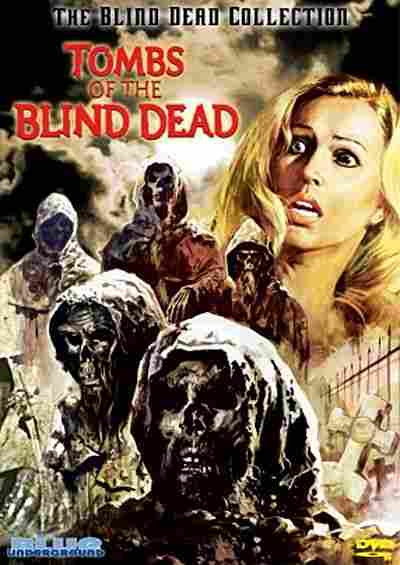
Tombs of the Blind Dead (1971)


Tombs of the Blind Dead is a 1970s Spanish (or Portuguese) horror movie. Hundreds of years ago the Templar knights sacrificed virgins to drink their blood. The Church finally stopped their satanic rites by hanging all the knights and letting the birds peck their eyeballs out. The church didn't know how heavily into the occult the Templars were, though, because the Templars found a way to come back from the dead!

Hundreds of years later, Virginia and Roger are on vacation in Portugal where they run into Virginia's old school chum, Betty. All three decide to go camping together. On the way, Roger and Betty get awfully flirty, which upsets Virginia who jumps off the train to get away. She walks through the empty landscape to a large fortress that appears to have been abandoned hundreds of years ago. Virginia calls out, but the place is empty and she gets no response. After exploring a bit and finding nothing but an old graveyard, Virginia sets up camp for the night. As she settles into the silence, the Templars begin rising from the graveyard. The dread builds with the slow and ominous way the Templars rise, accompanied by low chanting that gradually gets louder and louder...

I don't have to tell you that Virginia ends up as the Templars' midnight snack (oops, I think I just did!). Meanwhile, Roger and Betty are sipping sangria back at the hotel. Hmmmm, they think, Virginia didn't come back to the hotel, so where could she be? Roger, ever the gracious boyfriend, decides that, hey! maybe I should go look for her! So off he and Betty go, on horseback, to the region that Virginia jumped off the train. When they arrive, they find la policia already there...Virginia, they are told, is dead. She's not the first one either. There has been a string of brutal murders in the area and la policia suspect a gang of smugglers. Roger decides to go give them a talking to and meets Pedro, the head of the gang. To solve the mystery of Virginia's death and to clear the gang's name of the murders, they all decide to have a sleepover at the Templar's fortress to find out what's really going on.

Plenty of hanky panky goes on when they arrive at the castle...that is, until the Templars arise to seek the blood of the living! Turns out the Templars can't see you (hence the name, Tombs of the Blind Dead) but they can hear your heartbeat! The last twenty minutes of the movie is full of nail-biting terror! The end will leave you shocked and giddy! This was an excellent film from director Amando de Ossorio. The Templars' skeletal remains, draped with tattered old robes were terrifying...then even had spooky old horses to ride! Awesome, just plain awesome...

By the way, I watched the American version, which supposedly has many gory scenes cut from it (shucks!), so try and find the Spanish version with English subtitles if you can!

Check it out on Amazon!

Thursday, March 9, 2006

The Cabinet of Dr. Caligari (1920)


I have finally gotten around to viewing one of the great-great-great ancestors of the horror genre, the great German Expressionist film The Cabinet of Dr. Caligari. Amazon.com says that Caligari is:
A milestone of the silent film era and one of the first "art films" to gain international acclaim, this eerie German classic from 1919 remains the most prominent example of German expressionism in the emerging art of the cinema. Stylistically, the look of the film's painted sets--distorted perspectives, sharp angles, twisted architecture--was designed to reflect (or express) the splintered psychology of its title character, a sinister figure who uses a lanky somnambulist (Conrad Veidt) as a circus attraction. But when Caligari and his sleepwalker are suspected of murder, their novelty act is surrounded by more supernatural implications. With its mad-doctor scenario, striking visuals, and a haunting, zombie-like character at its center, Caligari was one of the first horror films to reach an international audience, sending shock waves through artistic circles and serving as a strong influence on the classic horror films of the 1920s, '30s, and beyond. It's a museum piece today, of interest more for its historical importance, but Caligari still casts a considerable spell..
The amazing style of this film first lured me in with its funhouse-feel of its design. A very eerie, stylized funhouse, that is.

The film begins with Francis and Alan - bestest of friends, even when in love with the same girl - heading to the town fair. There, they see Dr. Caligari's exhibit of a "somnambulist," Cesare. Cesare can tell the future, and when Alan asks how long he will live, Cesare says, "until dawn!" OK, HERE is where the movie really grabbed me. I was like, "Oh no he didn't!!"

Of course Cesare's prophecy comes true, and Francis is convinced that Dr. Caligari controlled Cesare to commit the murder. Soon, Francis' love, Jane, is kidnapped by Cesare. The townsfolk chase Cesare thru the fantastically nightmarish scenery until he releases Jane but he continues to run. Cesare finally is caught when he drops dead with exhaustion. Meanwhile, Francis has been watching Dr. Caligari...after Cesare is discovered, Caligari makes a run for it, with Francis tailing him. They end up at an insane asylum...and it gets so good after that, I won't spoil it!

Even though this was a silent film, it was very well done. I was yawning a bit towards the beginning, but after I got used to reading the titles and after the story started moving along, I was fully engaged. Yes, it is a grainy black and white SILENT film. Yes you have to read. Yes it is a little slow in places. It is one amazing film, though. I still cannot believe it was made in 1919 (and released in 1920)...absolutely superb! The orchestra that provides the music throughout the entire film is excellent, perfectly conveying the mood and atmosphere. The set design and art direction are just amazing...the story is completely engaging...

This is a definite must-own for horror fans!

Order it on Amazon!
Related Posts Plugin for WordPress, Blogger...